
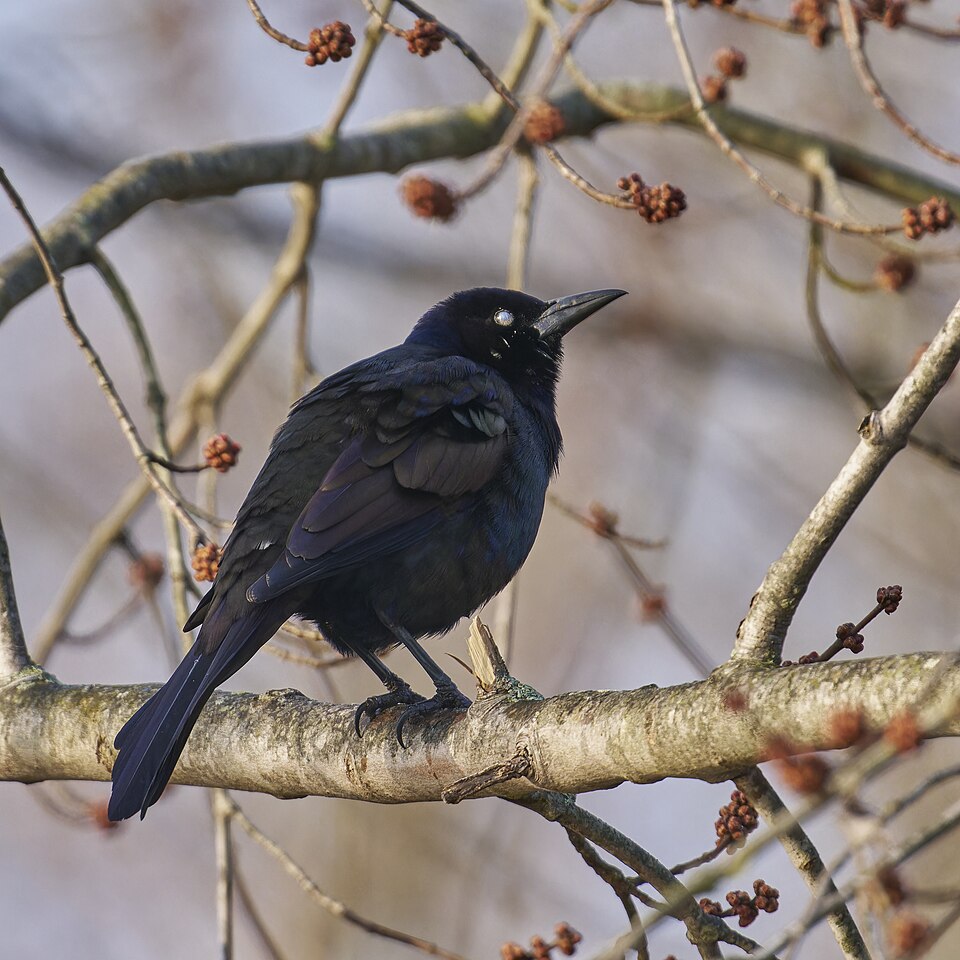
The Common Grackle (Quiscalus quiscula) is a medium-sized blackbird in the family Icteridae, recognized by its glossy, iridescent black plumage, bright yellow eyes, long black bill, and distinctive keel-shaped tail. It thrives in open habitats with scattered trees, including farmlands, suburbs, and parks, and is known for its gregarious nature, often roosting in large mixed-species flocks.
Learn to identify
Adult male Common Grackle perched, photographed in Prospect Park, Brooklyn.
Learning lesson · openly licensed photographs, labelled by BirdBot; labels checked against the cited sources and approved by AI
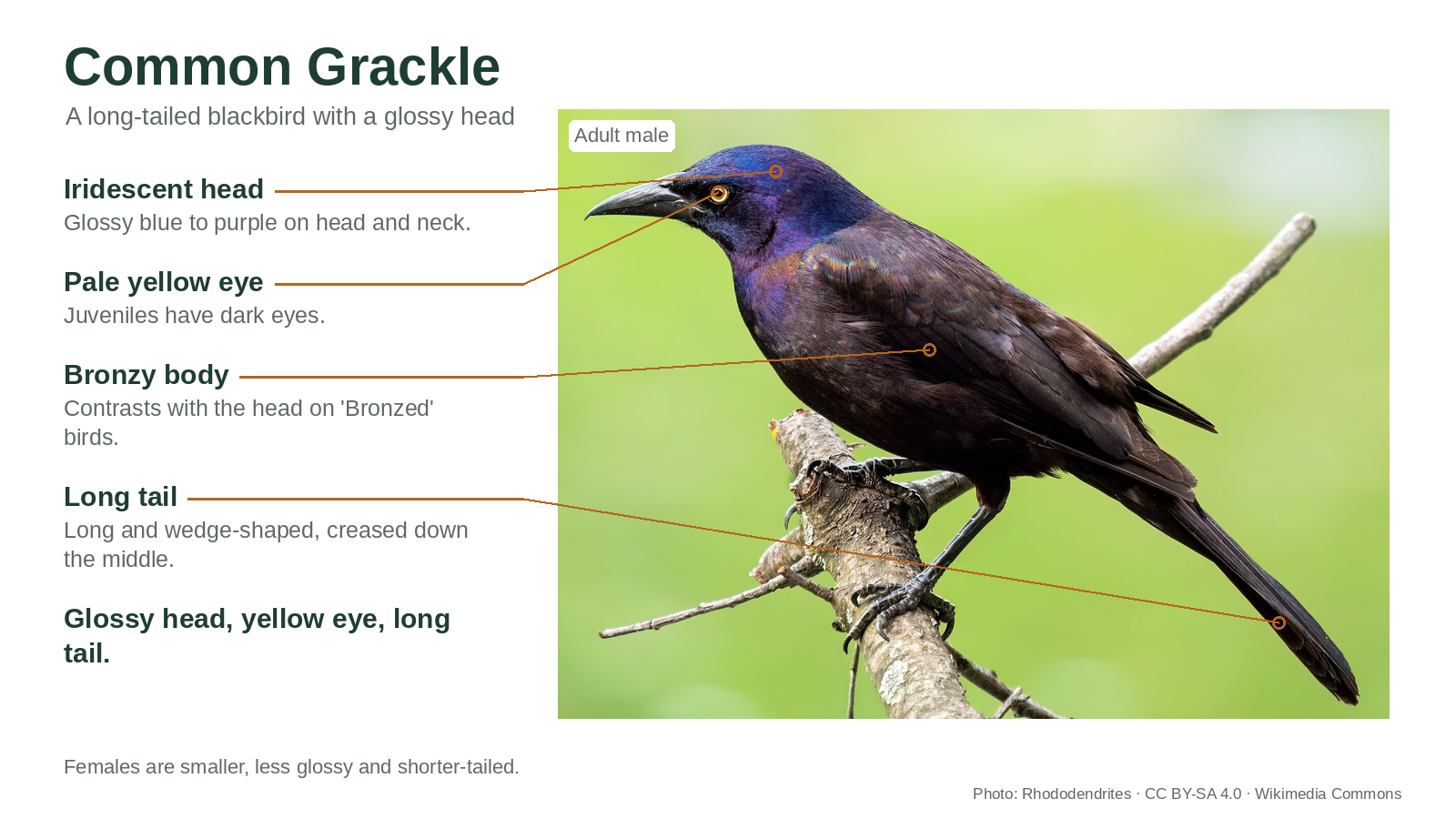
A long-tailed blackbird with a glossy head. Iridescent head: glossy blue to purple on head and neck. Pale yellow eye: juveniles have dark eyes. Bronzy body: contrasts with the head on 'Bronzed' birds. Long tail: long and wedge-shaped, creased down the middle. Glossy head, yellow eye, long tail. Females are smaller, less glossy and shorter-tailed.
Females are smaller, less glossy and shorter-tailed.
Sources: Wikipedia: Common grackle (revision 1382279813) · Audubon Guide to North American Birds: Common Grackle
Photo: Rhododendrites, CC BY-SA 4.0, via Wikimedia Commons; labels added by BirdBot.
Field identification relies on the bird's silhouette and iridescence rather than static color. In flight, the long, keel-shaped tail creates a distinct wedge shape, a key cue for separating grackles from other blackbirds. On the ground, look for the bright yellow eyes and long, sharp black bill. The glossy black plumage shifts in hue with lighting and region: purplish-blue or bluish-green in the east, brassy bronze in the west, and greenish in the southeast.
Sexual Dimorphism: Females are smaller, duller, and have a shorter tail than males. While males typically weigh about 122 g, females are around 94 g. Juveniles are easily distinguished by their brown plumage and brown eyes, which lack the adult's iridescent sheen.
Common Grackles are highly adaptable and found in open areas with scattered trees, preferably coniferous. They are common around human habitation, including suburban developments, city parks, and cemeteries. They also inhabit farmlands, orchards, and swamps.
According to AviList v2026, their range extends from varied open habitats in the Northwest Territories eastward to Newfoundland, and southward from central New Mexico to southern Florida. They are resident in the southern two-thirds of their range, while northern populations move southward seasonally. Human alteration of forested habitats for agriculture has historically expanded their range and increased their numbers.
Common Grackles are highly gregarious, often roosting in mixed-species groups that can number in the thousands. These roosts frequently include red-winged blackbirds, European starlings, and brown-headed cowbirds. During the day, they are opportunistic foragers that primarily use their bills to uncover food on the ground, often following plows to find grubs or scavenging in open areas.
Territoriality: While social, grackles are territorial around their nest sites. Pairs actively defend these areas by mobbing, chasing, or diving at predators, including humans.
The diet of the Common Grackle shifts significantly with the seasons:
Common Grackles are usually monogamous, though polygyny occasionally occurs. Pair formation begins in early spring flocks, indicated by mutual displays and flights. The female typically chooses the nest site, often in coniferous trees, though unusual sites like woodpecker holes, barn rafters, or osprey nest crannies have been documented.
Nest Construction: The female builds a large, bulky nest of woody stems, leaves, and fine grasses. The cup is lined with mud, fine grasses, and horsehair. Unusual materials like fishing line, feathers, manure, and tape have also been used.
Clutch and Incubation: The female lays 1 to 7 eggs (usually 5 to 6), which are smooth and highly variable in color, typically light blue to pearl gray. She incubates them for 12 to 14 days. About half of the males desert the female at this stage; those that remain participate in parental care. The young leave the nest 12 to 15 days after hatching and are fed by adults for several weeks.
Brood Parasitism: Nests are sometimes parasitized by brown-headed cowbirds, but cowbird eggs in grackle nests are largely unsuccessful.
Common Grackles produce one song type that is individually distinctive, likely used for identification. The harsh song is often compared to the sound of a squeaking, rusty gate. Male song is most frequent around the time of first copulation and decreases during incubation. Females sing less frequently, often song-answering with their mate.
The pinned AviList v2026 record lists Common Grackle as Near Threatened (NT). This is the category recorded in that dataset, not a new population assessment. A bird can be familiar in parks or fields without those local sightings establishing how its population is doing across its range.
The Animal Diversity Web (ADW) account cites an estimated total population of 97,000,000 individuals. This figure is a historical estimate from that natural history account and should not be interpreted as a current census or a recent IUCN population assessment.
Common Grackles are most visible when they gather in large groups. In late autumn and winter, look for roosts in open areas with scattered trees, such as city parks, cemeteries, and suburban developments. These roosts can number in the thousands and often include red-winged blackbirds, European starlings, and brown-headed cowbirds. During the day, watch for flocks foraging on the ground in farmlands, orchards, or along field edges, where they use their bills to uncover insects and seeds.
When observing, maintain a respectful distance to avoid disturbing the flock or triggering defensive mobbing, especially near active nests in spring. Use binoculars to spot the distinctive keel-shaped tail and bright yellow eyes against the iridescent black plumage. In the breeding season, listen for the harsh, squeaking song of males, which is most frequent around the time of nest building and copulation.


