
Direct evidence on urban green corridors for birds is limited. Available studies on landscape gradients, habitat suitability, and connectivity suggest that vegetation structure and landscape context strongly influence bird density and diversity. While generalist species often thrive in modified landscapes, specialists may require specific structural complexity or climate refugia that narrow corridors may not provide. This synthesis clarifies where green infrastructure helps and where evidence is correlational or indirect.
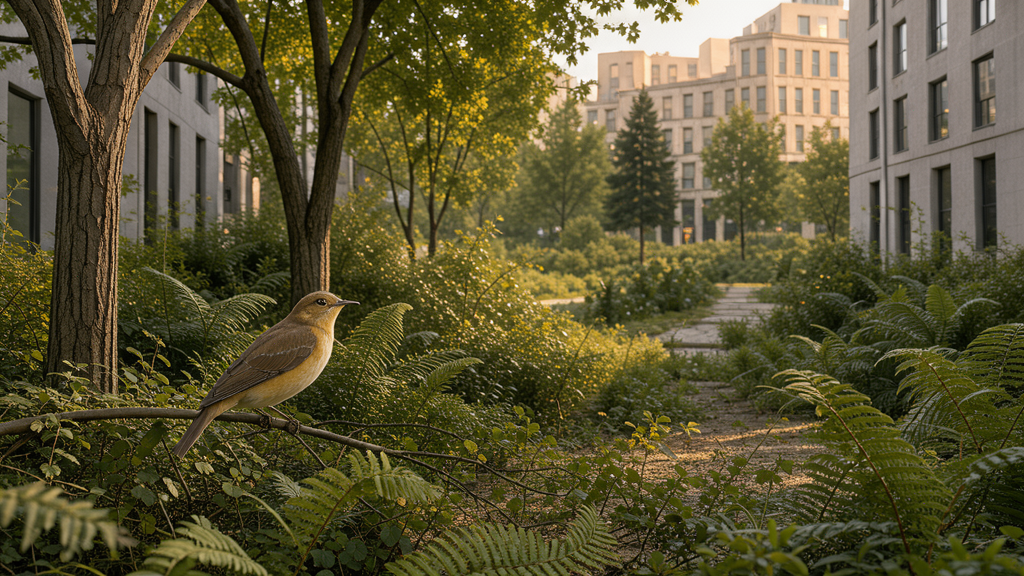
This synthesis examines whether urban green corridors improve movement, connectivity, occupancy, and population outcomes for birds, specifically comparing responses between habitat specialists and generalists. It evaluates whether linear green spaces function as true habitat for resident populations or merely as conduits for transient movement.
Retrieved studies indicate that landscape structure and vegetation complexity are critical determinants of avian response to urban green infrastructure. In a study of synanthropic birds in Northern India, researchers found that density patterns varied significantly across a rural-urban gradient, with frugivores showing highest densities in urban areas and carnivores in rural areas. The study noted that semi-urban and urban fringes had relatively lower densities of synanthropic birds, suggesting that intermediate landscapes require enhanced green space and vegetation structure to support avifaunal diversity. This implies that corridors in these transitional zones must be carefully designed to match the specific resource needs of different foraging guilds.
Another study focusing on butterfly diversity in Andean urban parks, while not directly about birds, provides a parallel insight into how connectivity metrics function in urban settings. It found that functional and taxonomic diversity were scale-dependent, with local vegetation structure (such as tree height) influencing functional dispersion, while landscape-scale connectivity (proximity to water bodies and park area) influenced functional richness. This suggests that for birds, similar scale-dependent effects may apply, but direct avian evidence is needed to confirm this.
Regarding habitat specialists, a study on the Australian Bustard, a wide-ranging species, used Species Distribution Modelling to assess habitat suitability under climate change. While not an urban corridor study per se, it highlights that for species with specific climatic and habitat requirements, connectivity is crucial for long-term persistence. The study found that protected areas and Indigenous Protected Areas serve as climate refugia, and that habitat connectivity is a key strategy for conservation. This supports the idea that for specialists, corridors must connect high-quality, suitable habitat patches to be effective, rather than just providing a linear path through unsuitable matrix.
A key trade-off is that corridors designed for generalists may not support specialists. Generalists often thrive in structurally simple, human-modified landscapes, while specialists require complex vegetation, specific food sources, or low disturbance levels. A study on small mammals in a Midwestern US metropolitan area found that species diversity increased with increasing proportional cover of human-modified land cover, but this was driven by high diversity in sites bordering streams in mowed parks and low diversity in sites with high tree canopy closure. This suggests that community-level metrics can mask species-specific responses. Similarly, in birds, a corridor that supports a high number of generalist species might exclude specialist species that require dense understory or specific nesting substrates. Therefore, a corridor's success depends on the target species' ecological requirements.
Contradictory findings may arise from different definitions of "connectivity." Some studies measure connectivity as the physical presence of vegetation, while others measure it as functional movement. A corridor may be physically continuous but functionally ineffective if it lacks the resources or safety for a specific species to traverse it. For example, a narrow tree line may allow a generalist songbird to move between patches but may not provide sufficient cover for a raptor or a ground-nesting specialist to use as a safe passage.
The retrieved evidence has several limitations. First, the studies are geographically diverse (Northern India, Andean Colombia, Australia, Midwestern US), making direct comparison difficult due to different species assemblages, climate, and urbanization patterns. Second, most studies focus on community-level responses or specific guilds rather than a direct head-to-head comparison of specialist vs. generalist birds in the same corridor system. Third, the studies often use different methods (point counts, trapping, SDM, network analysis), which can lead to different conclusions about the same phenomenon. Finally, the evidence is largely correlational, showing associations between landscape features and bird density or diversity, but not always proving causation. Long-term experimental studies that manipulate corridor width, vegetation structure, and connectivity are needed to establish causal links.
This synthesis is an AI-assisted evidence review, not original research or a peer-reviewed paper. We searched OpenAlex and arXiv for studies on urban green corridors, bird movement, connectivity, and habitat specialists/generalists. We retrieved abstracts and metadata from peer-reviewed journals and preprints. We did not access full texts for all studies, so our analysis is based on the provided abstracts and metadata. We prioritized studies that explicitly mentioned landscape gradients, connectivity, or habitat quality. We did not find a single study that directly compared specialist and generalist bird occupancy in the same urban corridor system, so we synthesized findings from related studies on landscape response, habitat suitability, and connectivity metrics.
| Study | Setting | Method | Result | Limitation |
|---|---|---|---|---|
| Gautam et al. (2026) | Rural-urban gradient, Northern India | Fixed-width point counts, hierarchical distance-sampling | Density of frugivores highest in urban, carnivores in rural; semi-urban fringes need enhanced green space | Focus on synanthropic birds; may not represent forest specialists |
| Lamichhane et al. (2025) | National scale, Australia | Ensemble Species Distribution Modelling (SDM) | Habitat connectivity is key for Australian Bustard persistence; protected areas serve as refugia | Model-based prediction, not field observation; focuses on one specialist species |
| Coral-Acosta et al. (2025) | Urban parks, Bogotá, Colombia | Vegetation structure and landscape heterogeneity analysis | Diversity is scale-dependent; local tree height and landscape connectivity both matter | Focus on butterflies, not birds; parallel insight only |
| Larson & Sander (2025) | Midwestern US metropolitan area | Small mammal trapping, land cover data, hierarchical community abundance model | Species diversity increased with human-modified land cover, but species-specific responses varied | Focus on small mammals, not birds; community-level metrics may mask species-specific effects |
To observe the difference between generalist and specialist responses to urban green corridors, select a linear green space (e.g., a tree-lined path, a riparian corridor, or a park strip) that connects two larger habitat patches. Conduct a 15-minute point count at three locations: one at each end of the corridor and one in the middle. Record all bird species, noting their foraging guild (e.g., frugivore, insectivore, granivore) and habitat use (e.g., canopy, understory, ground). Compare the species list and density at the middle location to the ends. If the middle location has fewer species or lower density, it may indicate that the corridor is not providing sufficient habitat for residency, only for movement. If the middle location has a similar or higher density of generalist species, it may be functioning as a habitat patch. Repeat this exercise in a different corridor with different vegetation structure to see how design affects outcomes. Note that a single 15-minute count is a rough indicator; multiple visits over different seasons are recommended for more reliable data.
