
In winter, waterfowl select habitats that provide accessible food and safety from predators. Narragansett Bay in Rhode Island is a key wintering area for 23 North American waterfowl species, including 11 of the 15 known sea duck species (Kreakie et al., 2015). Mallards exhibit considerable flexibility in winter distribution, influenced by temperature, water conditions, and population size (Hunt et al., 1984). American Black Ducks, often found in the eastern U.S., may face displacement from feeding sites by dominant Mallards (Kaczmarska et al., 2020).
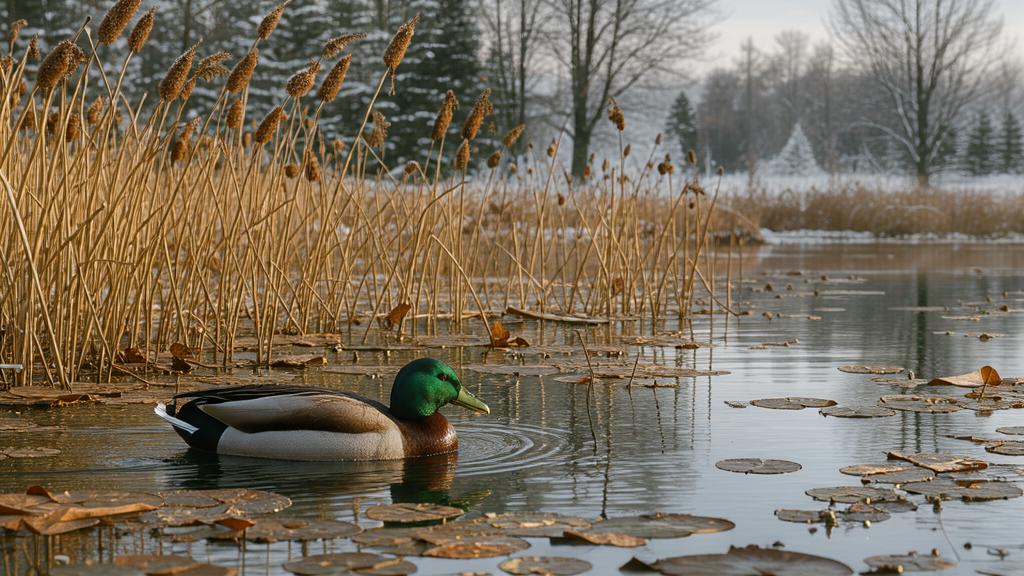
Winter habitat selection for waterfowl is driven by the need for accessible food and safety from predators. Research indicates that habitat selection is highly effective in mitigating predation, particularly during vulnerable periods like flightless moult (Rees et al., 2015). Sea ducks, which breed in boreal Canada, winter in coastal areas like Narragansett Bay, where they can access marine food sources (Kreakie et al., 2015). The availability of open water is a critical factor in determining where ducks winter, as it allows them to continue feeding and avoid predators.
The Mallard (Anas platyrhynchos) is widespread and adaptable, with winter distribution influenced by temperature and water conditions (Hunt et al., 1984). The American Black Duck (Anas rubripes) is common in the eastern U.S. but may be displaced from feeding sites by aggressive Mallards, particularly male Mallards (Kaczmarska et al., 2020). Sea ducks, such as the Common Eider and Common Goldeneye, are frequently seen in coastal bays; Narragansett Bay alone hosts 11 of the 15 known sea duck species (Kreakie et al., 2015).
Field cues: Mallards are dabbling ducks that feed on the surface, while sea ducks are diving ducks that forage underwater. Male Mallards are often more aggressive and dominant than Black Ducks at feeding sites (Kaczmarska et al., 2020). Look for the Common Eider’s white head and the Common Goldeneye’s green eye patch to distinguish these sea ducks from other diving species. To distinguish the American Black Duck from the Mallard, look for its overall dark brown plumage and a prominent white wing patch visible in flight, contrasting with the Mallard’s iridescent green head and gray body.
Coastal bays and estuaries are prime locations for wintering waterfowl. Narragansett Bay in Rhode Island is a well-studied example, where 23 North American waterfowl species have been observed wintering, including 11 sea duck species (Kreakie et al., 2015). The Mississippi Alluvial Valley (MAV) is the principal wintering area for Mallards in the Mississippi Flyway, where recovery distributions of banded birds show that ducks move farther south in cold years and that wet winters increase recoveries in the MAV for most age and sex classes (Hunt et al., 1984). Sea ducks that breed in boreal Canada winter as far south as Chesapeake Bay (McKinney, 2004, in Kreakie et al., 2015).
When planning a birding trip, consider:
Observing winter ducks ethically is crucial for minimizing disturbance. Keep a safe distance to avoid stressing the birds or disrupting their foraging. Use binoculars or a spotting scope to observe from afar. Avoid using calls or decoys, which can alter natural behavior. Consider participating in community science projects, such as the Narragansett Bay Winter Waterfowl Survey, which began in 2004 through a collaboration between the U.S. EPA’s Atlantic Ecology Division, state wildlife agencies, and local environmental groups (Kreakie et al., 2015). Your observations contribute to valuable data for conservation.
Try this exercise to enhance your winter ducking experience:
This simple metric provides a quick snapshot of the habitat type and helps you compare your site to long-term community science trends.
