
Wildfire severity does not produce a uniform effect on bird communities. High-severity fires tend to negatively impact species with specific traits, such as canopy foragers and those requiring closed canopies, while other species may benefit from the habitat heterogeneity created by varying burn intensities. Recovery is time-dependent, with negative impacts often diminishing in the years following a fire.
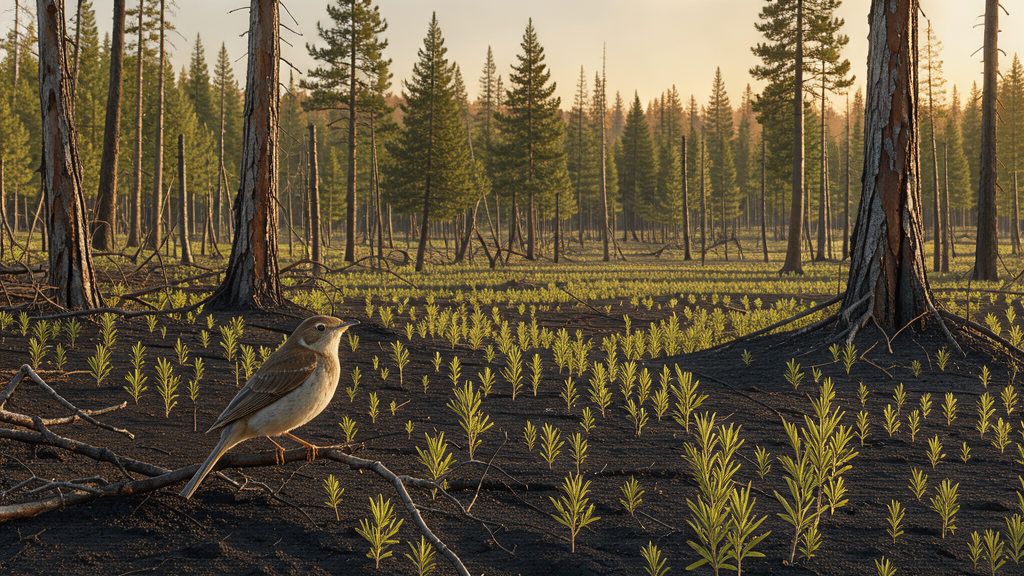
This synthesis examines how the intensity of wildfire (burn severity) influences avian community composition, abundance, and recovery trajectories. It specifically compares findings from spatial studies (comparing different severity levels at the same time), temporal studies (tracking changes over time since fire), and trait-based analyses to identify consistent patterns and contradictions in the literature.
Recent peer-reviewed studies indicate that the relationship between fire and birds is complex and context-dependent. A global systematic review by Vielleux et al. (2026) found that while most terrestrial vertebrate species showed neutral responses to fire severity, high-severity fires elicited both more negative and more positive responses than low-severity fires. Specifically, species with weak shelter, canopy-foraging habits, and preferences for closed canopies were more likely to decline after high-severity fire. However, these negative responses diminished with increasing time since fire, highlighting opportunities for population recovery.
In contrast, spatial studies in tropical dry deciduous forests suggest that fire can support biodiversity through habitat heterogeneity. Pradeeshwar et al. (2026) surveyed birds in the Western Ghats, India, five years post-fire. They found that while richness and evenness were not significantly different across burn severity classes, bird community composition was significantly dissimilar between all severity classes. Notably, the abundance of ground and generalist species was significantly higher in high-burn-severity areas than in unburned areas, supporting the pyrodiversity-biodiversity hypothesis.
Temporal dynamics also play a critical role. Mitchell et al. (2026) studied the endangered mallee emu-wren in Australia and found that rainfall in the 12 months before and after fire significantly influenced the relative likelihood of the species' occurrence. The relative likelihood of occurrence peaked 15 years after fire, with a peak time window of 10–20 years. This suggests that abiotic conditions at the time of fire, particularly pre-fire rainfall, have long-lasting impacts on habitat suitability for fire-sensitive species.
Furthermore, a study of boreal lake islands in Canada by the authors of the 2026 Ecological Applications paper (DOI: 10.1002/eap.70218) tested the pyrodiversity-biodiversity hypothesis in a true island system. Using a chronosequence of 42 islands, they found that species richness of plants and birds increased with spatial pyrodiversity (variation in burn severity within islands), while beta diversity of all taxa increased with temporal pyrodiversity (variation in time since fire among islands). This highlights the importance of conserving age-class variation within the boreal patch mosaic to maintain biodiversity.
The evidence presents a trade-off between immediate habitat loss and long-term heterogeneity benefits. While high-severity fire can cause immediate declines in sensitive species, it can also create open habitats that benefit ground-foraging and generalist species. For example, in the Western Ghats study, high-severity areas supported higher abundances of ground species, whereas the global review indicated that canopy-dependent species declined in high-severity zones. This suggests that community-level responses depend on the functional traits of the resident species.
Furthermore, the Pantanal wetland study by Loureiro et al. (2026) reported null findings for occupancy, stating they did not find evidence of effects of wildfires on occupancy for the 35 species studied. However, they did note that species composition differed over time, with some species no longer detected in 2022 and 64% exhibiting declines in relative abundance. This highlights that occupancy metrics may not capture subtle shifts in abundance or community composition.
Several limitations constrain the generalizability of these findings. First, studies vary in their geographic scope, from tropical dry forests in India to boreal lake islands in Canada and wetlands in Brazil. Second, the definition of "severity" varies, with some studies using remote sensing indices like dNBR and others relying on visual assessment. Third, temporal studies often have limited duration, making it difficult to assess long-term recovery beyond 20 years. Finally, most studies focus on community-level metrics, and fewer examine individual species' demographic responses in detail.
This synthesis is an automated synthesis, not original research or a peer-reviewed paper. It is based on a curated set of retrieved peer-reviewed studies provided in the evidence base, rather than a live search of databases like OpenAlex or ArXiv for this specific draft. We prioritized studies that used before-after-control-impact (BACI) designs, spatial comparisons, or temporal chronosequences. We excluded studies that did not provide clear evidence of fire severity metrics or bird community responses. The following table summarizes the key studies included in this synthesis.
| Study | Setting | Method | Result | Limitation |
|---|---|---|---|---|
| Vielleux et al. (2026) | Global systematic review | Ordinal logistic regression on functional traits | High-severity fire caused more negative responses in canopy foragers; responses diminished over time. | Global scope may obscure local context; relies on published data quality. |
| Pradeeshwar et al. (2026) | Western Ghats, India (tropical dry forest) | 120 point counts, 5 years post-fire, dNBR severity classes | Community composition differed by severity; ground species more abundant in high-severity areas. | Single time point (5 years); limited to one ecosystem type. |
| Mitchell et al. (2026) | Ngarkat Conservation Park, Australia (heathland) | Random forest modeling of historical presence records | Pre-fire rainfall influenced long-term occurrence; peak suitability 10–20 years post-fire. | Single species focus; relies on historical data prior to extirpation. |
| Authors of DOI 10.1002/eap.70218 (2026) | Boreal lake islands, Canada | Fixed-area sampling plots in a chronosequence of 42 islands | Bird richness increased with spatial pyrodiversity; beta diversity increased with temporal pyrodiversity. | Island system may not generalize to mainland landscapes; multi-taxa focus. |
| Loureiro et al. (2026) | Pantanal Wetlands, Brazil | Camera trapping, 2019–2022, hierarchical Bayesian models | No significant effect on occupancy; 64% of species showed abundance declines. | Short time frame; occupancy may not reflect abundance changes. |
To see these dynamics in action, look for early-successional bird species in recently burned areas. Species that prefer open habitats or ground foraging often increase in abundance in the years following high-severity fire, while canopy-dependent species may be less common. Monitoring these shifts over time can help you understand how local bird communities respond to fire and habitat change.
