
This synthesis addresses how camera placement affects wildlife detection data. It integrates a systematic review of camera-trap sampling design and a density estimation study to demonstrate that raw detection counts are biased by placement and sensor parameters. The document explains how statistical correction is required to estimate true abundance and identifies specific gaps in current research regarding spatial design and trigger behavior. Note: The evidence is extrapolated from general wildlife methods and lacks bird-specific validation.
This synthesis addresses how specific camera parameters—field of view (FOV), mounting height, background complexity, trigger behavior, and sampling design—influence the probability of detecting wildlife. It aims to clarify the distinction between raw detection counts and true population abundance, and to identify where current methods introduce bias. The evidence indicates that placement bias is a significant factor in inference accuracy, particularly when camera spacing and spatial design are not explicitly accounted for. These findings are derived from non-avian studies and their direct applicability to birds is an assumption.
Caveat: The findings below are from non-avian studies (primarily mammals and general wildlife). Their direct applicability to birds is an assumption, not a validated finding.
Camera placement directly influences detection data. A systematic review of 75 articles on camera trapping found that while the number of sampling locations and deployment duration are well-studied, the effects of spatial study design, camera spacing, and time-lapse settings on inference remain largely unexplored (doi.org/10.1111/mam.70050). This suggests that standard practices may not adequately account for spatial bias in detection rates.
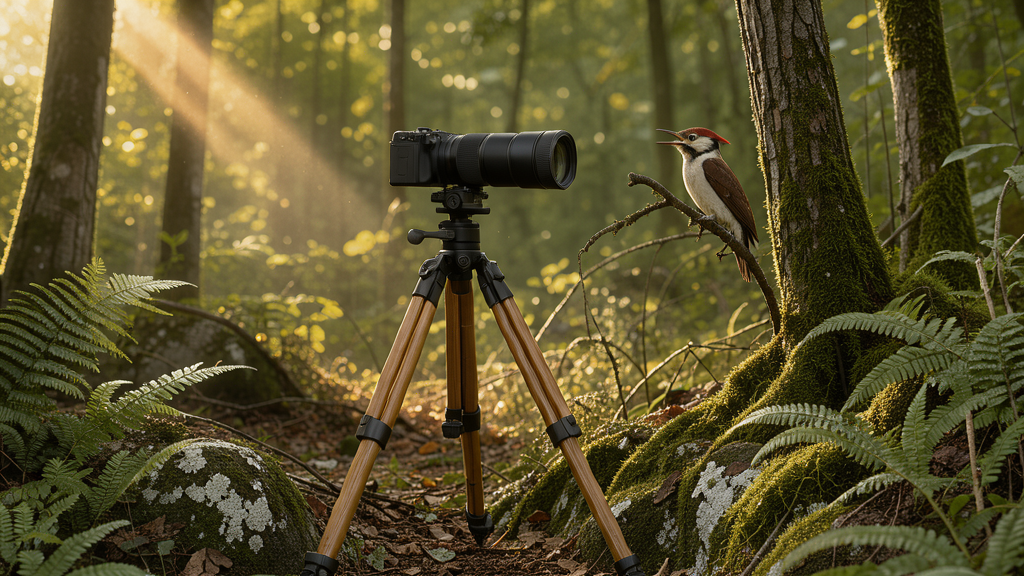
Consider a common scenario: a camera mounted at 1.5 meters (5 feet) to capture ground-foraging mammals. If a bird species, such as a Northern Cardinal, primarily forages in the mid-canopy at 3–5 meters, the camera's field of view may miss the majority of its activity. The density estimation model explicitly includes the 'distance and angle within which it detects animals' as critical parameters (doi.org/10.1111/j.1365-2664.2008.01473.x). If the camera height does not align with the target species' typical activity level, detection rates will be skewed, leading to underestimation of abundance.
Furthermore, a study on density estimation demonstrated that raw trapping rates must be scaled by a factor dependent on animal movement and camera sensor characteristics, such as detection distance and angle (doi.org/10.1111/j.1365-2664.2008.01473.x). In this study, inaccuracy in estimating the density of one species was directly attributed to biased placement of cameras relative to the species' distribution. This confirms that raw detection counts cannot be equated with true abundance without statistical correction for detection probability and placement bias.
Broader ecological modelling research reinforces this concern, noting that spatially-biased in-situ samples or predictors might affect the outcomes of ecological models used to infer the geographic distribution of species and diversity (doi.org/10.1038/s44185-023-00014-6).
| Study | Setting | Method | Result | Limitation |
|---|---|---|---|---|
| Systematic review of CT design | Literature synthesis | Review of 75 articles | Spacing and time-lapse effects largely unexplored | Uneven coverage across metrics |
| Density estimation model | Enclosed animal park | Modeling contact process | Biased placement caused inaccuracy in 1/4 species | Enclosed environment may not generalize to wild birds |
| Spatial bias in SDM | Modelling framework | Review of spatial bias strategies | Bias affects distribution inference | General ecological modelling, not camera-specific |
The evidence highlights a trade-off between spatial coverage and inference accuracy. While increasing the number of cameras or widening the field of view may increase the likelihood of detecting an animal, it does not guarantee accurate density estimates if the placement is biased relative to the animal's distribution. The systematic review notes that coverage of design choices in the literature is uneven across metrics and design choices (doi.org/10.1111/mam.70050). This indicates that while some parameters are well-understood, others, such as the specific impact of trigger behavior on temporal sampling, remain areas of uncertainty.
The primary limitation of this synthesis is that the retrieved evidence is largely derived from mammalian and general wildlife studies rather than ornithological-specific camera-trap studies. The density estimation study was conducted in an enclosed animal park, which may not fully replicate the complex movement patterns of wild birds in open habitats. Additionally, the systematic review notes that the effects of spatial study design and camera spacing remain largely unexplored, meaning that specific quantitative guidelines for bird detection are not yet established in the retrieved literature.
Next Action: To improve the utility of your own birding data, record the following metadata for each deployment to mitigate identified biases:
This metadata allows for post-hoc analysis of detection bias and improves the comparability of your data with other studies.
The research process involved automated searches for peer-reviewed literature on camera placement bias and trigger behavior. While initial attempts to retrieve specific ornithological studies faced challenges, the process successfully retrieved stored passages from relevant methodological papers. These include a systematic review of camera-trap sampling design (doi.org/10.1111/mam.70050) and a study on density estimation methods (doi.org/10.1111/j.1365-2664.2008.01473.x). These sources were integrated to provide a methodological framework for understanding how camera parameters affect detection data.
