
Dabbling ducks and diving ducks differ primarily in leg placement, takeoff mechanics, and feeding methods. Dabblers have legs positioned toward the rear of their body, allowing them to walk on land and take off from water with a short run. Divers have legs set further back, making them awkward on land but powerful swimmers that dive underwater to feed and often require a longer run-up to take off.
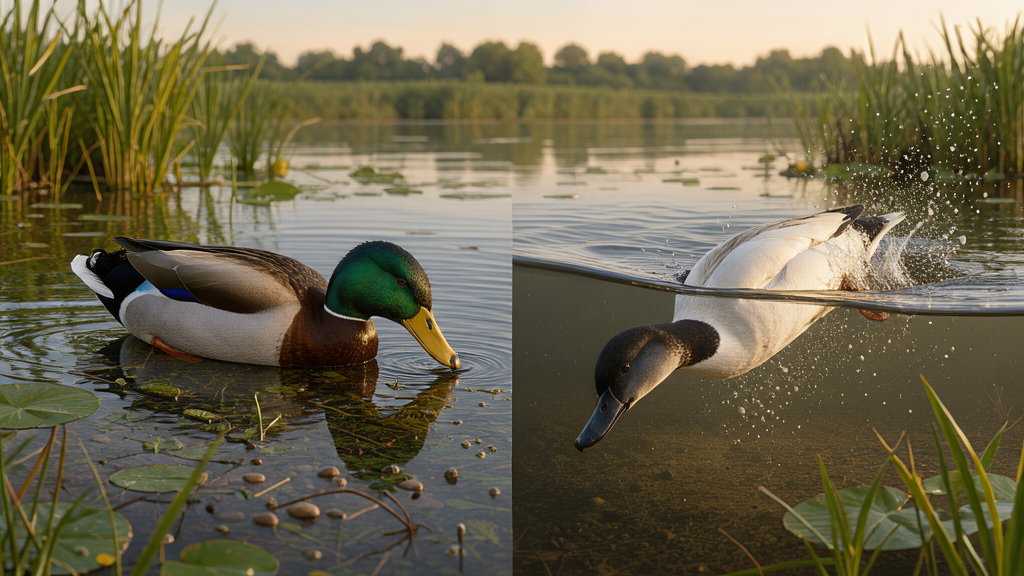
The most reliable field cue for distinguishing these two groups is the position of the legs relative to the body's center of gravity. In dabbling ducks (subfamily Anatinae), the legs are positioned further forward, near the center of the body. This placement allows them to balance on land and walk, albeit often with a waddling gait. In diving ducks (subfamilies Aythya, Oxyura, and others), the legs are set much further back, closer to the tail. This rearward placement acts as a rudder for efficient swimming and diving but makes terrestrial locomotion difficult and unstable.
While body shape varies across species, the functional implication of leg placement is consistent: the rearward position in divers optimizes underwater propulsion, whereas the forward position in dabblers supports terrestrial mobility. Comparative studies of diving birds, such as those examining the double-crested cormorant and anhinga, show that deeper, more energetic diving behavior is supported by specific adaptations in O2 storage capacity and oxidative muscle phenotypes (White et al., 2024).
Feeding method is a definitive behavioral distinction. Dabbling ducks feed primarily at the surface or just below it. They typically tip their bodies forward, lifting their tails into the air, to reach submerged vegetation, invertebrates, or small fish. This "dabbling" motion is visible from a distance and is a key identification cue. They do not submerge their entire bodies to feed.
Diving ducks, as the name suggests, submerge their entire bodies to feed. They dive underwater to pursue fish, aquatic invertebrates, and plants. This behavior requires significant energy and physiological adaptations. Research on diving birds indicates that the highly energetic foraging behavior exhibited by many diving species requires a reliable supply of O2 to power the locomotory muscles without fatigue (White et al., 2024). Unlike dabblers, you will rarely see a diving duck tipping its body at the surface; instead, it will disappear beneath the water and re-emerge, often shaking off water.
Takeoff behavior is another critical field cue. Dabbling ducks can take off from water with a relatively short run-up, often just a few meters. Their leg position and body shape allow them to generate lift quickly. In contrast, diving ducks typically require a longer run-up on the water's surface to achieve flight. This is due to their heavier body mass and the hydrodynamic drag of their rearward-set legs. Observing a duck's takeoff distance can be a reliable way to distinguish between the two groups in the field.
While both groups use wetlands, their habitat preferences can differ. Dabbling ducks are often found in shallow wetlands, marshes, and agricultural fields, where they can access surface vegetation and invertebrates. They are also more likely to be seen on land, walking or resting on grassy areas. Diving ducks prefer deeper, open water bodies such as lakes, reservoirs, and coastal areas, where they can dive for food. They are less commonly seen on land and tend to stay in the water when not flying or roosting.
Understanding common species helps solidify these distinctions. Examples of dabbling ducks include the Mallard (Anas platyrhynchos), Green-winged Teal (Anas crecca), and Northern Shoveler (Anas clypeata). The Mallard is recognizable by its broad, flat bill and, in males, a green head with a white neck ring. The Northern Shoveler is distinguished by its exceptionally large, spoon-shaped bill. These species are often seen tipping their bodies to feed and can take off quickly from water.
Examples of diving ducks include the Redhead (Aythya americana), Canvasback (Aythya valisineria), and Ring-necked Duck (Aythya collaris). The Redhead has a rounded, reddish-brown head in males, while the Canvasback is identified by its long, sloping neck and white head with a black crown. These species are powerful swimmers that dive to feed and require a longer run-up to take off. The behavioral ecology of these diving ducks is distinct from other waterfowl; for instance, males of the five typical pochards of North American diving ducks (Aythya) establish monogamous pair-bonds that are maintained only long enough to assure that the female’s eggs are fertilized, a strategy that contrasts with the permanent pair-bonds seen in whistling-ducks (Dendrocygna) (North American Whistling-Ducks, Pochards, and Stifftails, 2017).
Imagine you are standing on the shore of a large lake in late autumn. A group of ducks is feeding in the shallows. One bird, a Mallard, tips its body forward, lifting its tail high into the air as it reaches for submerged vegetation. This is a classic dabbling motion. Nearby, a Canvasback sits calmly on the surface. Suddenly, it vanishes beneath the water, leaving only a small ripple. It re-emerges a few seconds later, shaking its head. This submersion is the hallmark of a diving duck. If you watch them take off, the Mallard will launch with a short, quick run, while the Canvasback will need a longer distance to build speed.
To practice distinguishing between dabbling and diving ducks, use this decision flowchart. Start with the most visible behavior and move to structural cues if the bird is at rest.
| Observation Cue | Dabbling Duck | Diving Duck |
|---|---|---|
| Feeding Behavior | Tips body forward at surface; tail up. | Submerges entirely; disappears underwater. |
| Takeoff Mechanics | Short run-up; quick launch. | Longer run-up; slower acceleration. |
| Leg Position | Legs set further forward (near center of gravity). | Legs set further back (near tail). |
| Habitat Preference | Shallow wetlands, marshes, fields; often on land. | Deep, open water; rarely on land. |
By combining these cues, you can reliably identify whether a duck is a dabbler or a diver, even if you are unsure of the specific species.
While the distinctions between dabbling and diving ducks are generally reliable, there are nuances to consider. For example, the physiological demands of diving vary among species. Studies on seaducks such as the Harlequin Duck (Histrionicus histrionicus), Long-tailed Duck (Clangula hyemalis), Surf Scoter (Melanitta perspicillata), White-winged Scoter (Melanitta fusca), and Common Eider (Somateria mollissima) show that body mass dynamics and feather growth rates during the flightless moult period differ significantly between species (Viain, 2015). These variations mean that while the general "diver" category holds, the specific physiological and behavioral adaptations can vary, making it important to use multiple cues in combination for reliable identification.
