
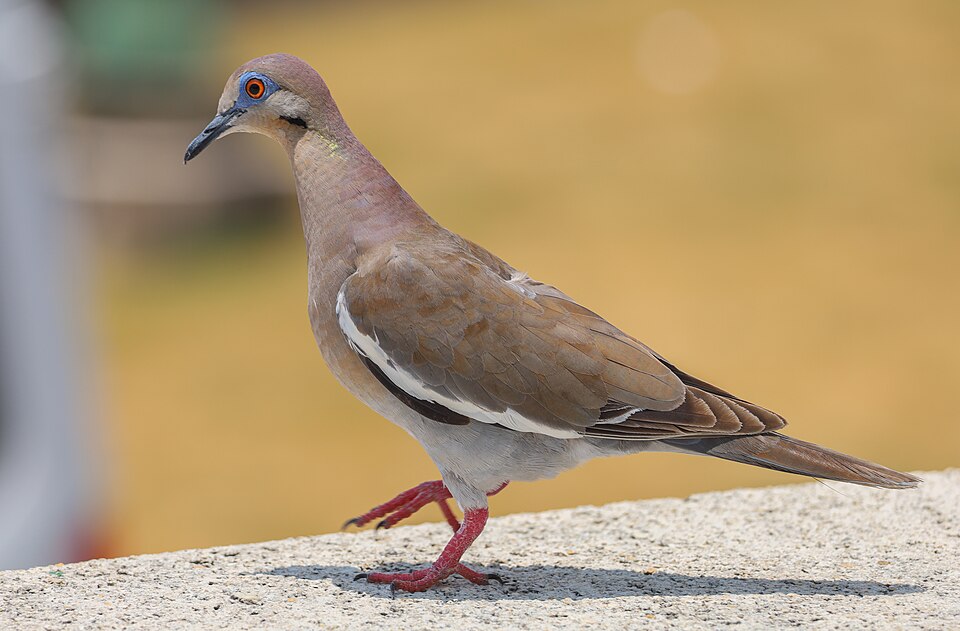
The White-winged Dove (Zenaida asiatica) is a large, brownish-gray dove in the family Columbidae, distinguished by brilliant white wing bars that form crescents in flight, blue featherless eye rings, red irises, and black ear spots. It inhabits brushlands, desert scrub, agricultural fields, and residential areas across the Americas, with a strong ecological association to saguaro cacti in the Sonoran Desert.
Learn to identify
Adult White-winged Dove photographed in Old San Juan, Puerto Rico.
Learning lesson · openly licensed photographs, labelled by BirdBot; labels checked against the cited sources and approved by AI

Red eye, blue skin: crimson eye in a ring of bare blue skin. Dark cheek mark: a long dark mark on the lower face. White wing edge: bold white patch along the folded wing. Pinkish-red legs: bright pink to red legs and feet. A white wing stripe rules out Mourning Dove.
Juveniles are duller, with brown eyes.
Sources: Audubon Guide to North American Birds: White-winged Dove · Wikipedia: White-winged dove (revision 1380711976)
Photo: Ligocsicnarf89, CC BY 4.0, via Wikimedia Commons; labels added by BirdBot.
White-winged Doves are large, pigeon-like birds. Adults are brownish-gray above and gray below. The most diagnostic feature is the distinct white wing marking, found in no other New World dove. When perched with wings folded, these markings form a narrow margin along the leading and lower edges of the wings. In flight, they appear as brilliant white crescents framing the body on the upper surface of each wing.
Both sexes possess a ring of blue, featherless skin around each eye, red irises, a patch of black feathers (the "ear spot") beneath and behind the eye, and red or pinkish-red legs and feet. Males are slightly larger and more colorful than females, exhibiting a hint of purple on the neck and head and a bolder black ear spot. Juveniles are more gray-brown than adults, lack the blue eye ring, have black irises, and pink or brownish-pink legs.
White-winged Doves are often compared to Mourning Doves (Zenaida macroura). Mourning Doves are slightly smaller with smaller heads and bills. Their tails are pointed rather than squared, and they lack the distinct bright wing patches and white tail tips of the White-winged Dove.
White-winged Doves inhabit a wide variety of environments, including brushlands, woodlands, desert scrub, cacti, agricultural fields, and residential areas. Eastern migratory populations breed in semi-tropical thorny woodlands in Mexico and along the Lower Rio Grande Valley in Texas, often nesting extensively in citrus orchards. Western populations breed in desert scrub and riparian woodlands in the southwestern United States and Mexico. During winter, both populations join resident birds in semi-arid regions of thornscrub, deciduous dry forest, and agricultural areas with scattered trees.
According to AviList v2026, the range includes drier habitats from southern Nevada and southeastern California to central Texas and the Gulf coast, southward through Mexico and Central America, and into the Caribbean. The range is noted as expanding, with vagrants frequent northward.
White-winged Doves feed on a variety of seeds, grains, and fruits. Their diet includes wild plants, ornamental cultivars, and domestic crops such as sunflower, barley, sorghum, wheat, and corn. To supplement their seed-based diet, they ingest shells of small snails and bits of bone from raptor pellets or mammal feces, which provide essential calcium for eggshell and crop milk production.
Western populations have a strong ecological association with the saguaro cactus (Carnegiea gigantea). During the hottest and driest months (May to mid-July), saguaro pollen, nectar, and fruit provide virtually all the food and moisture needed by desert doves. Isotopic analysis has shown that most of the carbon and water in Western White-winged Dove tissues during this period is derived from saguaros. This relationship explains why the original range of western populations was closely tied to the distribution of saguaro cacti.
Males establish nesting territories and attract mates with cooing and visual displays, aggressively defending the area from other males with wing-slaps if necessary. Courtship involves additional cooing, wing and tail fanning, bowing, and mutual preening. Western birds may fly up to 8 km from the nest to a water source, while urban birds in areas like San Antonio, Texas, have been observed foraging 5-20 km from their nests.
Females build flimsy nests of twigs and grasses in tree forks or atop abandoned nests of other birds. They usually lay two unmarked eggs, and both parents incubate for about 14 days. Chicks are fed "crop milk" for the first four days, followed by regurgitated seeds. They fledge in 13-16 days, and the male continues to feed them until they are about four weeks old.
The White-winged Dove is listed as Least Concern (LC) in the IUCN Red List as recorded in AviList v2026. While the species is not globally threatened, its range is noted as expanding, with vagrants frequent northward. In the early 1900s, breeding populations increased as irrigation and grain farming brought new sources of food and water to their historic range. However, since the 1960s, the overriding trend amid these fluctuations has been a steady decline in Eastern and Western White-winged Dove populations on their traditional breeding grounds. As a result of these habitat modifications, White-winged Dove populations have fluctuated throughout much of their range in response to changing nesting and feeding conditions. Today, the species continues to adapt to human-modified landscapes, including citrus orchards and agricultural fields, which support significant nesting activity.
To observe White-winged Doves ethically, visit citrus orchards or desert scrub areas during the breeding season (late April to early August). Early morning and late afternoon are often the best times to observe foraging and territorial behaviors, as males are most active in defending territories and seeking mates during these cooler periods. Look for the distinctive white wing flashes in flight and listen for the cooing of males defending territories. Maintain a respectful distance to avoid disturbing nesting pairs, especially in colonies. In urban areas, observe doves foraging in agricultural fields or using bird feeders, noting their long foraging flights from residential nest sites.


