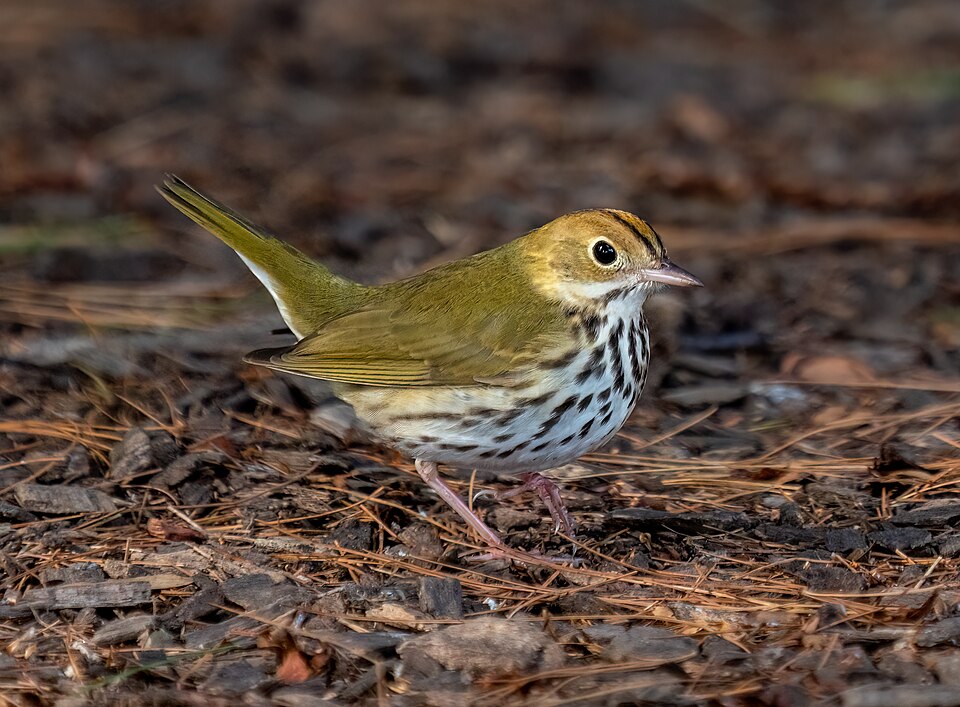
The Ovenbird (Seiurus aurocapilla) is a large, olive-gray warbler that is far more often heard than seen. It is identified by its loud, ringing "teacher, teacher, teacher" song, bold black spotting on the underparts, and a habit of walking quietly on the forest floor among leaf litter. It builds a distinctive, camouflaged, Dutch-oven-shaped nest on the ground.
The Ovenbird is a thrush-like warbler, approximately 5.75 to 6 inches (14–15 cm) long and weighing about 21 grams. Its plumage is olive to olive-gray above and white below, with bold black spotting on the underparts aligned into rows. Adults feature a bold white eye-ring, a thin blackish malar stripe, and blackish lateral crown stripes that border a dull orange central crown stripe. The eye is large and thrush-like, and the legs are pinkish, stout, and long. Males and females have similar plumage, though immatures are less brightly colored and often have broader olive crown stripes.
Ovenbirds are primarily ground-dwellers. They usually walk, rather than hop or fly, alone on the forest floor among the leaf litter, often wagging their tail and bobbing their head while moving. They are notably quiet when approached, often remaining still on the ground rather than flushing. When agitated, they may raise their crest slightly, revealing the orange color of the median crown. If flushed, they typically fly upward to a branch.
Their foraging strategy is efficient; they search for food based on prey distribution, learning where areas of high prey density are located and repeatedly revisiting those sites. While they primarily eat insects, spiders, snails, and worms found in leaf litter and fallen logs, they will feed in trees during spruce budworm outbreaks. Seeds and other vegetation sometimes make up part of their fall and winter diet.
The Ovenbird's song is its most reliable field mark. It is a loud, ringing, and distinct "teacher, teacher, teacher" call. Males deliver this song from perches up to 30 feet above the ground, and occasionally from the ground, using it to delineate territories. Females rarely sing. The song is so distinctive that it can often be heard before the bird is seen, making it a key cue for identification in dense forests.
The Ovenbird's common name derives from its nest, which is shaped like a Dutch oven. The nest is built in the open, on the leaf-covered floor of deciduous woods or just above the ground in a clump of low plants or shrubs. It is constructed from dried grass, leaves, moss, other vegetative matter, and hair, and is well camouflaged with leaves, branches, and other litter placed on the roof. The entrance is a small slit on the side of the nest.
Eggs are white with brown and gray markings, and about 0.8 inches (2 cm) long. Females incubate the eggs and will perform a distraction display if approached closely. Ovenbirds occasionally have two broods, and even three when spruce budworms are abundant. During the breeding season, they are generally monogamous, although multiple mates have been documented.
Ovenbirds are found in mature deciduous or mixed broadleaf-conifer forest with little undergrowth and abundant leaf litter. They require relatively large contiguous forest tracts for breeding. Breeding habitats are typically relatively dry uplands or slopes, although they have been noted to breed in bottomland forests and swampy areas. Occasionally, they breed in pine forests.
According to AviList v2026, Ovenbirds breed in deciduous and coniferous forest from southern Northwestern Territories and northeastern British Columbia eastward to Newfoundland and Labrador, and from Colorado to northern Georgia. They winter from southern Florida, the Caribbean, and Mexico (mostly eastern, including the Yucatan Peninsula) through Central America to eastern Panama, and are scarcer in the lowlands of northern Colombia.
The Ovenbird is listed as Least Concern (LC) in AviList v2026. However, the species is sensitive to forest fragmentation of its breeding habitat and wintering grounds. Fragmentation decreases suitable breeding sites and increases cowbird parasitism, to which Ovenbirds are very susceptible. Towers, windows, and other human structures also take a toll on migrating Ovenbirds.
To observe an Ovenbird ethically, listen for the ringing "teacher" call from above the canopy, then look for the bird walking quietly on the forest floor below. Because they often do not flush when approached, maintain a respectful distance and avoid disturbing their foraging or nesting activities. If you spot a nest, observe from a distance; females may perform a distraction display if approached closely, so keeping your distance minimizes stress on the breeding pair. Community scientists can contribute to shared datasets by recording Ovenbird detections and observations, helping to track population trends and habitat use.