
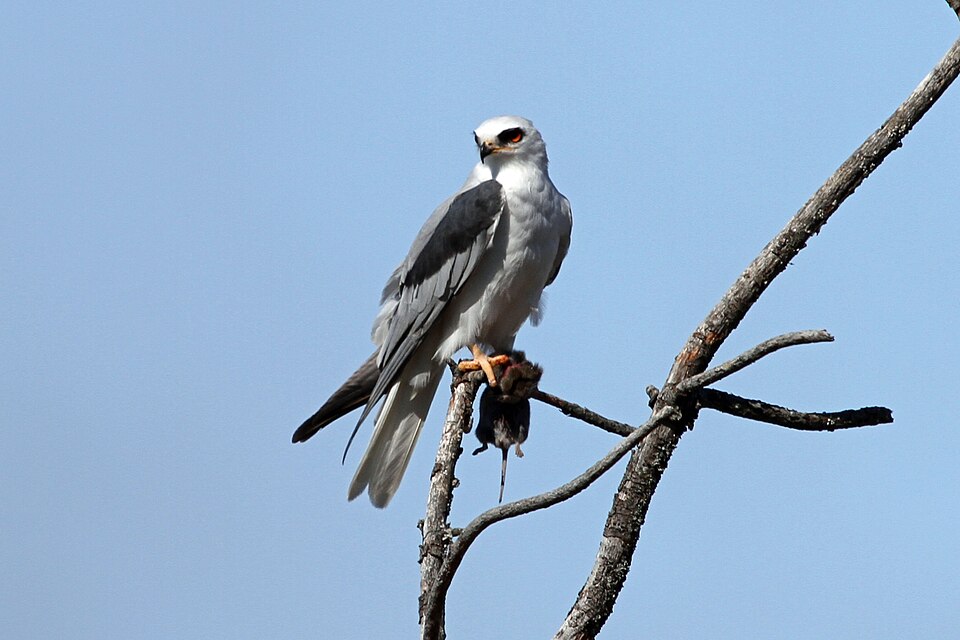
The White-tailed Kite (Elanus leucurus) is a medium-sized raptor in the family Accipitridae, easily recognized by its all-white body, grey wings with black shoulder patches, and bright red eyes. It is famous for its "kiting" behavior, where it holds a stationary position in the air while fluttering its wings to scan open ground for small rodents. Found across North and Central America in grasslands, marshes, and orchards, this species is currently listed as Least Concern on the IUCN Red List.
Learn to identify
Adult White-tailed Kite perched on a wire, Colombia.
Learning lesson · openly licensed photographs, labelled by BirdBot; labels checked against the cited sources and approved by AI

Deep red eye: set in a white face. Black shoulder: a black patch on the gray wing. White underparts: clean white from throat to belly. Long, pale tail: wings and tail are relatively long. White hawk with black shoulders: think kite.
Juveniles show brown on the chest and back.
Sources: Audubon Guide to North American Birds: White-tailed Kite · Wikipedia: White-tailed kite (revision 1380711905)
Photo: Alejandro Bayer Tamayo from Armenia, Colombia, CC BY-SA 2.0, via Wikimedia Commons; labels added by BirdBot.
The White-tailed Kite is one of the most visually distinct raptors in the Americas. Adults display a stark contrast between their white plumage and dark wing markings. Because the species is not sexually dimorphic, males and females look identical, making plumage and behavior the primary identification cues.
Juveniles are significantly duller and more mottled. They feature a cinnamon-brown wash on the breast and crown, along with speckled brown patches on the shoulders. This juvenile plumage helps them blend into the ground and vegetation, offering camouflage that the stark white of adults does not provide.
White-tailed Kites prefer open habitats where they can hover and scan for prey. They are commonly found in grasslands, open fields, marshes, orchards, and river valleys. A key ecological driver of their habitat selection is the density of small mammals; kites choose areas with high rodent populations.
Their range spans from the northwestern United States and southern Florida southward through Mexico and Central America to eastern Panama, and across much of South America to south-central Argentina and isolated populations in Chile. In North America, they often remain in the same general area, making local movements in response to prey availability.
The defining behavior of the White-tailed Kite is "kiting." The bird faces the wind and beats its wings rapidly to hold a stationary position in the air. This hovering allows the kite to scan the ground below for movement. When prey is detected, the kite dives down, wings held up, to snatch the animal with its talons.
Unlike many solitary raptors, White-tailed Kites are relatively social. They are territorial but tolerant of other kites nearby. During the non-breeding season, they often gather in communal roosts at dusk, perching in the highest points of trees. Groups of up to 100 individuals have been recorded in these roosts.
White-tailed Kites are carnivorous, feeding primarily on small rodents. Their diet includes voles, field mice, shrews, rats, pocket gophers, and young rabbits. In rare instances, they will consume other birds, frogs, lizards, or insects. The hover-and-dive hunting technique is highly efficient for capturing these ground-dwelling prey items.
Research in an agrarian area of southern Brazil found that breeding White-tailed Kites and Barn Owls share a high overlap in their mammalian food niches, with the house mouse (Mus musculus) constituting 63% of the kite's diet by number of prey items.
Pairing often begins in December, with males hovering near females in a "V" formation and offering prey. The pair selects a nest site together, typically in a live tree such as an oak, avocado, orange, cottonwood, or sycamore, about 20 to 50 feet above the ground.
The female builds the nest, a loose structure of dead branches and twigs lined with straw and grass. The male may assist by bringing nesting material. The average clutch size is four eggs, which are white and speckled with warm brown. Incubation lasts 30 to 32 days, during which the male brings food to the female. Hatchlings are helpless and brooded by the female, while the male forages. The female aggressively guards the nest, attacking any perceived threats, sometimes joined by the male.
White-tailed Kites produce a variety of calls, including rough grating sounds, quiet whistled yelps, and low "kewps." The "kewp" is often used to announce presence, particularly when a male approaches a female with food. They also emit an "eee-grack" call to communicate unease, which is a high-pitched whistle followed by a low, guttural raspy sound. There are no apparent differences in vocalizations between sexes.
The White-tailed Kite is currently listed as Least Concern (LC) on the IUCN Red List, as recorded in AviList v2026. Historically, the species faced significant pressure from habitat loss, egg collection, and shooting between the 1930s and 1940s. Populations have since rebounded, aided by the expansion of agricultural habitats that support high rodent densities. In the United States, the species is protected under the Migratory Bird Treaty Act.
Recent data from Central Valley Christmas Bird Counts and eBird records indicate that White-tailed Kite numbers declined significantly during the 2011–2015 drought. Researchers attribute this decline primarily to reduced densities of small rodents, which are the kite's primary food source.
The best time to observe White-tailed Kites is at dusk in open fields or near marshes. Look for groups perched high in trees or individuals holding a stationary "kiting" position in the air. Maintain a respectful distance to avoid disturbing their roosting or hunting behavior. Using binoculars or a telephoto lens allows for detailed observation of their flight patterns and plumage without causing stress to the birds.
Practical Next Step: Check the edges of agricultural fields or grasslands at dawn or dusk. Kites often perch on fence posts or isolated trees at these times, making them easier to spot than when they are actively hovering over open ground.


