
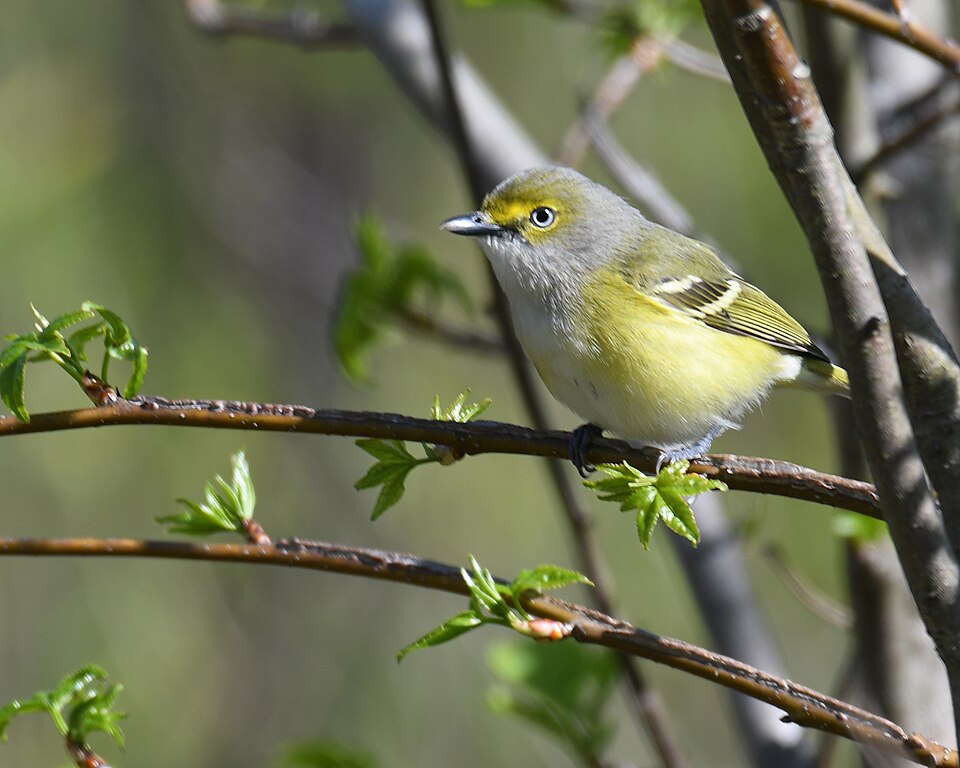
The White-eyed Vireo (Vireo griseus) is a small, stocky songbird in the family Vireonidae, easily recognized by its bright yellow "spectacles" surrounding white eyes in adults. It breeds in dense, brushy habitats near water, such as swamps and abandoned fields, and is known for its explosive, warbling territorial song.
Learn to identify
Adult White-eyed Vireo photographed at Patuxent, Maryland, in spring.
Learning lesson · openly licensed photographs, labelled by BirdBot; labels checked against the cited sources and approved by AI

Yellow spectacles: yellow surrounds the eye. White eye: adults have a white iris. Two white wing bars: on dark wings. Yellow flanks: whitish below with yellow sides. Check the eye: white iris inside yellow spectacles.
Immatures in first fall and winter have darker grey-brown eyes.
Sources: Audubon Guide to North American Birds: White-eyed Vireo · Wikipedia: White-eyed vireo (revision 1362784499)
Photo: lwolfartist, CC BY 2.0, via Wikimedia Commons; labels added by BirdBot.
At 12.7 cm in length and weighing about 11.5 g, the White-eyed Vireo is compact and robust. Adults display a dark olive back, with darker, almost black wings and tail. The head is olive with a gray nape, and the underparts are whitish with pale yellow flanks and undertail coverts. The most diagnostic features are the bright yellow markings around the eyes (lores and eye-ring) and the white irises that develop in adulthood. Beaks and legs are black.
Juveniles differ significantly: they have dark irises, white spectacles (instead of yellow), a pale gray head, and overall paler plumage. There is no sexual dimorphism; males and females look identical.
The male's breeding song is explosive and warbling, often described mnemonically as "quick-with-the-beer-check." It consists of short, sharp notes at the beginning and end, with a rapid warble in the middle. This song is used to establish territory and attract mates. Fledgling males learn this song early, sometimes mimicking their father's call within a month of leaving the nest.
Both sexes use a harsh chattering call in response to predators or during territorial disputes. Mated pairs also exchange short "pik" contact calls when nearby. If handled, adults and nestlings may emit a harsh squeal, likely to startle predators or alert a mate.
White-eyed Vireos prefer brushy habitats with a dense understory, typically near a water source. They are common in secondary deciduous scrub, swamps, and mangroves. In the southeastern United States, they favor "bayhead" areas dominated by red bay, sweet bay, dahoon holly, and wax myrtle. They also inhabit abandoned agricultural fields that have been fallow for 20 to 50 years, allowing shrubby vegetation to establish.
The breeding range extends from southeastern Kansas eastward to Massachusetts, southward to central Texas and the Gulf slope into eastern Mexico, southern Florida, and Bermuda. Wintering grounds include the southern USA, the Bahamas, the Greater Antilles, eastern Mexico, and northern Honduras.
Most White-eyed Vireos are migratory, moving north in spring and south in fall. However, non-migratory populations remain year-round in southern coastal regions of the US (South Carolina to Texas) and along the Gulf Coast of Mexico. The species is highly territorial year-round. On wintering grounds, both sexes defend small territories, particularly around Bursera trees, which are a key food source. During migration, they may join inter- or intra-species flocks.
The diet shifts seasonally. During the breeding season, the vireo is primarily insectivorous, gleaning caterpillars, flies, beetles, and other insects from foliage. It often perches motionless, tilting its head to locate prey before hovering or lunging to capture it.
In the non-breeding season, the diet becomes mostly frugivorous. The species has a strong relationship with Bursera simaruba trees, acting as a primary seed dispersant. It also consumes fruit from sumac, dogwood, poison ivy, pokeweed, waxmyrtle, and wild grapes.
White-eyed Vireos are monogamous, with pair bonds typically lasting one season. Males establish territories, and females select a mate after visiting several. The breeding season runs from late April to early August. Pairs build a suspended, cup-shaped nest in dense vegetation, usually less than 1 meter from the ground. The nest is constructed from spiderweb silk, twigs, bark strips, and grass, taking 3 to 5 days to complete.
The female lays four eggs, incubating them for 13 to 15 days alongside the male. Chicks fledge after 9 to 11 days and are brooded by both parents for up to 23 additional days. White-eyed Vireos can breed in their first spring, though success varies.
The White-eyed Vireo is listed as Least Concern (LC) in the IUCN Red List, as recorded in AviList v2026. This status reflects its large population size and wide geographical range. However, the species may face future threats from habitat loss, as its preferred shrubby habitats are vulnerable to urbanization and agricultural conversion.
To find White-eyed Vireos, focus on dense brushy habitats near water, such as swamp edges, abandoned fields, or bayhead areas. In the southeastern US, "bayhead" areas are characterized by a dense understory of red bay, sweet bay, dahoon holly, and wax myrtle. Abandoned agricultural fields that have been fallow for 20 to 50 years often provide the ideal shrubby successional vegetation this species prefers. In early morning during spring migration, listen for the male's explosive, warbling song to locate birds in dense cover. In winter, look for birds foraging on Bursera trees or other fruiting shrubs. When observing, maintain a respectful distance to avoid disturbing nesting or foraging activities. Avoid playing recorded songs to attract birds, as this can cause unnecessary stress and territorial aggression.


