
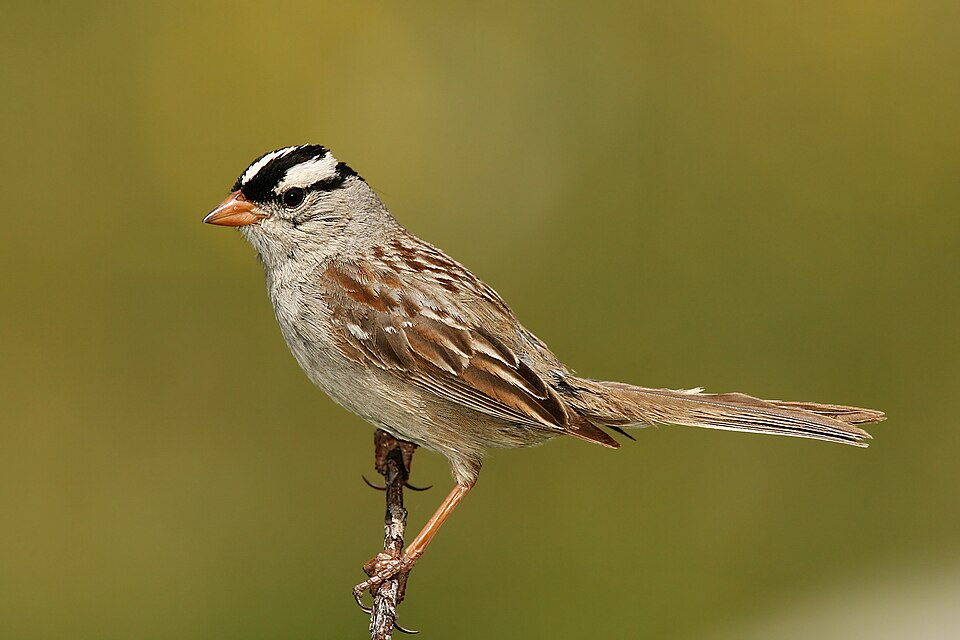
The White-crowned Sparrow (Zonotrichia leucophrys) is a medium-sized New World sparrow distinguished by its bold black-and-white head stripes, gray face, and brown streaked upperparts. It breeds in boreal forests, tundra, and alpine meadows, and winters across North America, often foraging in flocks on bare ground near dense cover.
Learn to identify
Adult White-crowned Sparrow (subspecies oriantha), photographed in Yoho National Park, British Columbia.
Learning lesson · openly licensed photographs, labelled by BirdBot; labels checked against the cited sources and approved by AI

Black-and-white crown: bold black and white head stripes. Pink to orange bill: pale pink, orange or yellow by subspecies. White wing bars: two white bars on brown, streaked wings. Plain gray breast: unstreaked pearly gray below. White-throated Sparrow has a white throat patch and yellow lores.
Immatures show brown and tan head stripes instead.
Sources: Audubon Guide to North American Birds: White-crowned Sparrow · Wikipedia: White-crowned sparrow (revision 1385035191)
Photo: Charles J. Sharp, CC BY-SA 4.0, via Wikimedia Commons; labels added by BirdBot.
The most reliable field mark for an adult White-crowned Sparrow is the head pattern. Both males and females display two distinctive black stripes that extend along the crown and behind the eyes, boldly outlining the solid white feathers of the head. The face is a solid light gray, contrasting with the dark brown flight feathers and brown streaked upperparts. The wings are brown with white bars, and the underparts are generally gray. The bill is typically pink or yellow.
Juveniles present a common identification challenge. They possess a similar body shape but differ significantly in head coloration. Instead of black stripes, juveniles have brown head stripes surrounding a slightly darker, brownish-white patch. Their overall plumage is browner than the gray of adults. There is no seasonal variation in plumage, but geographical variation exists among subspecies.
The White-crowned Sparrow is frequently confused with the White-throated Sparrow, especially during migration when they travel in mixed flocks. The key distinction is that the White-crowned Sparrow lacks the white throat markings and yellow lores (the area between the eye and bill) found in the White-throated Sparrow. In the field, look for the solid gray face and the specific arrangement of head stripes to separate the two.
White-crowned Sparrows are highly flexible in their habitat selection. They breed in boreal forests, tundra, and alpine meadows, ranging from northern Alaska eastward to Newfoundland and southward through the northern and western United States. In winter, they are found along the Pacific coast from southernmost Alaska to southern Baja California, and across the western and eastern United States down to central Mexico and southern Florida.
Their habitat requirements are relatively simple: tall coniferous trees on the edge of a territory, grass, bare ground for foraging, and dense coverage to hide nests and roosting areas. This flexibility allows them to breed at altitudes as low as 800 meters and as high as the Rocky Mountains. They are also known to occupy human-altered environments, such as the edges of parking lots, provided the necessary structural elements are present.
Outside of the breeding season, White-crowned Sparrows are social, often traveling in small groups of about eight during migration and foraging in larger flocks in winter. However, during the breeding season, males become extremely territorial. Most males return to guard the same non-overlapping territories year after year.
When responding to an intruder or predator, a male will puff up his chest, hold up his crown feathers, and sing very loudly. Fighting is common when males are first settling into territories. The species is almost always monogamous, with the female initiating courtship by bowing and parting her tail feathers. The male responds by raising his crown feathers and standing on her back briefly before mating.
To avoid revealing their nest location to predators like Belding's ground squirrels or garter snakes, sparrows fly toward the nest but stop short, traveling the final few meters on foot. If a nest is approached, the female performs a distraction display by wagging her tail and running away from the nest.
White-crowned Sparrows are primarily granivores, with about 92% of their diet consisting of plant matter such as seeds, buds, grass, and fruit. Their small, tough bill is well-adapted for cracking seeds. During the spring, however, they shift their diet to include mainly insects and seeds, likely to provide protein for breeding.
They forage by hopping on bare ground, often in low vegetation. Because they do not store food and lack a functional crop, they focus their most intense feeding times early in the morning and late at night. Dense shrubbery is critical for their foraging, as feeding activity decreases when proper coverage from predators is lacking.
Nests are typically built low in bushes or on the ground under shrubs. The cup-shaped nest is constructed by the female, who also incubates the eggs. Most pairs produce only one brood. The female incubates three to five brown-marked gray or greenish-blue eggs for about 12 days, turning them regularly and leaving the nest during the day to forage. She develops a brood patch during nest construction to facilitate heat transfer to the eggs.
Once the eggs hatch, the male begins to contribute to feeding the young, though his contribution decreases as the chicks mature. The young are naked at birth, fledge by the tenth day, and reach adult weight by day 30 to 35.
The White-crowned Sparrow is a model species for studying bird song learning and cultural evolution. Males sing loudly to defend territories and attract mates. Their songs are not just individual variations but are culturally transmitted "dialects" that vary geographically. A 2025 study by Luo et al. demonstrated that in Nuttall's white-crowned sparrows (Z. l. nuttalli), genetic divergence coincides with major song boundaries, such as at Monterey Bay, California. This suggests that discrimination against non-local songs can drive genetic divergence, potentially acting as a foundation for speciation.
Recent research, including work by Elizabeth Derryberry, has also shown that white-crowned sparrow songs are affected by human activity and noise, indicating that anthropogenic factors can influence the acoustic structure of their communication.
The White-crowned Sparrow is listed as Least Concern (LC) in the AviList v2026 checklist. The species does not currently require specific management interventions. Interestingly, logging practices, which often disturb other bird species, have provided White-crowned Sparrows with new habitats by creating bare ground and grasslands suitable for foraging. Cattle grazing has been identified as a potential deterrent to their habitat requirements, as it can reduce the necessary dense cover.
To observe White-crowned Sparrows ethically, look for them hopping on bare ground near dense shrubbery. Maintain a distance to avoid stressing the birds, especially during the breeding season when they are territorial. Listen for the loud, complex song of a male defending his territory. In winter, watch for flocks foraging on the ground, and note the bold head patterns of adults versus the browner, less distinct patterns of juveniles. If you see a female performing a distraction display near a nest, back away immediately to protect the brood.


