
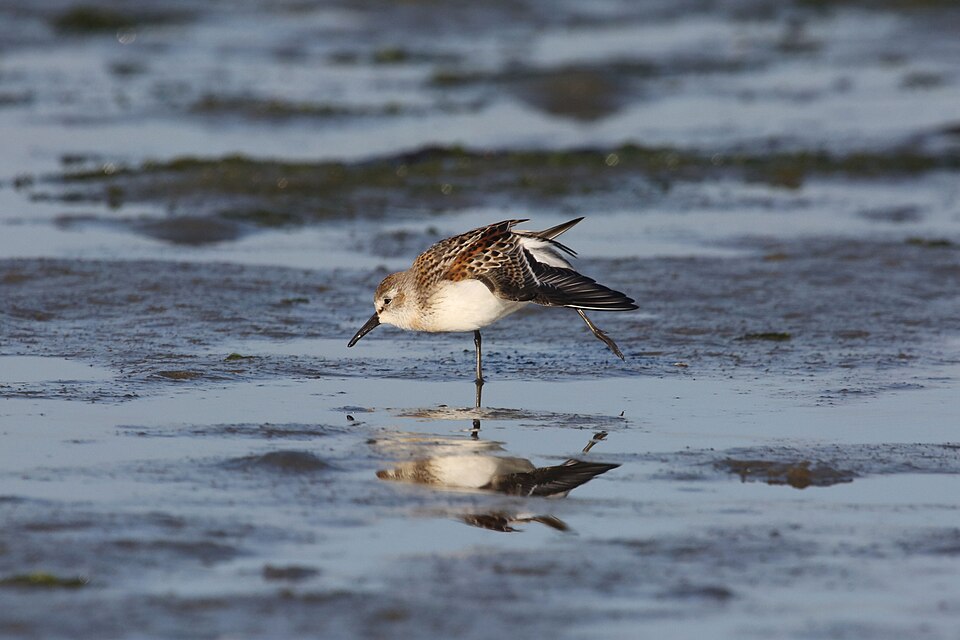
The Western Sandpiper (Calidris mauri) is a small shorebird in the order Charadriiformes and family Scolopacidae. It is identified by its long, slightly down-curved black bill, black legs, and a narrow white wing bar. Females are larger than males, with bills approximately 15 percent longer. The species breeds in subarctic Alaska and winters on coastal mudflats, briny flats, and mangroves across the Americas.
Learn to identify
Western Sandpiper in breeding plumage standing in tundra vegetation.
Learning lesson · openly licensed photographs, labelled by BirdBot; labels checked against the cited sources and approved by AI

Rusty crown: reddish-brown on the crown and face. Bill droops at the tip: usually longer than a Semipalmated's. Black spots on breast and sides: spring adults are boldly marked below. Dark legs: also less brown overall than Least Sandpiper. Check bill length and droop on small peeps.
Winter birds are plain grey and very like Semipalmated Sandpiper.
Sources: Audubon Guide to North American Birds: Western Sandpiper · Wikipedia: Western sandpiper (revision 1380711690)
Photo: Tim Bowman, Public domain, via Wikimedia Commons; labels added by BirdBot.
Western Sandpipers measure 14–17 cm in length and weigh 22–35 g, with a wingspan of 35–37 cm. They possess a long, black bill that curves slightly downward with a fine tip, black legs, and small webbed toes. The tail is primarily black, except for the white outer rectrices. A narrow white wing bar is a key field mark visible in flight.
Sexual dimorphism is present: females are generally larger and heavier, with bills about 15 percent longer than those of males. Males display brighter chestnut coloration on the upper body and more streaking on the underparts. During the nonbreeding season, plumage becomes a mix of black, white, tan, and reddish-brown as the birds undergo their definitive prealternate molt.
Field Comparison: Western vs. Semipalmated Sandpiper
The Semipalmated Sandpiper is the primary look-alike. The most reliable distinctions are bill shape and plumage intensity:
Historical field guides, such as Chester A. Reed’s 1916 Bird Guide, noted that the Western Sandpiper is "more rusty above, with stronger markings" than its Semipalmated counterpart, a distinction that remains useful for field identification today.
While the Semipalmated Sandpiper is the primary look-alike, historical records provide context for the species' range and taxonomy. Leander S. Keyser’s 1902 Birds of the Rockies described the Western Sandpiper as a rare migrant breeding in the remote North. These early observations reflect the species' limited presence in eastern North America compared to its current status as a frequent Pacific coast migrant. Current taxonomy places the species in the genus Calidris, replacing the historical Ereunetes or Pisobia designations found in older literature.
Western Sandpipers breed in subarctic Alaska, specifically on the Yukon-Kuskokwim Delta, utilizing drained heath-covered tundra and low-lying marsh tundra. These areas are characterized by grasses, sedges, and nearby water sources like lakes and streams. AviList v2026 records breeding in the Chukotskiy Peninsula, Anadyr, St. Lawrence Island, and western/northern Alaska.
During the nonbreeding season, they occupy coastal areas with sandy and muddy surfaces, including briny flats, mangroves, and cattail marshes. They have been recorded at elevations up to 2,500 meters in winter. Their wintering range extends from coastal Washington to Peru and the Galapagos, as well as southeastern Canada to the Caribbean and inland central Mexico to northern Costa Rica.
Western Sandpipers are social and migrate in flocks during the day. They arrive at breeding grounds in mid-May as snow melts and depart for coastal California around mid-July (adults) or a month later (juveniles). They stay on wintering grounds from September to early May.
On breeding grounds, males are territorial, using hunched postures, rail-runs, and wing-lifting displays to defend areas of 2,000–3,000 square meters. Both parents perform distraction displays, such as feigning injury or mimicking a rodent, to protect their young from predators.
On breeding grounds, adults consume benthic invertebrates, spiders, and insects. During migration and winter, their diet shifts to marine benthic invertebrates, polychaete worms, and molluscs. A study by Kuwae et al. (2008) found that northward-migrating Western Sandpipers feed on intertidal biofilm, which contributes half of their daily energy supply. Juveniles begin foraging on surface insects like flies and beetles within 24 hours of hatching.
The male song is an eight-note tune beginning with "t-e-e-e" followed by a low, buzzy trill. Both sexes emit quick, trilled alarm calls while nesting. In flight, they produce a "bbeet" call to communicate with conspecifics. Adults also use freeze, brooding, and gather calls to interact with nestlings.
Western Sandpipers are monogamous, with pairs often mating for consecutive years. Females incubate eggs from evening to morning, while males take over during the day. Clutches typically contain four eggs (range 2–5), hatching around mid-June. Chicks are precocial and leave the nest to forage within 12–24 hours. Both parents guard the brood until fledging, which occurs two to three weeks after hatching.
The Western Sandpiper is listed as Least Concern (LC) in AviList v2026 and the IUCN Red List. However, it is considered a species of high concern in US and Canada Shorebird Conservation Plans due to habitat deterioration, climate change, and human impacts.
Specific threats include the drainage of coastal marshes, oil spills, and the encroachment of invasive species like Spartina alterniflora in estuaries such as those in Washington state. These changes reduce the availability of critical foraging habitats during migration and winter.
Conservation efforts are coordinated through the Western Hemisphere Shorebird Reserve Network (WHSRN), which designates and protects key habitats throughout the Americas. Additionally, the species is protected under the US Migratory Bird Treaty Act, which prohibits the taking of birds without a permit. Local habitat restoration projects and monitoring programs further support population stability.
To observe Western Sandpipers ethically, maintain a distance to avoid disturbing their foraging or distraction displays. Focus on coastal mudflats during migration or tundra areas during the brief breeding season. Community scientists can contribute to shared datasets by recording detections in eBird or through local birding groups, supporting broader conservation monitoring. Always prioritize the bird's welfare by minimizing stress and respecting protected areas.


