
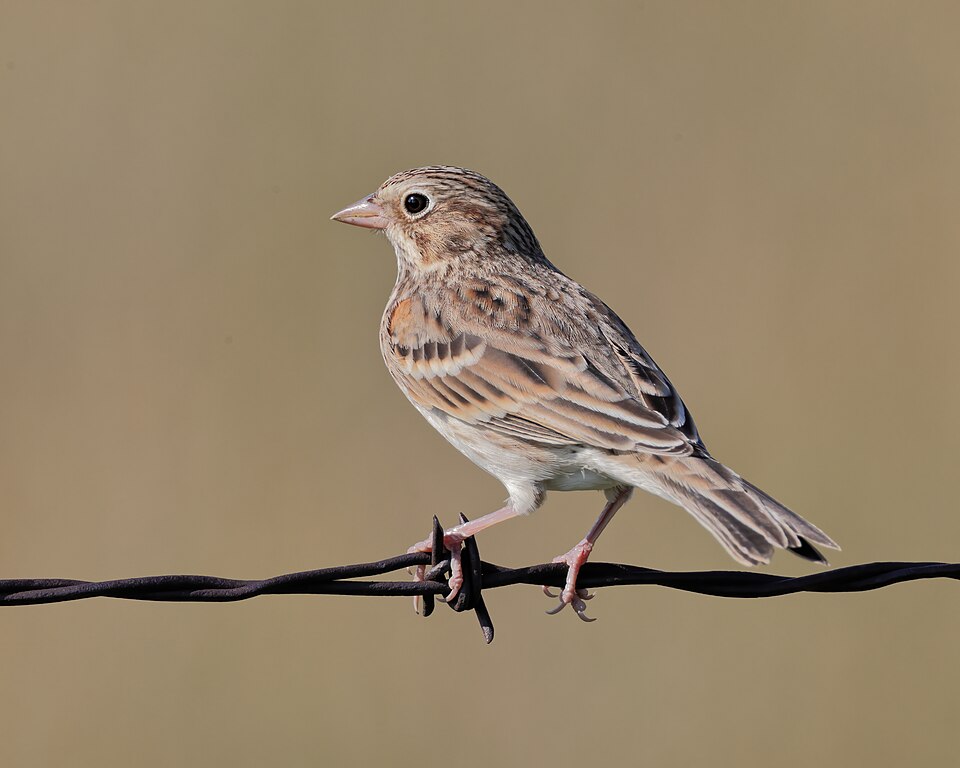
The Vesper Sparrow (Pooecetes gramineus) is a streaky-brown sparrow in the family Passerellidae, recognized by its white outer tail feathers, cream-colored stomach, and a song of whistles followed by trills. It breeds in dry grasslands and early successional areas, singing from high perches to defend territories, and is currently listed as Least Concern by the IUCN.
Learn to identify
Adult Vesper Sparrow perched on a post in the United States.
Learning lesson · openly licensed photographs, labelled by BirdBot; labels checked against the cited sources and approved by AI

White eye-ring: a small, crisp white ring round the eye. Dark-edged cheek patch: heavy dark outline to the ear patch. Chestnut shoulder: often hidden, but visible here. Streaked breast: fine dark streaks on pale underparts. In flight, look for white outer tail feathers.
No bold eyeline; some western birds look pinkish.
Sources: Audubon Guide to North American Birds: Vesper Sparrow · Wikipedia: Vesper sparrow (revision 1378900991)
Photo: Tim from Ithaca, CC BY 2.0, via Wikimedia Commons; labels added by BirdBot.
Vesper Sparrows are medium-sized birds with an average length of 15.9 cm and a wingspan of 25.4 cm. Their plumage is streaky-brown with a cream-colored stomach, white outer tail feathers, white eye rings, and white malar stripes. The tail is notched, and the bill is conical and pinkish. Males are slightly larger than females, with an average body mass of 26.5 g compared to 24.9 g for females. Juveniles lack the rufous lesser coverts found in adults, which is a key field mark for distinguishing age classes. In spring and summer, the plumage appears grayer with more prominent streaks.
The song is a primary identification tool, especially in open habitats where the bird may be hidden in grass. The basic song structure consists of two to four whistles followed by up to seven trills. Males often sing from high perches such as fence posts or bush tops to establish and defend territories. A longer "extended flight song" lasting six to ten seconds is given in flight. The four recognized subspecies have weak dialects, meaning slight geographic variations in song exist.
The species name vesper reflects its habit of singing toward evening, a behavior noted by early observers like Chester A. Reed (1919). Neltje Blanchan (1923) described the song as a "serene, pastoral strain" that is "restful as the twilight," often continuing until the early night when only the rose-breasted grosbeak remains vocal. While the song is most prominent in the late afternoon, it is also one of the first voices to join the morning chorus.
Vesper Sparrows are generalists that nest in early successional areas like croplands, meadows, and pastures, typically within an elevation range of 0 to 3,000 m. They prefer dry areas with patchy, shrub-like vegetation and generally avoid dense vegetation. During the non-breeding season, they inhabit dry shrublands and grasslands. Their breeding range extends from eastern British Columbia to Nova Scotia, south to south-central California, New Mexico, and far northwestern North Carolina. Wintering grounds range from the southern USA to southern Baja California, central Oaxaca, and southern Florida.
Males establish territories by vocalizing from high perches and display with raised wings and tails during courtship. They often take flight to sing during these displays. Foraging behavior varies by season; in winter, they may form small groups near cover, with flock size increasing as cover proximity increases. In summer, they forage alone or in pairs, walking or flying to different sites within their territory. They are most commonly found foraging where vegetation is not very dense.
The diet shifts significantly with the seasons. In winter, Vesper Sparrows eat primarily grains and seeds, including amaranth, cupgrass, dropseed, fingergrass, and panicum. In summer, they feed on insects in addition to grain, providing almost exclusively insects to their nestlings. Common insect prey includes grasshoppers, beetles, and caterpillars. Most adult Vesper Sparrows also consume grit and small rocks as a digestive aid.
Vesper Sparrows are migratory, reaching breeding ranges as early as April and staying until late August. They typically produce two to three broods per season, with clutches of 2 to 5 eggs. Females build the nests and incubate the eggs for 11 to 14 days. Both parents feed the nestlings and protect the nest, though males may occasionally incubate or take over a brood while the female starts another. Nestlings fledge after 7 to 14 days but remain dependent on parents for 20 to 29 days.
The Vesper Sparrow is listed as Least Concern (LC) on the IUCN Red List, as recorded in AviList v2026. This global status does not reflect local population trends or regional conservation assessments.
The best time to find a Vesper Sparrow is in mid-to-late April, when males arrive on breeding grounds and begin establishing territories. Walk slowly along fencerows or the edges of dry pastures and listen for the distinctive song: a series of whistles followed by trills, often given from a high perch like a fence post or bush top. If you hear the song, look for a small, streaky-brown bird with a cream-colored stomach. When the bird flies, note the prominent white outer tail feathers, a key field mark that distinguishes it from other sparrows.
Caution: During the breeding season (April–August), maintain a respectful distance from active nests and avoid disturbing them. Vesper Sparrows build ground nests in grass, which can be easily overlooked or damaged by foot traffic. A useful field exercise is to listen for the general song structure—whistles followed by trills—to practice distinguishing this species from other sparrows in the same habitat while keeping a respectful distance.


