
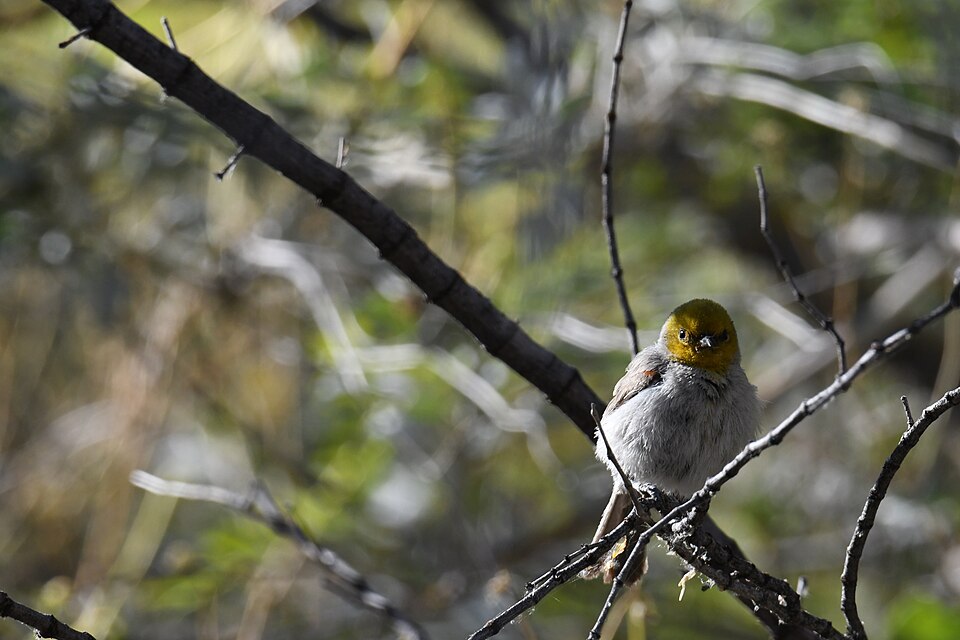
Imagine standing in a quiet wash in the Sonoran Desert, the air still cool in the early morning. A tiny, gray bird flits rapidly through the thorny branches of a desert shrub, its bright yellow head flashing against the muted scrub. This is the Verdin (Auriparus flaviceps), a bird so small it rivals the American Bushtit, yet so distinct in its desert habitat that it is the only member of the Old World family Remizidae found in North America. Verdins inhabit arid desert scrub, riparian zones, and washes in southeastern California, southwestern Utah, northern Texas, and central Mexico. Their rapid, flitting foraging behavior and construction of domed nests from twigs and thorns make them a unique sight in the arid landscapes they call home.
Learn to identify
Adult Verdin of the southwestern United States and Mexico, photographed in Arizona.
Learning lesson · openly licensed photographs, labelled by BirdBot; labels checked against the cited sources and approved by AI

Yellow head: bright yellow face and crown on adults. Rufous shoulder: a small reddish patch, often hidden. Gray body: plain gray over the rest of the bird. Gray juveniles suggest a Bushtit, but are never in flocks.
Juveniles are plain gray, without the yellow head or rufous shoulder.
Sources: Audubon Guide to North American Birds: Verdin · Wikipedia: Verdin (revision 1379213422)
Photo: Andy Reago & Chrissy McClarren, CC BY 2.0, via Wikimedia Commons; labels added by BirdBot.
At approximately 11 cm (4.5 inches) in length, the Verdin rivals the American Bushtit as one of the smallest passerines in North America. Adults are ash-gray on the upperside and pale-gray or white on the underside. The most striking field mark is the bright yellow head, which contrasts sharply with the dark lores (the area between the eye and bill). A maroon patch on the shoulders (lesser coverts) is also visible, particularly when the bird is in flight or stretching its wings.
Sexes are similar, though males are generally brighter overall. Juveniles are distinct from adults; they lack the yellow head, dark lores, and maroon shoulder patch, appearing plain gray overall. The bill is short, sharp, and pointed, differing from the broader bills of true tits. The tail is short and rounded.
Verdins are residents of arid scrub and riparian areas in lowlands to hills. Their range extends from southeastern California to southwestern Utah, eastward to northern Texas, and southward through Baja California, Sinaloa, and Hidalgo in central Mexico. They prefer thorny brush over open desert and are often found along washes and in desert riparian zones. While primarily a low-elevation species, they can be present at higher elevations in central Mexico.
Two subspecies nest in the United States: A. f. acaciarum, associated with the Sonoran Desert, and A. f. ornatus, associated with the Chihuahuan Desert. The remaining subspecies are resident to Mexico.
Verdins rarely approach the ground, instead foraging within the live foliage of trees and shrubs. They move with short, quick wing beats and often hop from branch to branch. A distinctive foraging behavior is grasping flowers or prey with one foot to examine it and gain leverage. When capturing large prey, they hold it with their feet and tear it apart with their bill.
These birds are generally solitary, with males tolerating other males only within about 0.5 km of their territory. They can be aggressive in the presence of larger predators or competitors such as Bendire's Thrashers, Cactus Wrens, and Loggerhead Shrikes. Verdins are among the last birds to begin morning activity and the first to roost in the evening.
The bulk of the Verdin's diet consists of insects, including caterpillars, aphids, beetle and wasp larvae, leafhoppers, and jumping spiders. This is complemented by nectar, fruits, and seeds of legumes. Verdins forage actively among desert shrubs and trees, chasing insects and piercing the base of long flowers to reach nectar. In fall and winter, they shift to feeding more on fruits, berries, and legume seeds. They have shown no evidence of food storage.
Verdins build remarkable domed nests from bulky twigs, branches, and thorns, lined with grasses, feathers, and hair. The entrance is a small circular hole, usually at the bottom of the sphere, facing away from the center of the host plant. Nests are typically placed in shrubs at an average height of 1.8 m (6 ft), ranging from 0.8 to 4 m.
In March, males may build display nests to attract females. Both sexes participate in constructing the breeding nest, with the male working on the outer shell and the female on the inner layers. The female lays 3–6 eggs, which are blue-green to greenish-white with reddish-brown speckles. She incubates the eggs for 14–18 days, while the male remains nearby and vocalizes frequently. Young fledge 17–21 days after hatching. If a second clutch is laid, the male assumes full responsibility for feeding the first set of fledglings.
Verdins produce loud calls for their size. The typical call is a rapid, staccato "tschep" repeated frequently while foraging. Unmated males repeat a "tseet" call in early spring, which may function to attract females. This call is also used by mated pairs and solitary birds to maintain contact. A "gee-gee-gee-gee" alarm call is given in response to predators. Fledglings may produce soft warbling notes during their post-juvenile molt.
The Verdin is listed as Least Concern (LC) in the AviList v2026 checklist. While healthy populations exist in suburban environments, verdin populations have been shown to decrease in highly urbanized areas such as mobile home parks and golf courses due to habitat loss from commercial and residential development. The provided sources do not offer a specific abundance estimate or confirm that the species is widespread and common across its entire range.
To observe Verdins ethically, visit arid desert scrub or riparian zones in their range during the day. Look for small, gray birds with bright yellow heads flitting rapidly among the branches of thorny shrubs. Listen for their rapid "tschep" calls, which are loud for their size. Maintain a respectful distance to avoid disturbing their foraging or nesting activities. In suburban areas with suitable desert vegetation, they may be seen near hummingbird feeders, though they primarily forage in natural foliage. A practical next step is to focus your binoculars on the upper branches of thorny desert shrubs, where the bird's quick, short wing beats and foot-grasping behavior are most visible.


