
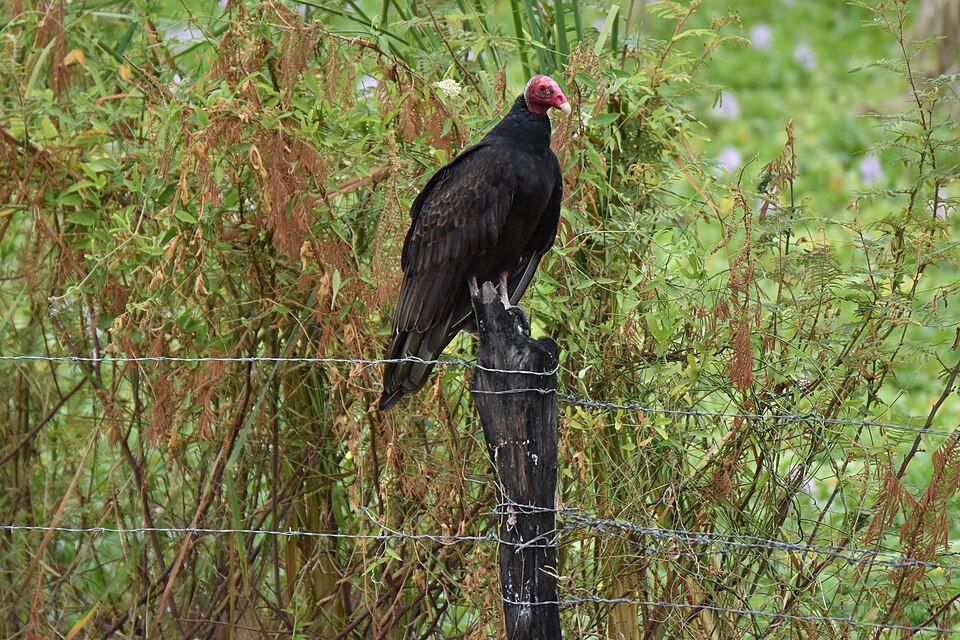
The Turkey Vulture (Cathartes aura) is a large New World vulture identified by its brownish-black plumage, bare pink-to-red head, and grey flight feathers. It is one of the few bird species that uses its sense of smell to locate carrion, roosts in large groups, and breeds in sheltered sites with minimal nest structure. Classified as Least Concern, it is common throughout the Americas.
Learn to identify
Adult Turkey Vulture soaring overhead, New Island, Falkland Islands.
Learning lesson · openly licensed photographs, labelled by BirdBot; labels checked against the cited sources and approved by AI

Silvery flight feathers: pale gray beneath, against dark linings. Small red head: bare, red and small for the body. Black wing linings: the other half of the two-toned underwing. Long tail: longer than a Black Vulture's. Soars with wings in a shallow V.
Juveniles have gray heads; compare Black Vulture.
Sources: Audubon Guide to North American Birds: Turkey Vulture · Wikipedia: Turkey vulture (revision 1381887559)
Photo: Stefan Brending (2eight), CC BY-SA 3.0 de, via Wikimedia Commons; labels added by BirdBot.
Turkey Vultures are large birds, with total lengths ranging from 64 to 81 cm and weights between 0.85 and 2 kg depending on the subspecies. Sexes do not differ in appearance. The most striking feature is the bare head and neck, which varies in color from pink to bright red. The body plumage is brownish-black.
A critical field mark for distinguishing the Turkey Vulture from the similar Black Vulture is the color of the flight feathers. Turkey Vultures have grey primary and secondary feathers, whereas Black Vultures have black flight feathers with white underwing patches. Additionally, the Turkey Vulture's head is pink to red, while the Black Vulture's head is entirely black.
Their wing surface to weight ratio results in light wing loading, making them more buoyant in the air than other vultures. This adaptation allows them to utilize thermals to stay in flight with minimal energy usage, often soaring with wings held in a slight V-shape, a common field mark.
Turkey Vultures exhibit a unique social structure: they roost in large community groups, sometimes numbering in the hundreds, but forage independently during daylight hours. These roosts often include Black Vultures. Populations in colder areas migrate seasonally to warmer weather, while those in southern regions may be resident year-round.
Their foraging behavior is driven by a well-developed sense of smell, a rare trait among birds. They use this keen olfaction, combined with vision, to locate carcasses. Black Vultures, which do not rely on smell to the same extent, often follow Turkey Vultures to food sources and then exclude them from feeding.
Turkey Vultures feed primarily on carrion. Their diet varies by habitat: in agricultural areas, they feed mainly on livestock carrion, while in developed areas, they rely heavily on roadkill. In non-agricultural regions, wild carrion is the primary food source. They prefer smaller carcasses but will feed on dead animals of any size, often waiting for decay to penetrate the thick skin of larger animals. Occasionally, they consume rotten fruit, insects, reptiles, or dung.
Breeding in North America occurs from March to June. Turkey Vultures do not build traditional nests; instead, they use sheltered sites such as hollow trees, logs, cliff crevices, or old buildings. Eggs are laid directly on debris or the flat bottom of the site. The eggs are off-white with brown and lavender markings. Incubation lasts 30 to 40 days, and chicks are altricial, meaning they are born naked and helpless. Both parents care for the young for 70 to 80 days by regurgitating well-digested food. Chicks become independent about a week after fledging.
Mating rituals involve ground hopping in circles with wings partially spread and aerial displays of flapping and diving.
Like most vultures, Turkey Vultures have simple vocalizations, consisting mainly of grunts, hisses, and barking sounds. These sounds are used primarily for predator deterrence. Visual cues, such as wing positions and body language, play a significant role in mating rituals and other forms of communication.
Turkey Vultures are listed as Least Concern (LC) by the IUCN Red List, as recorded in AviList v2026. They are common throughout their range, which extends from southern Canada through the Greater Antilles and South America to Tierra del Fuego and the Falkland Islands. Their adaptability to diverse habitats, including areas with human development, contributes to their widespread presence.
To observe Turkey Vultures, look for large roosting groups in open areas or near forests. Use binoculars or a telephoto lens to view them from a distance, avoiding disturbance to their roosts. In flight, watch for the grey flight feathers and the V-shaped wing posture. If you see a Turkey Vulture circling, it may be locating carrion by smell; observe from a safe distance without approaching the carcass, as this can stress the birds and interfere with their feeding. Recording observations in community science platforms can help track population trends and habitat use.


