
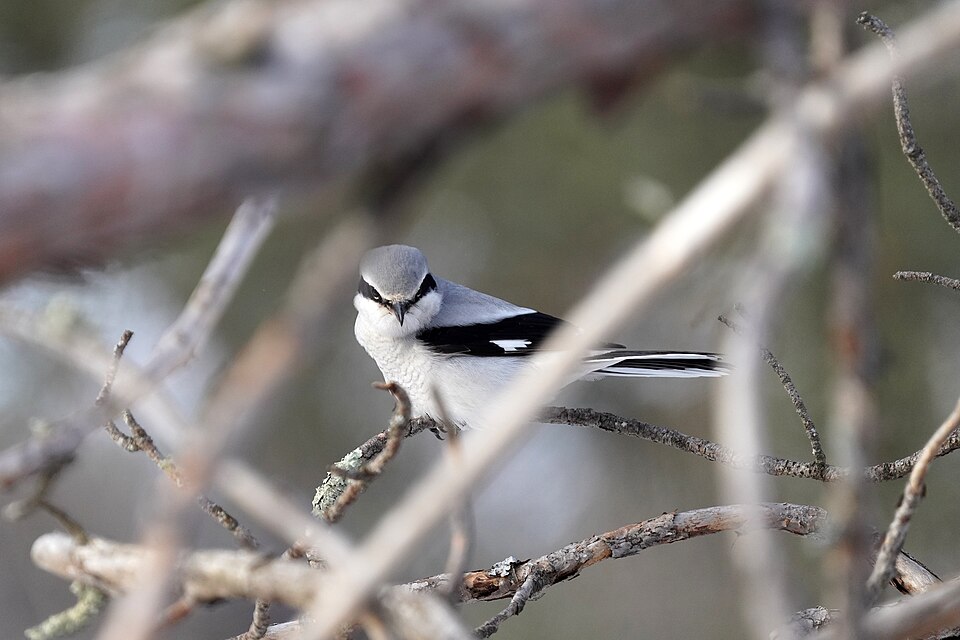
The Northern Shrike (Lanius borealis) is a large songbird in the shrike family (Laniidae) native to North America and Siberia. It is distinguished from the similar Loggerhead Shrike by its larger size, lighter grey plumage, smaller black face mask, and longer bill with a more prominent hook. Classified as a distinct species in 2017, it is currently listed as Least Concern by the IUCN Red List.
Learn to identify
Adult Northern Shrike in North America, photographed in Missouri in January.
Learning lesson · openly licensed photographs, labelled by BirdBot; labels checked against the cited sources and approved by AI

Pale gray above: crown and back paler than a Loggerhead's. Black mask: narrows in front of the eye. Hooked bill: a heavy bill with a hooked tip. Loggerhead Shrike is smaller, with a bigger mask and a shorter bill.
First-winter birds are tinged brown, with a narrow dusky mask and barred chest.
Sources: Audubon Guide to North American Birds: Northern Shrike · Wikipedia: Northern shrike (revision 1322344985)
Photo: Chrissy McClarren and Andy Reago, CC0, via Wikimedia Commons; labels added by BirdBot.
The Northern Shrike is a robust bird, historically described as being about the size of a robin, with a length of approximately 9.5 to 10.5 inches. Males display slate-gray upper parts, while the underparts are light gray, often tinged with brownish and marked with faint waving lines of darker gray. A defining feature is the black band that runs from the bill, through the eye, to the side of the throat. In flight, the black wing quills and tail are edged and tipped with white, creating a conspicuous pattern, along with a white spot on the center of the outer wing feathers.
Females are similar to males but possess a more obscure eye-band and a more distinct brownish cast to their plumage.
Because the Northern Shrike and Loggerhead Shrike (Lanius ludovicianus) can overlap in range and share similar hunting behaviors, accurate identification is critical. The Loggerhead Shrike is smaller, with darker grey plumage and a larger black face mask that covers the eye completely. It also has a shorter bill with a less prominent hook. Their calls are similar, making visual cues the primary method of differentiation in the field. Key field marks to look for include the extent of the black mask (complete eye coverage in Loggerheads vs. a band in Northern Shrikes) and the relative bill length and hook prominence.
The Northern Shrike breeds in taiga and tundra habitats across a vast range, from Labrador west through Alaska (including some Aleutian Islands) to western Siberia. Its breeding range extends south to extreme northwestern China, northern Mongolia, and James Bay. The species prefers forest edge habitats wherever suitable trees or shrubs are present. The northern limit of its breeding range is often defined by the presence of 1-2 meter high shrubby willows.
During the non-breeding season, Northern Shrikes are irruptive. While some individuals remain year-round in the breeding range, most move south depending on winter severity, food supply, and competition. In North America, they have been recorded as far south as New Mexico, Kansas, Illinois, Ohio, Pennsylvania, and New Jersey. In Asia, they winter as far south as northeastern China and Japan. On wintering grounds, they prefer open country, including forest edges, prairies, agricultural land, savannas, and coastal marshes.
Northern Shrikes are predatory songbirds that employ a "perch and pounce" hunting strategy. They often sit on tall poles, branches, or other elevated perches to survey the area for food. Their diet is diverse, including arthropods (such as spiders, beetles, bugs, and grasshoppers), small mammals (like shrews, mice, and voles), reptiles (such as spiny lizards), and passerine birds (including horned larks, chickadees, starlings, sparrows, and juncos).
A notable behavior is the impaling of prey on thorns or the barbs of wire fences. Northern Shrikes have also been observed hunting finches and house sparrows at bird feeders and are known to lure small birds by imitating their calls.
Northern Shrikes nest in white spruce, black spruce, felt-leaf willow, mountain alders, and poplars. The nests are described as rude, bulky structures of twigs and weeds, often placed in thorny trees or hedges. Clutches typically consist of four to six eggs, which are grayish white with spots of light brown and darker gray.
The Northern Shrike is currently classified as Least Concern (LC) on the IUCN Red List, as recorded in the AviList v2026 checklist. This status indicates that the species is not currently facing a high risk of extinction in the wild. However, observations in areas like Idaho suggest that suitable wintering territories may be in demand, as individuals that die in a particular area are quickly replaced by others.
When observing Northern Shrikes, it is important to maintain a respectful distance to avoid disturbing their hunting or nesting activities. Use binoculars or a spotting scope to observe the bird's behavior from afar. Pay attention to the bird's perch and the surrounding environment, as the presence of impaled prey can be a strong indicator of the species. If you observe a shrike at a bird feeder, note the specific prey items and the bird's vocalizations, which can help confirm the identification.
Next Action: Scan high, commanding perches—such as lightning rods, weather vanes, or telegraph wires—for a shrike surveying the area. Look for the distinct white-edged black tail in flight as a primary field mark, and listen for mimicry calls, as Northern Shrikes are known to imitate the calls of small birds to lure them into range.


