
The Northern Saw-whet Owl (Aegolius acadicus) is the smallest owl in eastern North America. This nocturnal, solitary hunter relies on acute hearing to locate small mammals from low perches. Classified as Least Concern (LC) in AviList v2026, the species breeds in tree cavities and migrates south in autumn, often appearing in rural and suburban woodlands during winter. See the identification section below for detailed field marks.
Learn to identify
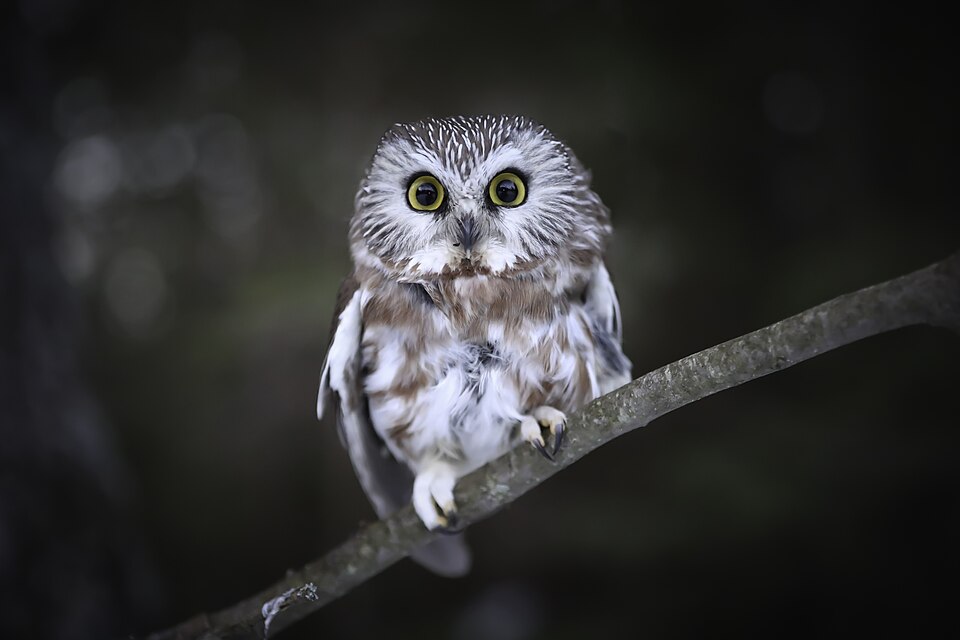
Adult Northern Saw-whet Owl roosting in a cedar, Downsview Park, Toronto.
Learning lesson · openly licensed photographs, labelled by BirdBot; labels checked against the cited sources and approved by AI

Round head, no ear tufts: finely streaked with white. Yellow eyes, dark bill: in a pale face with brown and cream streaks. White-spotted upperparts: brown or reddish above, spotted white. Reddish streaks below: warm brown streaks on a white chest. Robin-sized owl: streaked chest, no tufts.
Juveniles are chocolate brown with a tawny belly.
Sources: Audubon Guide to North American Birds: Northern Saw-whet Owl · Wikipedia: Northern saw-whet owl (revision 1357853052)
Photo: Mykola Swarnyk, CC BY-SA 4.0, via Wikimedia Commons; labels added by BirdBot.
At approximately 75 grams, a male Northern Saw-whet Owl weighs about as much as an American Robin, while females are slightly larger at around 100 grams. Body lengths range from 18 to 20 cm for males and 20 to 21.5 cm for females, with an adult wingspan of 45 to 60 cm. The bird’s compact shape and lack of ear tufts distinguish it from larger owls like the Great Horned Owl.
Adults display a wide, reddish-brown body with white streaks on the abdomen and a large, grayish facial disk centered on a reddish-brown head. The neck is speckled with white, and the tail features three distinct bars. This plumage provides effective camouflage against tree bark and dense vegetation, allowing the owl to remain hidden while roosting during the day. Juveniles differ significantly, appearing chocolate-brown with large white spots above the bill that extend over the eyes.
Two subspecies are recognized. The nominate subspecies, Aegolius acadicus acadicus, is found throughout most of the range with white underparts. The Queen Charlotte Island subspecies, Aegolius acadicus brooksi, is restricted to British Columbia and features buff-colored underparts instead of white. Aside from this geographic variation, plumage is relatively consistent across the species.
Northern Saw-whet Owls inhabit woodlands of all types, with a preference for coniferous forests, though they are also common in deciduous and mixed forests. Their primary habitat requirements are perches for hunting and dense vegetation for roosting. During migration and winter, they occupy a wide variety of habitats across various altitudes and latitudes, frequently appearing in rural or even suburban environments.
According to AviList v2026, the breeding range extends from southern Alaska eastward across Canada to Nova Scotia, southward in the western U.S. to southern California, and in the Rocky Mountains to southern Arizona, southern New Mexico, and adjacent Texas. In Mexico, the range extends southward in the Sierra Madre Occidental to the volcanic belt in northern Michoacan and in the Sierra Madre Oriental to southern Coahuila, adjacent Nuevo León, and San Luis Potosí, reaching southeastward to northern Oaxaca. In the northeastern U.S., the range reaches into northern Illinois, Indiana, Ohio, Pennsylvania, and New Jersey, extending south in the Appalachian Mountains to eastern Tennessee. During winter, the species moves to lower elevations across most of the United States.
These owls are strictly nocturnal and solitary, roosting silently in thick vegetation during the day. They are active from about 30 minutes after sunset to 30 minutes before sunrise. Hunting is conducted from low perches, where the owl detects prey using both sight and sound. Their asymmetrical skull structure allows them to locate prey by hearing alone, a critical adaptation for hunting in dense forest understories.
When prey is located, the owl drops from the perch to capture it with its talons. Prey is typically torn apart and eaten in pieces, though larger items may be stored on a branch for later consumption. Home ranges are relatively small; radio-tracking studies of two males indicated territories of approximately 1.42 and 1.59 square kilometers.
The diet consists primarily of small mammals, particularly deer mice, voles, and shrews. Other common prey includes pocket mice, harvest mice, and jumping mice. Juveniles of larger mammals, such as chipmunks and squirrels, are occasionally taken. Insects like beetles and grasshoppers, as well as small birds, are also part of the diet, with small birds being more common during migration when they are active at night.
Northern Saw-whet Owls breed between March and July. Males establish territories and advertise for mates by calling in late winter and early spring. Pairs are typically monogamous, though polygyny can occur when prey is abundant. The female selects the nest site, which is usually a natural cavity or an abandoned woodpecker hole, often made by Northern Flickers or Hairy Woodpeckers, located 2 to 12 meters high.
The female lays 4 to 7 eggs (usually 5 or 6) at two-day intervals and incubates them for 26 to 28 days. The male provides food and defends the territory during this period. Chicks are altricial, with eyes closed for the first 7 to 10 days. The female broods and feeds the chicks until they are about 18 days old, after which the male takes over feeding duties. Chicks fledge at 4 to 5 weeks but continue to be fed by the male for at least a month. Juveniles reach sexual maturity and may begin breeding at one year old.
The Northern Saw-whet Owl is listed as Least Concern (LC) on the IUCN Red List, as recorded in AviList v2026. The species is not protected under the U.S. Endangered Species Act.
Because Northern Saw-whet Owls are small, cryptic, and roost silently in thick vegetation, listening is the most effective detection method. In late winter and early spring, listen for male territorial calls in quiet, wooded areas to locate breeding sites. During the day, look for subtle movement or eye glints in dense vegetation rather than relying on visual identification of plumage details, which are often obscured by camouflage. Maintain a significant distance to avoid disturbing the bird, and avoid using playback calls, which can cause stress and displace the owl from its territory.


