
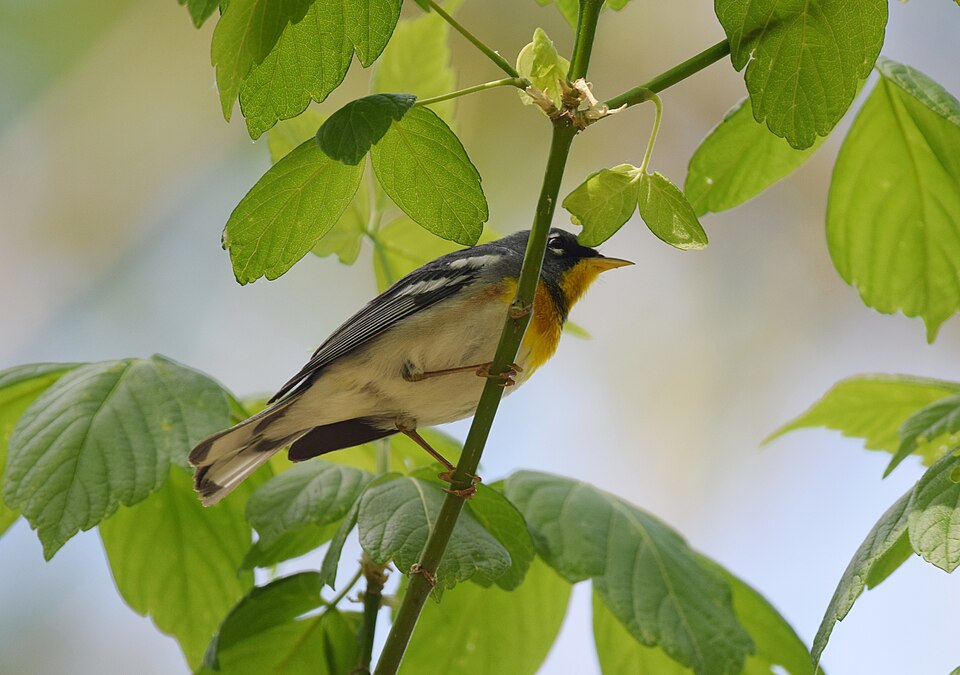
The Northern Parula (Setophaga americana) is a small, blue-gray wood-warbler with a green mantle, yellow throat, and white wing-bars. It is best identified by its stationary perching in the upper canopy and its distinctive ascending, buzzy trill that ends abruptly. Males display black and rufous breastbands during the breeding season, while females are duller. This species breeds in moist coniferous forests and bottomlands with hanging moss, constructing pendulum nests in epiphytes like Spanish moss.
Learn to identify
Northern Parula in female-type plumage (no breast bands), from a Commons photo by Rhododendrites.
Learning lesson · openly licensed photographs, labelled by BirdBot; labels checked against the cited sources and approved by AI

Greenish back patch: in the centre of the blue-gray upperparts. White eye crescents: broken arcs above and below the eye. Yellow throat and breast: shading into a white belly. Two white wing bars: bold on the blue-gray wing. Blue-gray, yellow throat, white wing bars, eye crescents.
Adult males add black and rusty chest bands.
Sources: Audubon Guide to North American Birds: Northern Parula · Wikipedia: Northern parula (revision 1381615420)
Photo: Rhododendrites, CC BY-SA 4.0, via Wikimedia Commons; labels added by BirdBot.
At 11.4 cm in length and 8.6 g in weight, the Northern Parula is a compact bird with a streamlined body. During the breeding season, both sexes share a blue-gray upper body with a distinct green, triangular mantle. The wings and tail are a darker blue-gray, marked by a pair of bold white wing-bars. The throat and breast are bright yellow, blending into a two-toned bill with a black upper mandible and a yellow lower mandible. The belly and undertail coverts are unmarked white.
Sexual dimorphism is most evident in the male's face and breast. Breeding males feature white eye-arcs surrounding a black eye stripe that connects to the bill base. They also display prominent black and rufous breastbands, often called "necklaces." Females are similar but overall duller, lacking the sharp facial contrast. After the breeding season, both sexes molt into duller plumage; the male's breastband fades, and it may disappear entirely in females.
Juveniles resemble wintering adults but are more greenish-gray above with shorter wing-bars. They lack any breastband, and their yellow throat and breast are less extensive than those of adults.
The primary call of the Northern Parula is an ascending, buzzy trill that abruptly ends with a short note of lower tone, often described as "trills up, falls over." This call is used by males to attract or interact with females. A second call, a buzzy, rapid string of short phrases, is used in territorial disputes. Only males sing full songs, which serve to establish and defend territory as well as attract mates. Both sexes produce short chip notes to maintain contact with mates or young.
The Northern Parula is a Neotropical migrant that breeds in the eastern half of North America, from southern Canada to the southern United States, and overwinters in Central America. Its habitat preferences vary by region and season. Northern populations breed in mature, moist coniferous forests, often in spruce bogs or hemlock swamps where suspended clumps of moss or coniferous twigs are abundant. Southern populations prefer mature, moist bottomland forests where Spanish moss is prevalent. Abundance is positively correlated with tree species diversity, canopy height, and percent canopy cover.
Outside the breeding season, the species becomes a habitat generalist, utilizing pastures, moist or dry forests, and agricultural fields during migration and winter.
Unlike many small woodland birds that are constantly flitting, the Northern Parula is relatively stationary, often perching for extended periods in the upper canopy. It is a territorial species during the breeding season, with males defending territories ranging from 0.16 to 0.40 hectares. Territory size tends to increase with the presence of American beech or larger stand sizes. Males defend their territories using a combination of calls and physical displays, including spreading wings, holding the body horizontally, and swiping bills against perches. If these displays fail, the male may launch an aggressive aerial attack.
Foraging occurs primarily in the mid- to upper canopy. The bird is insectivorous, consuming caterpillars and spiders most frequently, along with other invertebrates like beetles, flies, and ants. It primarily uses a hover-glean method to capture prey from vegetation but may also make short flights to snatch prey in mid-air or hang upside-down to forage. In winter, the diet shifts to include more beetles and occasionally berries, seeds, and nectar.
The Northern Parula is generally monogamous, though a few cases of polygamy have been reported. Males arrive on breeding grounds first to establish and defend territories. After pair formation, the female selects a nest site within the male's territory, preferring locations near water sources, often at the end of branches suspended over water.
The female constructs a pendulum-shaped nest in hanging epiphytes such as Spanish moss. She hollows out a clump of vegetation and fills the cavity with fibers, animal hair, grass, or pine needles. These nests average 7 cm in outside diameter. The female lays an average of 4 to 5 white or cream-colored eggs speckled with brown. Incubation lasts 12 to 14 days, and the female is the sole incubator. The male occasionally feeds the female during brooding. After hatching, the female performs most brooding and feeding, while both parents remove fecal sacs to maintain nest hygiene. Young fledge at 10 to 11 days old.
The Northern Parula is listed as Least Concern (LC) by the IUCN Red List, as recorded in AviList v2026. According to the Animal Diversity Web account, the species has historically been extirpated from several regions where it previously bred. In states such as Massachusetts, New Jersey, Connecticut, New York, Rhode Island, and Vermont, increased air pollution has led to the loss of many epiphytes that the species prefers for nesting. Clearcutting and bog draining have also reduced preferred breeding habitats. Sustainable forestry practices and reduced air pollutants are recommended to maintain habitat quality.
To locate a Northern Parula, scan the upper canopy for a stationary, blue-gray bird with a green mantle. Listen for the distinctive "trills up, falls over" call, which can be heard from a distance. In the breeding season, look for the male's black and rufous breastbands. In non-breeding areas, focus on the white wing-bars and yellow throat. Ethical observation involves maintaining a respectful distance to avoid disturbing nesting birds, especially in sensitive habitats like bogs and swamps.


