
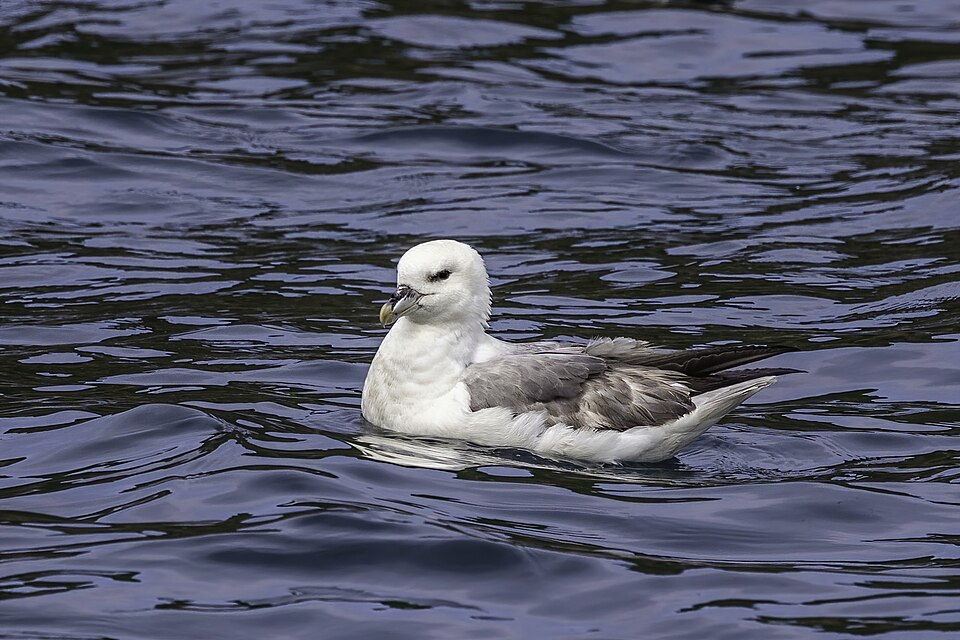
The Northern Fulmar (Fulmarus glacialis) is a medium-sized seabird in the order Procellariiformes and family Procellariidae. It is distinguished from similar shearwaters by its thick, rounded head and stubby, hooked bill. Fulmars exhibit four plumage morphs ranging from very light to very dark, with light morphs showing white underparts and gray backs. They breed on rocky cliffs near water and forage over continental shelves, rarely straying more than 100 km from shore.
Learn to identify
Light-morph Northern Fulmar on the water, photographed off Skomer Island, Wales.
Learning lesson · openly licensed photographs, labelled by BirdBot; labels checked against the cited sources and approved by AI

A stocky, big-headed seabird, not a gull. Big head, thick neck: looks bull-necked next to a gull. Stubby, thick bill: short and heavy, yellowish in tone. Grey back and wings: light birds are grey above. White head and underparts: the gull-like pattern of light birds. Gull-like colours, but a stubby bill and big head. Colour varies widely: dark and intermediate birds also occur.
Colour varies widely: dark and intermediate birds also occur.
Sources: Audubon Guide to North American Birds: Northern Fulmar · Wikipedia: Northern fulmar (revision 1369028503)
Photo: Charles J. Sharp, CC BY-SA 4.0, via Wikimedia Commons; labels added by BirdBot.
The most reliable field mark for separating a Northern Fulmar from shearwaters like the Pink-footed or Flesh-footed Shearwater is the head and bill. Fulmars have a thick, rounded head and a stubby, strongly hooked bill, whereas shearwaters typically have more slender bills and less bulky heads. The bill is yellow to gray, with darker areas over the nostril tubes, and the legs and feet are flesh-colored to gray.
Plumage variation in Northern Fulmars is continuous but is traditionally divided into four morphs for convenience: very light, light, dark, and very dark. Light morphs are uniformly pale, with white heads, necks, and ventral surfaces, and gray backs and wings. Dark morphs are uniformly dark gray. A key diagnostic feature across nearly all morphs is a light to white patch on the dorsal surface of the wings, formed by the exposed lighter portion of the primaries; this patch is only absent in the darkest individuals.
Geographic variation exists in bill shape and morph frequency. Atlantic populations tend to have robust bills and are almost exclusively light morphs, while Pacific populations have more slender bills and exhibit the full range of color variation. Dark morphs are more common in the southern portions of the Atlantic range and the northern portions of the Pacific range. Immature individuals cannot be reliably distinguished from adults by plumage alone.
Northern Fulmars are found in ocean waters over continental shelves, from the pack ice of Arctic waters to temperate regions. They prefer shelf-break habitats, where the continental shelf begins to descend toward the sea floor, or areas over the continental slope. They are rarely seen more than 100 km from shore.
According to AviList v2026, the species breeds on islands and coasts of the North Atlantic, bays between the Arctic and North Atlantic, and the North Pacific, including the Sea of Okhotsk to Hokkaido (northern Japan) and the Bering Sea. Non-breeding ranges extend to the coasts of the northwestern Pacific southward to central Japan, the northeastern Pacific southward to Baja California (northwestern Mexico), the western Atlantic southward to North Carolina, and the eastern Atlantic southward to France.
Breeding sites are typically rocky cliffs and islands up to 1 km inland, but usually close to the water or coastal. They have occasionally been reported nesting on human structures, such as houses in coastal areas. For observers, the peak window for viewing active colonies is late spring through early summer, when birds are present on ledges for courtship, incubation, and chick-rearing. Sea cliffs with accessible viewpoints or offshore islands accessible by boat offer the best opportunities to observe these dense aggregations.
Northern Fulmars fly in a manner typical of the Procellariidae family, with stiff wingbeats and gliding. They tend to fly close to the water and use upwellings of air to support aerial maneuvers near cliff colonies. One account from the Animal Diversity Web calculates an average air speed of 13 m/s (47 km/h), though this specific metric is derived from a single attributed source. On the water, they are buoyant and spend a fair amount of time preening. They bathe with enthusiasm, sometimes becoming completely soaked and unable to fly for some time afterward.
During the breeding season, individuals defend small nesting areas, about 1 m around the nest, and may use visual displays such as raising wings, rushing at other birds, or pushing their breasts against intruders. They also use oil-spitting to defend their nesting sites.
Northern Fulmars eat fish, squid, and large zooplankton, including amphipods such as Thysanoessa, Hyperia, Gammarus, and Themisto species. They are opportunistic feeders and also take discarded fish and carrion, such as whale, walrus, and seal blubber. They prefer fish with high fat content and drink seawater. Prey is captured mainly at the surface, though they will occasionally dive.
They often accompany fishing fleets, forming large aggregations to take advantage of fish waste. Northern Fulmars are one of the few bird species with a well-developed sense of smell and are thought to use olfaction to detect prey. They tend to forage at marine upwellings that cause temporary concentrations of large zooplankton, including areas near ice sheets or upwelling associated with feeding gray whales or trawling operations. During the breeding season, foraging trips last 4 to 5 days and may take them up to 460 km from the colony, although most foraging occurs within 100 km.
Northern Fulmars are monogamous and rejoin their mates each year at the same nest site. Breeding begins in April, with eggs laid in late May to early June in large colonies on ledges and among rocks. Nests are simple scrapes, sometimes lined with bits of vegetation. From 80 to 99% of nests are re-used by at least one member of the original pair each year.
Females lay a single white egg, and incubation lasts 47 to 53 days. Both parents incubate, with males often taking longer shifts at the beginning to allow the female to recover. Young hatch with a light covering of down and are closely tended for 10 to 16 days. Parents feed the chick by regurgitation in response to its food-begging call. Chicks fledge at 49 to 58 days old, about 4 to 5 days after the parents have stopped feeding them, at 115 to 119% of adult body mass. Sexual maturity is not reached until 5 to 20 years old, averaging 8 years in males and 12 years in females.
Northern Fulmar vocalizations are described as "cackling" or "braying" at various speeds. These sounds are used during courtship, at approaches to nesting colonies, and in aggression against intruders. They also make grunts, mewing, and spitting calls, which warn a threat that the bird is about to spit stomach oil, a defensive mechanism. Hatchlings use a specific food-begging call that stimulates parents to regurgitate.
The Northern Fulmar is listed as Least Concern (LC) in AviList v2026. The species has a large range and large population sizes. Populations in the northern Atlantic have increased and expanded their range over the last two centuries, possibly due to greater food availability from fish discards from commercial fishing operations. While they were once heavily exploited at colonies for food, they are not generally taken for food currently. Potential threats include coastal pollution near breeding colonies and mortality associated with entanglement in fishing gear.
When observing Northern Fulmars, maintain a significant distance. Colonies emit a strong, musky odor that can be detected from afar, serving as a useful indicator of proximity to active nesting sites. Visually, look for birds displaying aggressive posturing, such as raising their wings, rushing at intruders, or pushing their breasts against other birds. These visual cues, combined with the distinct smell, are helpful field indicators. If you observe these defensive behaviors, back away immediately to avoid triggering oil-spitting and to reduce stress on the colony. Observing from a distance respects the birds' space and ensures a safer, more ethical viewing experience.


