
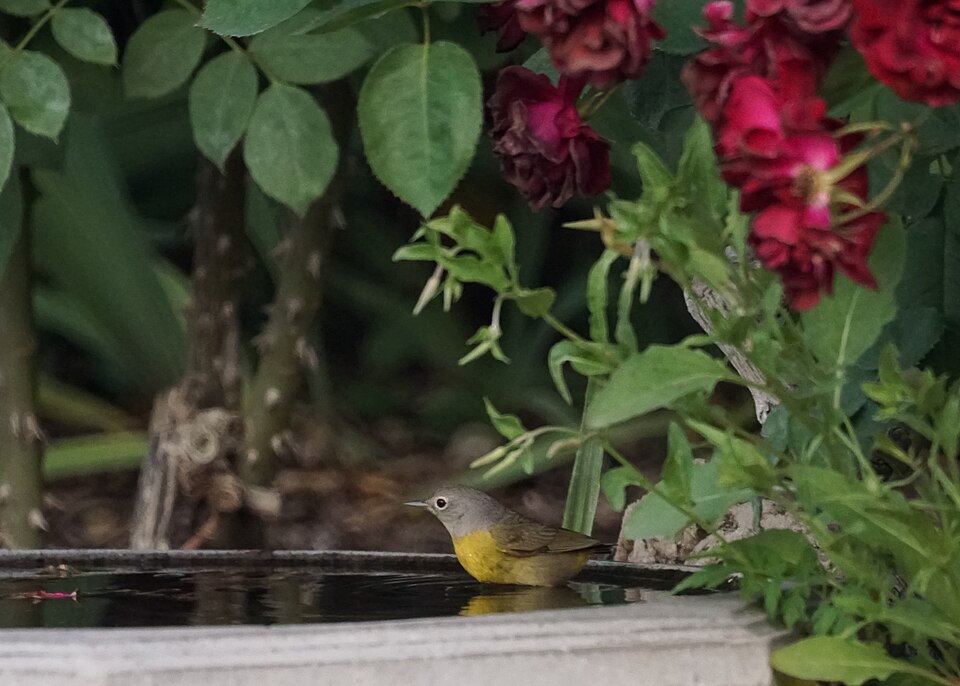
Imagine standing in a quiet spruce-cedar bog in early May. The air is still, and from a bare snag at the forest edge, a rapid, bell-like song cuts through the silence: seewit-seewit-seewit-ti-ti-ti. You are hearing the Nashville Warbler (Leiothlypis ruficapilla), a small New World warbler that is often heard before it is seen. This species is distinguished by a complete white eye ring, a gray head, an olive-green back, and yellow underparts, with no wing bars. Males display a rusty crown patch that is often concealed by gray feathers.
Learn to identify
Adult Nashville Warbler of North America, photographed on a sassafras branch in autumn.
Learning lesson · openly licensed photographs, labelled by BirdBot; labels checked against the cited sources and approved by AI

Gray head: contrasts with the yellow throat. White eye ring: a complete pale ring around the eye. Yellow throat: yellow throat and breast. Olive back and wings: greenish olive above. Connecticut and MacGillivray's warblers also have gray heads but lack a yellow throat.
Females and young are duller, with an olive-gray head.
Sources: Audubon Guide to North American Birds: Nashville Warbler · Wikipedia: Nashville warbler (revision 1380697680)
Photo: Steve Maslowski, U.S. Fish and Wildlife Service, Public domain, via Wikimedia Commons; labels added by BirdBot.
Nashville Warblers are compact birds, measuring approximately 12 cm in length and weighing around 10 g on average. Their plumage is deceptively simple, which can make them challenging to distinguish from similar species like the Tennessee Warbler or Connecticut Warbler at a distance. However, several key field marks provide reliable identification cues.
The Nashville Warbler is closely related to Virginia's Warbler, Lucy's Warbler, and the Colima Warbler, the four sharing generally similar plumage. Unlike the Tennessee Warbler, the Nashville Warbler has a complete white eye ring and no wing bars, a distinction that is critical for accurate identification in the field.
Adult males are the most vibrant, with a clear gray head and bold yellow underparts. Females are duller, with a more olive-gray head and less intense yellow on the throat. Juveniles resemble females but have a duller overall appearance, with brown or gray heads and pinkish bills that darken with age.
The Nashville Warbler breeds in two distinct regions: the northeastern United States and southern Canada, and the northwestern United States. Despite its name, the species only visits Nashville, Tennessee, during migration. It winters in southern California, southernmost Texas, Mexico, and the northern parts of Central America.
In the breeding range, these warblers prefer open mixed woods, bogs, and second-growth forests. Specific habitat preferences vary by region:
During the non-breeding season, Nashville Warblers occupy a wider variety of habitats, including deciduous trees, shrubs, open mixed forests, urban parks, and gardens. In the Caribbean, they are found in coastal areas and dry forests.
Nashville Warblers are active, diurnal foragers. They typically glean insects from the lower parts of trees and shrubs, frequently flicking their tails while doing so. This tail-flicking behavior is a useful field cue for locating the bird in dense foliage.
During the breeding season, males are territorial and defend their nesting areas. In contrast, during migration and the wintering season, they join loose flocks, often forming mixed-species feeding flocks with other warblers and small songbirds. These flocks can include up to 20 species and groups of up to 100 individuals.
The song of the Nashville Warbler is one of its most reliable identification tools. Males sing from open perches, often at the tops of bare trees.
During spring migration, males often sing only the first half of their song, which is slower and less complex. The song is similar to that of the Tennessee Warbler, but the Nashville Warbler's notes are generally more bell-like and rapid.
Nashville Warblers are monogamous within a breeding season. The breeding season usually begins between April and May. The female builds the nest alone, typically on the ground, concealed under shrubs or on mossy ledges. The nest is a compact cup made of bark strips, leaves, moss, and rootlets, lined with fine materials like feathers or hairs.
Nashville Warblers are primarily insectivorous. Their diet consists mainly of lepidopterans (butterflies and moths), flies, grasshoppers, and spiders. They capture prey by gleaning from leaves and branches or by hovering briefly in the air. During the breeding season and winter, they supplement their diet with nectar, berries, and vegetation, such as tubular blossoms and native plums.
The Nashville Warbler is listed as Least Concern (LC) on the IUCN Red List, as recorded in AviList v2026. While the species is not currently threatened globally, it faces local pressures. In the western United States, habitat modification and tree harvesting can impact populations. In the northeast, declines have been noted, and collisions with windows and communications towers are documented threats, particularly for juveniles. The species is adaptable to second-growth forests and urban gardens, which may buffer against some habitat losses.
To observe Nashville Warblers ethically, focus on their preferred habitats during the appropriate seasons. In spring, listen for the rapid bell-like song from open perches in mixed woods or bogs. Watch for the distinctive tail flicks while foraging in the lower canopy. Because nests are on the ground, keeping dogs leashed and staying on trails is critical in bog habitats to avoid disturbing the female or destroying the nest. If you hear a song but cannot see the bird, remain quiet and patient; the bird may move to a more visible perch.


