
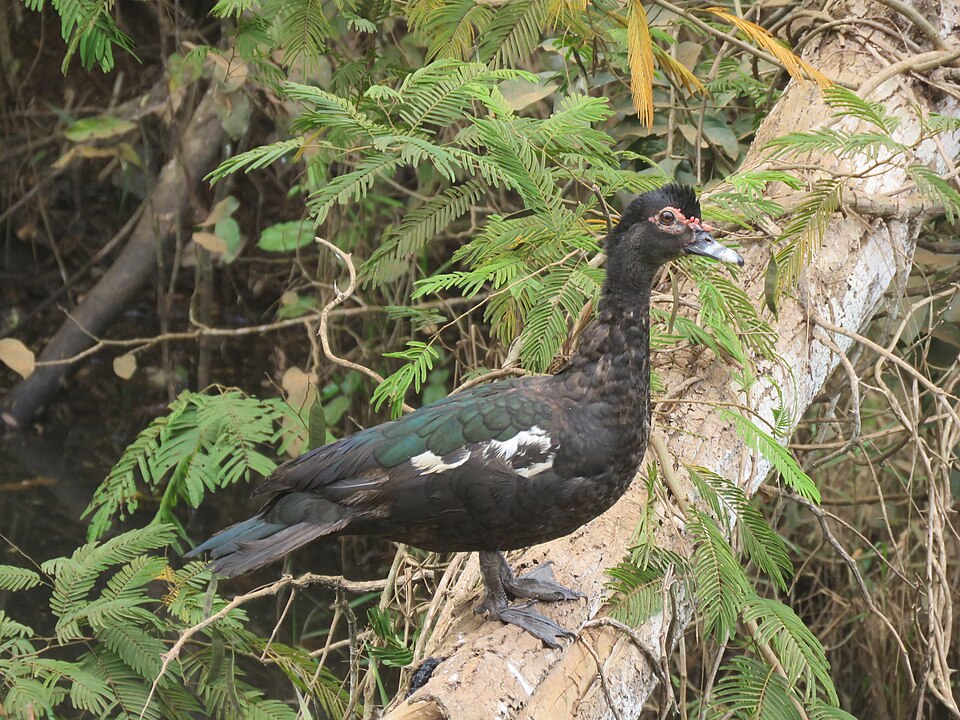
The Muscovy Duck (Cairina moschata) is a large, non-migratory waterfowl distinguished by red fleshy facial protuberances, iridescent green and purple plumage, and a preference for roosting in trees. Native to lowland wetlands in the Americas, it is currently listed as Least Concern. See the Identification and Field Marks section for detailed visual cues.
Learn to identify
Wild adult Muscovy Duck standing on a fallen trunk in the Bolivian Amazon.
Learning lesson · openly licensed photographs, labelled by BirdBot; labels checked against the cited sources and approved by AI

Short bushy crest: raised feathers on the crown and nape. Bare red face: males show bare skin and a knob; females are feathered. Glossy green wing: iridescent in males, drabber in females. White wing patch: large; most obvious in flight. Wild birds are mostly black; white patch on the wing.
Domestic Muscovies are bulkier and often show much white.
Sources: Audubon Guide to North American Birds: Muscovy Duck · Wikipedia: Muscovy duck (revision 1383027036)
Photo: Vincent Vos Bolivia, CC BY 3.0, via Wikimedia Commons; labels added by BirdBot.
Muscovy Ducks are among the largest ducks, with an average weight of 4.3 kilograms and a wingspan ranging from 137 to 154 centimeters. Males are generally larger than females and display more pronounced red, fleshy protuberances (caruncles) on the face. The plumage of wild birds is primarily brownish-black, with iridescent green and purple tones on the back and distinct white patches on the wings. These visual cues are critical for distinguishing them from other large dabbling ducks, particularly in low light or at a distance.
According to AviList v2026, the native range of the Muscovy Duck extends from northern Mexico southward, west of the Andes to southwestern Ecuador, and east of the Andes to northeastern Argentina and Brazil. They prefer forest areas near water, utilizing the canopy for safety. Unlike many other ducks that stay close to the water's edge, Muscovy Ducks are comfortable in terrestrial environments, often foraging on land and roosting in trees at night to avoid ground predators.
Muscovy Ducks are social and diurnal, maintaining a hierarchy where dominant males establish territories. These males use visual displays, such as raising their crests and wagging their tails, to dominate other males and attract females. The species has been described as having a lek mating system, where a few dominant males mate with most females, while unsuccessful males form bachelor groups. This social structure is a key behavioral trait that sets them apart from many other Anatidae.
As omnivores, Muscovy Ducks dabble and graze with their bills, consuming a diverse diet that includes the roots, stems, leaves, and seeds of aquatic and terrestrial plants. They also feed on small fish, reptiles, crustaceans, insects, millipedes, and termites. This broad dietary range allows them to thrive in various habitats, from dense wetlands to suburban parks where they may forage on lawns and gardens.
Unlike most ducks that nest on the ground, Muscovy Ducks nest in tree cavities, typically 3 to 18 meters high. Females build nests using twigs, stems, and mud. The breeding season generally runs from the beginning of August to May, depending on the region. Females lay an average of 8 to 10 eggs, incubating them for 33 to 35 days. After hatching, the female protects and teaches the ducklings for 60 to 70 days until they are independent. Males take about 29 weeks to reach sexual maturity.
Muscovy Ducks communicate through hisses directed at threats and quacks as contact calls. These sounds are often accompanied by visual cues, such as head movements and tail wagging, which are essential for understanding their social interactions in the field.
The Muscovy Duck is classified as Least Concern (LC) in the IUCN Red List as recorded in AviList v2026. While wild populations in some areas may face pressures from habitat loss, the species is common in its native range. Domesticated and feral populations are widespread globally, contributing to the species' overall stability.
When observing Muscovy Ducks in the wild, maintain a respectful distance to avoid disturbing their nesting or roosting sites. Look for males raising their crests or wagging their tails during dominance displays near water. Since they often roost in trees, scanning the canopy at dusk can be an effective way to spot them. Always prioritize the bird's welfare and adhere to local wildlife observation guidelines.
Ready to spot a Muscovy Duck? Focus your search on forested wetlands and riverbanks where trees provide roosting sites. During the day, look for the distinctive red facial caruncles and iridescent plumage as they forage on land or in shallow water. At dusk, scan the tree canopy for roosting flocks, listening for their characteristic hisses and quacks. For more on identifying similar species, see our guides on the Wood Duck and the Ruddy Duck.


