
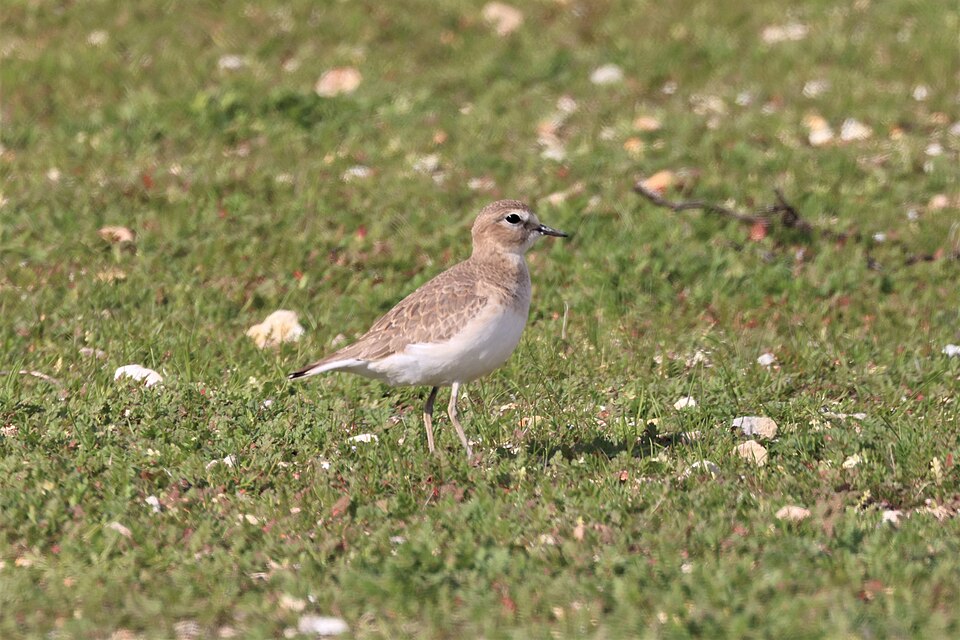
The Mountain Plover (Anarhynchus montanus) is a medium-sized, ground-dwelling plover that inhabits dry, level plains with short grass and bare ground, rather than mountainous terrain. It is identified by sandy-brown upperparts, whitish underparts, a black forecrown, and eye stripes, and it lacks the breast band found in most other plovers. Classified as Near Threatened, this species relies on open habitats maintained by grazing animals like bison and prairie dogs for nesting and foraging.
Learn to identify
Adult Mountain Plover with summer head marks, photographed on the plains near Briggsdale, Colorado.
Learning lesson · openly licensed photographs, labelled by BirdBot; labels checked against the cited sources and approved by AI

Black head marks: black forecrown and a black line from eye to bill. No breast band: lacks the dark chest bands of most plovers. Sandy brown upperparts: pale and plain, without bold markings. Golden-plovers and Black-bellied Plover are less plain above, with darker legs.
In winter the head marks fade and the eye line can look brown.
Sources: Audubon Guide to North American Birds: Mountain Plover · Wikipedia: Mountain plover (revision 1385908078)
Photo: Ron Knight from Seaford, East Sussex, United Kingdom, CC BY 2.0, via Wikimedia Commons; labels added by BirdBot.
Despite its name, the Mountain Plover is a bird of the plains, not the mountains. It is a medium-sized shorebird, measuring 8 to 9.5 inches (20 to 24 cm) in length and weighing approximately 100 grams. Its wingspan ranges from 17.5 to 19.5 inches (44 to 50 cm). Both sexes are similar in size and plumage.
The plumage is plain and cryptic, designed to blend into the dry, sandy soil of its habitat. The upperparts are sandy brown, while the underparts and face are whitish. A key field mark is the black feathers on the forecrown and a black stripe extending from each eye to the bill. In winter, this eye stripe may become brown and indistinct. Unlike most plovers in the genus Charadrius, the Mountain Plover lacks a band across the breast.
The most common confusion species is the Killdeer. While both are ground-dwelling plovers found in open habitats, the Mountain Plover is significantly quieter and lacks the breast band characteristic of the Killdeer. The Mountain Plover's plumage is also more uniformly sandy-brown, whereas the Killdeer has a more contrasting pattern.
The Mountain Plover prefers dry, level land with short grass and bare ground. It avoids wet soil and is rarely found near bodies of water, a distinct departure from many other shorebirds. The short vegetation is often the result of grazing by livestock, bison, or prairie dogs.
According to AviList v2026, the species breeds locally on the Great Plains of southwestern Canada to northeastern Utah and western Texas. Its winter range extends to inland central California, southern Arizona, southern Texas, and northern Baja California. Approximately 85 percent of the population winters in the San Joaquin and Imperial Valleys in California.
Mountain Plovers are primarily insectivorous, feeding on insects and small arthropods. They often associate with grazing livestock, such as cattle or bison, which stir up insects in the short grass, making them easier to catch. This behavior is a useful field cue: spotting a plover running alongside a herd of grazing animals in a dry, open field is a strong indicator of a Mountain Plover.
Historical field notes from the early 20th century describe the species as "very fleet on foot," often seen chasing grasshoppers or other active insects. When flushed, their flight is described as rapid, often devious, and usually at a low elevation, a behavior that helps them remain inconspicuous in their open habitat.
The species is migratory. After breeding, they leave their high-plains territories in late July for a period of wandering in the southern Great Plains. By early November, most move southward and westward to their wintering grounds. Spring migration is reportedly direct and non-stop.
Mountain Plovers nest on bare ground in early spring, typically in April in northern Colorado. They select breeding territories that share space with grazers like bison and black-tailed prairie dogs. These animals keep the vegetation short and expose bare soil through foraging and burrowing, creating ideal nest sites.
The nest is a simple depression in the ground, often lined with sparse vegetation. The eggs are cryptically colored to blend with the soil. The choice of bare soil is believed to provide camouflage from aerial predators and allow the birds to detect ground predators more easily. Nest survival rates vary widely, from 26 to 65 percent, influenced by climate, precipitation, and predation pressure.
The Mountain Plover is listed as Near Threatened (NT) in the IUCN Red List, as recorded in AviList v2026. This status reflects concerns over habitat loss due to cultivation, urbanization, and changes in grazing practices. The species requires large, contiguous areas of short-grass prairie, which are increasingly fragmented by human development. In 2009, the U.S. Fish and Wildlife Service proposed listing the species as threatened under the Endangered Species Act, highlighting the severity of its population decline.
Observing Mountain Plovers requires patience and an understanding of their cryptic nature. Look for dry, short-grass plains, particularly those with grazing livestock or prairie dog colonies. Scan the ground for the distinctive black forecrown against the sandy soil; because the rest of the plumage is plain and sandy-brown, the bird can be nearly invisible until it moves or flushes.
Listen for a single, low, musical whistle, which is often the first sign of the bird's presence. Because they are quiet and well-camouflaged, they may be difficult to spot until they flush. When observed, maintain a distance to avoid disturbing nesting birds or stressing the animals. Do not approach nests or attempt to flush birds for a better view. If you are using a camera, ensure it is set to a mode that does not require close proximity, and respect any local regulations regarding wildlife observation.


