
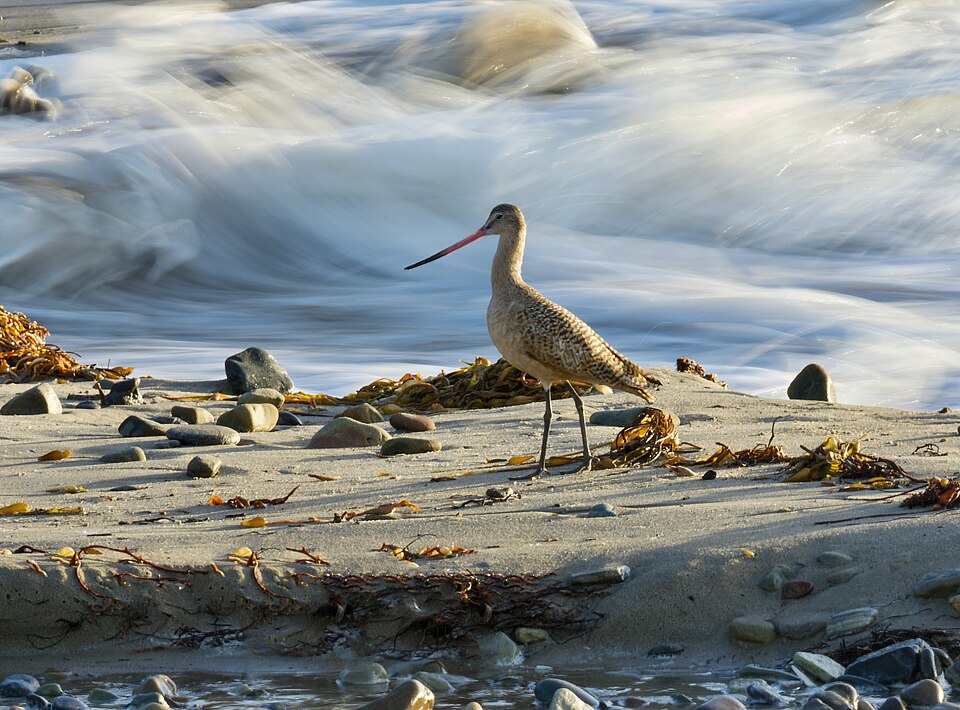
The Marbled Godwit (Limosa fedoa) is a large, tawny shorebird in the family Scolopacidae, distinguished by its long, slightly upturned pink bill and distinctive cinnamon-mottled underwings. It breeds in open grasslands and wetlands of the northern prairies and tundra, and winters in coastal marshes and mudflats across North America. The species is recorded as Vulnerable in the AviList v2026 dataset.
Learn to identify
Adult Marbled Godwit in breeding plumage, photographed in Grand Forks County, North Dakota, in June.
Learning lesson · openly licensed photographs, labelled by BirdBot; labels checked against the cited sources and approved by AI

Long upturned bill: pink at the base, dark at the tip. Barred underparts: warm brown with dark bars, heavier in summer. Mottled dark back: even warm brown overall, marbled above. Long grey legs: blue-grey and long. In flight, look for bright cinnamon in the wings.
Long-billed Curlew has a similar pattern but a different bill shape.
Sources: Audubon Guide to North American Birds: Marbled Godwit · Wikipedia: Marbled godwit (revision 1380694803)
Photo: ALAN SCHMIERER from southeast AZ, USA, CC0, via Wikimedia Commons; labels added by BirdBot.
Marbled Godwits are among the largest shorebirds in North America, ranging from 42 to 48 cm in length with a wingspan of 74 to 78 cm and a weight of 285 to 454 g. Their plumage is tawny buff, appearing darker on the upperparts than the underparts. The most reliable field mark is the underwing: in flight, the wings show a mottled brown pattern with bright cinnamon patches, which distinguishes them from the similar Bar-tailed Godwit (Limosa lapponica). Bar-tailed Godwits are slightly smaller, have shorter legs, and lack the bright cinnamon underwing coloration.
The bill is long, slightly upturned, and bright pink to orange. Legs are gray or blue-gray. During the breeding season, the breast and belly show dark barring, while in winter the underparts are plain. Females are larger than males.
Marbled Godwits are the most widespread godwit species. They breed in grasslands or wetlands in the northern prairies of the United States and Canada, particularly in areas lacking dense or tall vegetation. Breeding habitats include temporary ponds, pastures, hay fields, wet tundra, open taiga, lowland meadows, bogs, and coastal marshes. According to AviList v2026, the breeding range is disjunct, covering the central Alaska Peninsula, south-central Canada to north-central USA, and the west James Bay area.
During migration and winter, they occupy wetlands, marshes, shallow ponds, coastal estuaries, mudflats, salt marshes, and sandy beaches. The wintering range extends along the coasts of the United States from Washington to central Panama and from New Jersey to the Yucatan Peninsula.
Marbled Godwits are terrestrial birds capable of rapid walking and running. Their flight is strong, swift, and direct. They spend most of their daily time budget foraging, often in social flocks with other shorebirds such as Whimbrels (Numenius phaeopus) and Long-billed Curlews (Numenius americanus). They probe the mud with their sensitive bills, often inserting the entire bill into the substrate, sometimes submerging their heads completely to locate prey.
Their diet varies by season and location. In winter or on the coast, primary foods include annelid worms, small bivalves, crabs, and earthworms. In summer or while inland, they feed on insects such as grasshoppers, aquatic plant tubers, leeches, and small fish.
Marbled Godwits are monogamous and arrive at breeding grounds in April or May in more southern populations. Males perform a high, circling flight display followed by a steep dive to attract females. The male selects a nest site in a dry spot with short grass and creates a shallow scrape, which the female approves. Both parents add grass, and sometimes a canopy of grass is arched over the nest.
Nests are shallow depressions lined with grasses, lichen, moss, or leaves. Females typically lay four eggs, which are pale buff or olive with dark brown or purplish-gray spots. Both parents incubate the eggs for 24 to 26 days. The young are precocial, covered in down, and can walk and feed shortly after hatching. Chicks leave the nest after 1 to 2 days and fledge in 26 to 30 days.
The Marbled Godwit is recorded as Vulnerable (VU) in the AviList v2026 dataset. This guide uses the AviList v2026 record as the primary reference for conservation status. The species is protected under the United States Migratory Bird Act.
To observe Marbled Godwits ethically, visit open wetlands or coastal mudflats during migration or winter. Maintain a distance to avoid disturbing foraging flocks. Watch for the distinctive cinnamon underwings during flight, which is the most reliable way to separate them from Bar-tailed Godwits. Listen for their nasal, slightly crowing call, described as "ah, ha" or "ahk," which is used for mate selection and predator interaction. A specific call is uttered when an individual enters a group, believed to decrease aggression from newcomers.


