
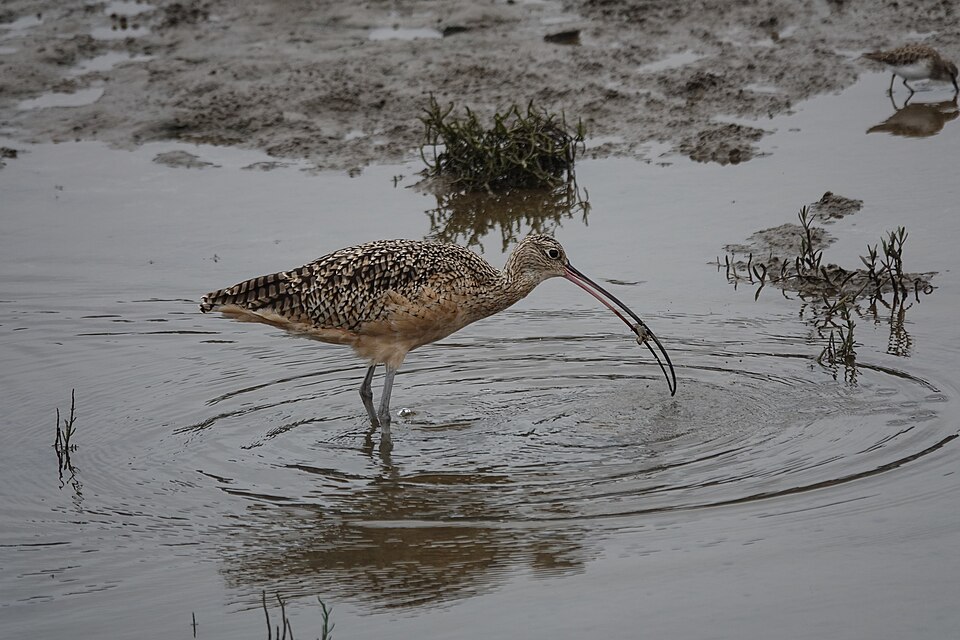
The Long-billed Curlew (Numenius americanus) is a large shorebird in the family Scolopacidae, distinguished by its exceptionally long, decurved bill and streaked crown. It breeds in shortgrass prairies and pastures with low vegetation, and winters in intertidal mudflats and coastal pastures. Its most recognizable field cue is a loud, two-note low-high whistle heard year-round, a sound Chester A. Reed (1916) memorably transcribed as "ker-loo."
Learn to identify
Long-billed Curlew standing on a Pacific coast beach.
Learning lesson · openly licensed photographs, labelled by BirdBot; labels checked against the cited sources and approved by AI

No bold head stripes: finely streaked crown, unlike Whimbrel. Very long curved bill: curves down; longest in females. Warm brown above: warmer brown than a Whimbrel. Cinnamon underparts: light cinnamon neck and belly. Huge curved bill, plain head: Long-billed Curlew.
Bill length varies; some birds' bills are not so extreme.
Sources: Audubon Guide to North American Birds: Long-billed Curlew · Wikipedia: Long-billed curlew (revision 1354935028)
Photo: Stilfehler, CC BY-SA 4.0, via Wikimedia Commons; labels added by BirdBot.
Long-billed Curlews are large shorebirds, with adults measuring 50 to 65 cm in length and weighing between 490 and 950 grams. Their wingspan ranges from 62 to 101 cm. The most diagnostic feature is the long, decurved bill, which is significantly longer in adults than in juveniles. Adult plumage is brown to buff with hints of darker browns and pinks. Dark brown streaks and bars cover the upper body, while the underwing coverts and axillaries are cinnamon-colored. A key distinguishing trait from other curlews is the streaked, rather than striped, crown.
Juveniles can be identified by their brighter coloration and shorter bills. Their wing coverts have dark brown centers, and they lack the dark brown barring and pale notches seen in adults. Females are slightly larger than males, though the difference is subtle in the field. In the field, their size is often striking; historical observer Chester A. Reed (1916) noted that when mixed with smaller plovers, their size appears "gigantic," and described their flight as compact and unison, often sailing up in the wind on outspread wings before alighting.
During the breeding season, Long-billed Curlews occupy inland grasslands, primarily shortgrass prairie, followed by pasture grasslands and cultivated cropland. They prefer wide-open areas with vegetation 4 to 15 cm tall, showing no significant preference between dry and irrigated land. In winter, they shift to coastal habitats, living primarily in intertidal areas and mudflats while foraging in nearby pastures.
According to AviList v2026, the species breeds in inland grasslands from southern British Columbia eastward to southwestern Saskatchewan and southward to northeastern California and northeastern New Mexico. Wintering grounds extend to coastal and inland California, the Gulf Coast, central Panama, and the western Yucatan Peninsula.
Long-billed Curlews are diurnal and territorial, spending most of their time foraging. They move between sites by flight and short glides. Non-breeding individuals are often solitary but form mixed-sex flocks during migration and at winter roosts. During the hottest parts of the day, they may leave their territories to forage in cooler areas, allowing neighbors to trespass temporarily.
Courtship is visually and acoustically striking. Males solicit mates with ground calls and vocal-bounding flights, often in perimeter or figure-8 patterns. When a female is present, males orient their flights around her. Unpaired females may wander through multiple territories over several days before choosing a mate, forming a monogamous pair bond.
The diet of Long-billed Curlews varies by habitat. Inland, they consume earthworms, spiders, grasshoppers, beetles, caterpillars, and wild fruits. In coastal areas, they prey on bivalves, marine worms, mollusks, crustaceans, and some fish. They forage by pecking food from the ground or water and probing loose mud and sand with their long bills. They may also exhibit insect hawking behaviors. Foraging occurs almost exclusively during the day, with little seasonal change in diet within their respective ranges.
Long-billed Curlews nest on the ground, creating a shallow bowl by scraping the earth and lining it with locally available materials like grass, leaves, stems, and twigs. Both sexes incubate the eggs, typically with the female sitting during the day and the male taking over in the evening. The incubation period averages 27 days. Chicks are precocial and hunt for themselves, though both parents initially watch over them. After two to three weeks, the female typically abandons the brood, leaving the male to care for the chicks until they fledge and become independent.
The Long-billed Curlew produces a distinctive two-note whistle year-round, characterized by a low-high pitch. This call serves as both a contact call and an anxiety tone. During the breeding season, additional alarm calls are observed between incubation and fledgling stages. Territorial disputes are resolved through displays, including flying directly at intruders before pulling up steeply, or crouch runs followed by aerial chases.
The call is often described as a flute-like whistle. In his 1916 field guide, Chester A. Reed transcribed the sound as "ker-loo," a description that remains a useful mnemonic for birders listening for the species in open habitats.
The Long-billed Curlew is listed as Least Concern (LC) in the IUCN Red List, as recorded in the AviList v2026 checklist. This global assessment is distinct from regional conservation evaluations. The U.S. Shorebird Conservation Plan categorizes the species as "highly imperiled" due to threatened habitat and persisting population declines. The primary threats are the loss of shortgrass prairie breeding grounds and coastal mudflats, driven by urban growth and wetland drainage. While protected under the U.S. Migratory Bird Act, illegal hunting remains a concern for adult mortality.
To observe Long-billed Curlews ethically, maintain a significant distance, especially during the breeding season when they are on the ground. Listen for the two-note whistle in open grasslands or mudflats while watching for probing foraging behavior. Avoid disturbing nesting sites, as the nests are shallow and camouflaged. If you observe a bird displaying at a predator, do not approach, as this may increase stress for the parent and chicks.


