
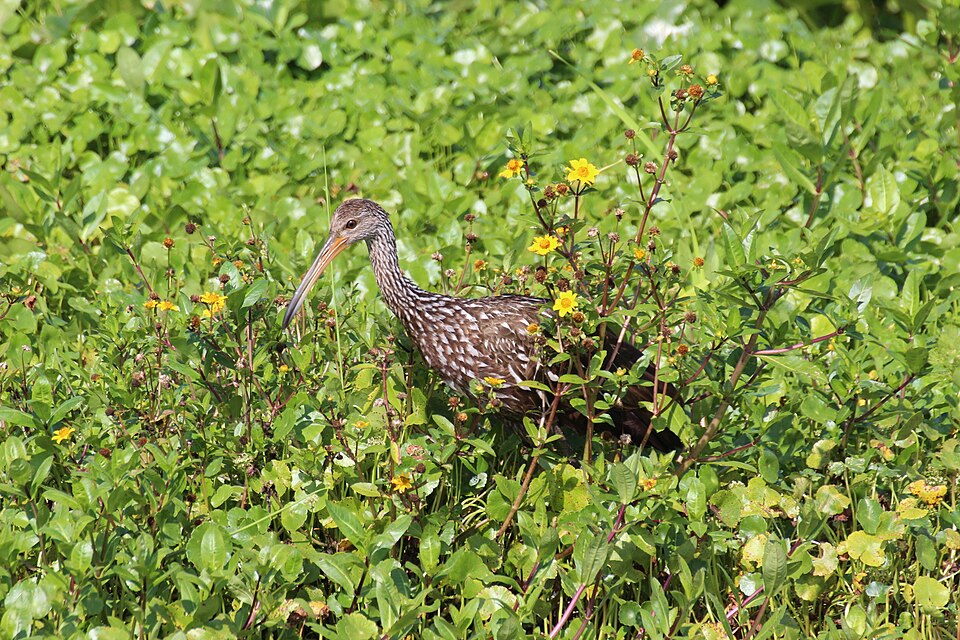
The Limpkin (Aramus guarauna) is a large wading bird related to rails and cranes, and the only extant species in the family Aramidae. It is a drab brown bird with a heavy, downcurved bill and a distinctive limping gait, best identified by its loud, wild wailing call, which is often heard at dawn, dusk, or night near freshwater marshes.
Learn to identify
Adult Limpkin, photographed in Florida.
Learning lesson · openly licensed photographs, labelled by BirdBot; labels checked against the cited sources and approved by AI

Long, downcurved bill: paler at the base, darker toward the tip. White-streaked neck: sharp white streaks on the long brown neck. Deep brown body: mostly dark brown, marked with white on the back. Long legs: long, dark gray legs. Easier to hear than see: listen for a loud, wailing scream.
Sexes look alike; first-year birds show slightly less white.
Sources: Audubon Guide to North American Birds: Limpkin · Wikipedia: Limpkin (revision 1387263119)
Photo: Judy Gallagher, CC BY 2.0, via Wikimedia Commons; labels added by BirdBot.
The Limpkin is a moderately large bird, measuring 64–73 cm (25–29 in) in length with a wingspan of 101–107 cm (40–42 in). Its plumage is drab dark brown with an olive luster above, marked with white streaks on the head, neck, wing coverts, and underparts. This streaking makes the head and neck appear light gray. The bird has long, dark-gray legs and a long neck. Its bill is long, heavy, and downcurved, yellowish with a darker tip. A key field mark is the slight gap near the tip of the bill, which gives it a tweezers-like action for extracting snails from their shells. In many individuals, the bill tip curves slightly to the right, mirroring the spiral of apple snail shells. First-year birds have slightly less conspicuous white markings. The Limpkin is often confused with the immature American White Ibis, but the Limpkin's streaked plumage and heavy, curved bill distinguish it from the ibis.
The Limpkin is often easier to hear than to see. Its common vocalization is a loud, wild wail or scream with a rattling quality, often represented as "kwEEEeeer" or "klAAAar." This call is most frequently given at night and at dawn and dusk. Other calls include a "wooden clicking" sound, clucks, and a piercing "bihk, bihk..." in alarm. Listening for these distinctive sounds in wetland habitats is one of the most reliable ways to locate the bird.
The Limpkin occurs from peninsular Florida and the Okefenokee Swamp in southern Georgia, through southern Mexico, the Caribbean, and Central America, to northern Argentina. In South America, it is found widely east of the Andes, with its range extending west of the Andes only to the Equator. It inhabits freshwater marshes, swamps, and ponds, often with tall reeds or mangroves. In the Caribbean, it also inhabits dry brushland. In Mexico and northern Central America, it occurs at altitudes up to 1,500 m (4,900 ft). In Florida, the distribution of apple snails is the best predictor of where Limpkins can be found. Reports of Limpkins across the United States have been increasing since 2014 and accelerating since 2022, including the establishment of new populations outside of Florida and southern Georgia. Individuals have been reported as far north as Wisconsin and Southern Ontario. The reasons for this expansion are unclear, although climate change is suggested as a likely cause. Birds may also migrate between Florida and Cuba, as several limpkins have been reported on the Florida Keys and Dry Tortugas, but these records may also represent vagrants or postbreeding dispersal.
Limpkins are active during the day but also forage at night. Where they are not persecuted, they are very tame and approachable, though they are usually found near cover. They are not aggressive for the most part and rarely fight with members of their own species. Limpkins forage primarily in shallow water and on floating vegetation such as water hyacinth and water lettuce. When wading, they seldom go deeper than having half the body underwater. They walk slowly with a gait described as "slightly undulating" and "giving the impression of lameness or limping," which gives the bird its common name. They search for snails visually and also probe in mud and among vegetation. They do not associate with other birds in mixed-species feeding flocks but may forage in small groups with others of their species. Because of their long toes, they can stand on floating water plants. They fly strongly, with the neck projecting forward and the legs backward, beating their wings shallowly and stiffly with a jerky upstroke. In the wild, Limpkins are reported to be attacked and eaten by American alligators.
The diet of the Limpkin is dominated by apple snails (Ampullariidae) of the genus Pomacea. The availability of this one mollusk has a significant effect on the local distribution of the Limpkin. Freshwater mussels, including Anodonta cowperiana, Villosa vibex, Elliptio strigosus, E. jayensis, and Uniomerus obesus, as well as other kinds of snails, are secondary food sources. Less important prey items include insects, frogs, lizards, crustaceans (such as crayfish), worms, and seeds. These prey items may be important in periods of drought or flooding when birds are pushed into less than optimal foraging areas. In one site in Florida, moon snails and mussels were the most important prey items. One study of stomach contents in Florida found 70% Pomacea apple snails, 3% Campeloma, and 27% unidentified mollusc, probably Pomacea. When a Limpkin finds an apple snail, it carries it to land or very shallow water and places it in mud, the opening facing up. It deftly removes the operculum or "lid" and extracts the snail, seldom breaking the shell. The extraction takes 10 to 20 seconds. The orange-yellow yolk gland of female snails is usually shaken loose and not eaten. Limpkins often leave piles of empty shells at favored spots.
Males have exclusive territories, which can vary in size from 0.15 to 4.0 ha (0.37 to 9.88 acres). In large, uniform swamps, nesting territories can often be clumped together in the form of large colonies. These are vigorously defended, with males flying to the territory edges to challenge intruders. Limpkins may be either monogamous or serially polyandrous. Nests may be built in a wide variety of places – on the ground, in dense floating vegetation, in bushes, or at any height in trees. They are bulky structures of rushes, sticks, or other materials. Nest building is undertaken by the male initially, which constructs the nest in his territory prior to pair-bond formation. Unpaired females visit a number of territories before settling on a male with which to breed. Males may initially challenge and fight off prospective mates, and may not accept first-year females as mates. Pair-bond formation may take a few weeks. Courtship feeding is part of the bonding process, where males catch and process a snail and then feed it to the female. The nest usually contains 4 to 8 eggs, olive to buff, and blotched with brown and gray in color. The young hatch covered with down, capable of walking, running, and swimming. They follow their parents to a platform of aquatic vegetation, where they are brooded. They are fed by both parents; they reach adult size at 7 weeks and leave their parents at about 16 weeks.
The Limpkin is listed as Least Concern (LC) in AviList v2026. Although not in danger worldwide, it was hunted to extinction in Florida during the early years of the 20th century. Legal protection has since helped Limpkin populations recover from the danger zone. In South America, it may move around somewhat with wet and dry seasons. It is a permanent resident in its limited United States range, though strays have very rarely wandered farther north. Two biting lice species, Laemobothrion cubense and Rallicola funebris, have been found on the species.
To find a Limpkin, listen for loud wailing calls at dawn or dusk near freshwater marshes, as the bird is often easier to hear than see. During the day, listen for a "wooden clicking" sound or look for the distinctive limping gait in shallow water. Look for piles of empty apple snail shells in shallow water or on mud, which indicate favored foraging spots. When observing, maintain a respectful distance to avoid disturbing the bird, especially during the breeding season. Limpkins are generally tame where not persecuted, but they may be sensitive to human disturbance near nesting sites. Avoid approaching nests or young birds, and do not feed the bird, as this can alter natural foraging behaviors and attract predators.


