
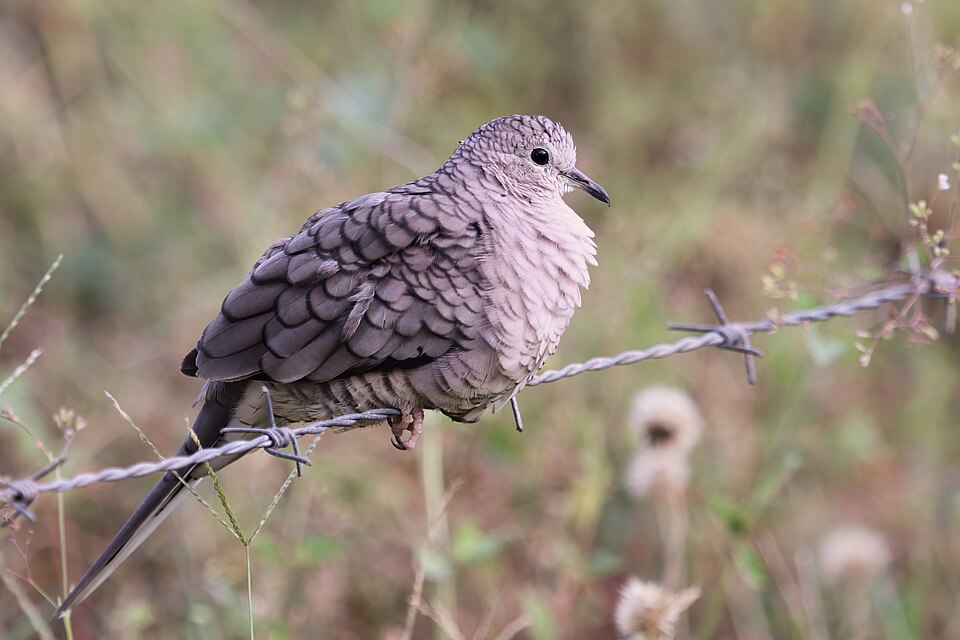
The Inca Dove (Columbina inca) is a small, terrestrial dove of arid and semiarid landscapes, from the southwestern United States to northwestern Costa Rica. It is a common sight in deserts, scrublands, and urban areas, where it forages on the ground and forms distinctive communal roosts in cold weather.
Learn to identify
Adult Inca Dove resting on pavement in Mexico City.
Learning lesson · openly licensed photographs, labelled by BirdBot; labels checked against the cited sources and approved by AI

Scaly head and neck: the dark scaling covers the whole bird. Grey-brown, scaled body: each feather edged dark. Long, square tail: edged white; the white flares in flight. In flight: rusty wing flash and white tail edges.
Common Ground Dove has a short tail; young Mourning Doves look scaly.
Sources: Audubon Guide to North American Birds: Inca Dove · Wikipedia: Inca dove (revision 1380685521)
Photo: Scott Loarie from San Francisco, USA, CC BY 2.0, via Wikimedia Commons; labels added by BirdBot.
The Inca Dove is a slender dove (16.5–23 cm) with a gray-brown body covered in feathers that create a distinct scaly pattern. The underparts are buffy, and the tail is long and rounded, edged with white feathers that may flare out in flight. In flight, the rusty red underwings are obvious, a key field mark that distinguishes it from similar species.
When perched, the bird’s slender body and long tail are evident. The beak is gray to black, and the legs and feet are pinkish gray. Adult birds have a dark red iris, while juveniles have a pale yellow iris. Males and females are very similar in appearance, as are adults and juveniles, except for the iris color.
The Inca Dove is very similar to the Ground Dove (Columbina passerina), but the Ground Dove lacks the overall scaly appearance and has a square tail. The Inca Dove’s tail is rounded, and its plumage has a distinct scaly pattern. In flight, the rusty red underwings of the Inca Dove are a reliable identifier, as the Ground Dove has less prominent underwing coloration.
The Inca Dove inhabits arid and semiarid residential areas, thornforests, savannas, deserts, scrublands, and cultivated lands, often near water sources. It is usually restricted to these habitats due to its low tolerance for cold. The species ranges from the semiarid southwestern United States to northwestern Costa Rica, and its range has been expanding northward and southward in recent decades.
In urban settings, Inca Doves take advantage of the ready availability of water from agricultural and suburban irrigation and feed on grass seeds. They are often common to abundant in suitable habitat and are well-adapted to living in close proximity to humans.
Inca Doves are social birds that forage on the ground, often in flocks. They spend their time foraging, roosting, and sunning. In cold weather, they form communal pyramid roosts, grouping together and standing on one another’s backs to conserve body heat. These pyramids can contain 10 or more birds and will periodically collapse and reform with different members on the interior.
Outside of their territories, Inca Doves often flock, with groups growing up to 100 birds strong. They can be social or territorial during feeding and display heavy defending of the territory during the breeding season.
Inca Doves eat seeds from grains, weeds, and grasses, often whisking their bills in the dirt to uncover the seeds. They forage almost entirely on the ground in short vegetation and are frequent guests at household bird feeders. They need to imbibe 9% of their body mass in water every day, which they accomplish by drinking from pools, dripping faucets, or by eating moist fruits on cacti or hydrants.
Inca Doves are year-round breeders and nest builders. The male brings nesting material to the nest and climbs on the back of the female to deliver it. The female then builds the nest, which is composed of twigs, grass, weed stalks, and leaves. The nest is often used over and over and is placed in a wide variety of trees, shrubs, or human structures such as houses and utility poles.
The Inca Dove emits a forceful cooing song, described as cowl-coo, POO-pup, or NO-hope, typically from an open, high perch such as a tree, wire, or television aerial. Upon takeoff, the wings produce a distinctive, quiet rattling noise, which can be a useful auditory cue for identification.
The Inca Dove is listed as Least Concern (LC) in AviList v2026. Its range is growing, primarily due to coexistence with humans, and it is not in danger of becoming extinct. The species is often common to abundant in suitable habitat and is well-adapted to urban and agricultural environments.
To observe Inca Doves, look for flocks foraging on the ground in short vegetation in arid or semiarid habitats, including deserts, scrublands, and urban areas. In cold weather, watch for communal pyramid roosts from a distance, as these birds can be sensitive to disturbance. You can also observe them at bird feeders or near water sources in suburban neighborhoods. Always maintain a respectful distance and avoid disturbing nesting sites or roosting groups.
Try observing a flock of Inca Doves foraging on the ground in a desert scrub or urban park. Note their scaly plumage, long rounded tail, and rusty underwings in flight. Listen for the forceful cooing song and the quiet rattling noise of their wings upon takeoff. In cold weather, look for communal pyramid roosts and observe how the birds shift positions to conserve body heat.


