
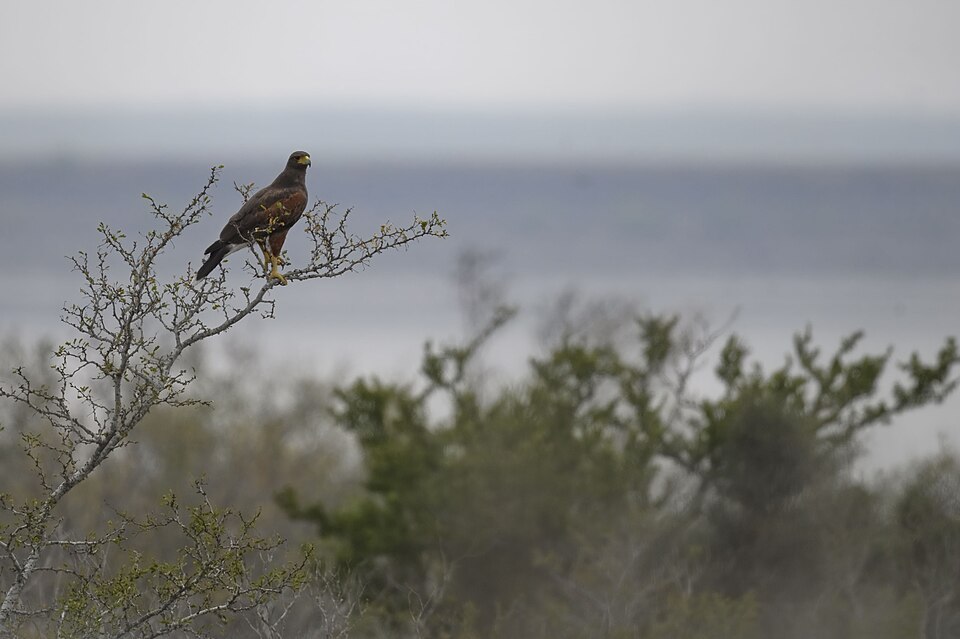
The Harris's Hawk (Parabuteo unicinctus) is a large, chocolate-brown raptor with reddish shoulders and distinct white bands on its tail. Unlike most solitary hawks, it lives in cooperative social groups that hunt together, flush prey from dense brush, and share food. It is recorded as Least Concern in the AviList v2026 checklist, though local populations face threats from habitat loss and human disturbance.
Learn to identify
Adult Harris's Hawk perched on a wire in Corpus Christi, Texas.
Learning lesson · openly licensed photographs, labelled by BirdBot; labels checked against the cited sources and approved by AI

Yellow cere: bright yellow skin at the base of the bill. Chestnut shoulders: rich rufous patch on the dark brown wing. White at tail base and tip: the rest of the tail is black. Chestnut thighs: rufous thighs above long yellow legs. Dark body, chestnut patches, white-ended black tail.
Juveniles are streaked below and have narrow tail bands.
Sources: Audubon Guide to North American Birds: Harris's Hawk · Wikipedia: Harris's hawk (revision 1380683580)
Photo: Terry Ross from Corpus Christi, Texas, United States, CC BY-SA 2.0, via Wikimedia Commons; labels added by BirdBot.
Harris's Hawks are large raptors with long tails and broad wings, ranging from 18 to 23 inches (46 to 76 cm) in length with wingspans of 40 to 47 inches (100 to 120 cm). Adults display a uniform chocolate-brown plumage with distinct reddish-brown shoulders, upper and underwing coverts, and leg feathers. The tail is dark with white upper and undertail coverts, a white base, and a white terminal band. This combination of dark brown body, reddish accents, and white tail markings is a key field mark.
Sexual dimorphism is evident in size: females are significantly heavier than males, averaging 1,047 grams compared to the male average of 735 grams. Juveniles resemble adults but are less distinctly colored, featuring a white belly with chocolate-brown streaking, pale tarsal feathers with reddish barring, and barring on the tail and wings.
Field Cues for Flight and Voice: In flight, Harris's Hawks are described as fast flyers. When hunting, they often land and take turns flushing prey from dense brush. Listen for hissing noises and alarm calls; the species likely supplements these vocalizations with visual communication signals during social interactions.
Harris's Hawks are non-migratory and diurnal, forming complex social groups that aid in nesting and hunting. Most groups are trios consisting of two males and a female, but groups of four or five are not uncommon. A strict dominance hierarchy exists: the breeding (alpha) female is dominant to all others, followed by the alpha male, a beta male, and subordinate gamma birds, which are often sexually immature offspring.
These groups hunt cooperatively, a strategy that allows them to take larger prey than solitary hawks. They flush prey from dense brush by taking turns to scare it out, with one member capturing the animal and assuming a posture known as mantling, where the hawk shields the prey with its wings to hide it from other birds. This cooperative behavior increases survival rates for individual birds by enabling access to larger food sources.
Territories range from 0.2 to 5.5 square kilometers, with size varying based on the availability of food and other resources.
Harris's Hawks occupy arid deserts, mesquite woodlands, and urban washes from 400 to 1,000 meters elevation, often near water sources. Their range extends from the arid southwestern United States to the Pacific slope of Colombia, Ecuador, and Peru, and to Brazil, southern Argentina, and southern Chile. In urban areas, they utilize washes, open lots, and open desert, showing adaptability to human-modified landscapes.
In the Colorado River valley, they inhabit upland desert dominated by saguaros as well as mesquite, palo verde, and ironwood woodlands. A population being reintroduced to the Colorado River prefers to nest near water in mesquite, willows, and cottonwoods.
Harris's Hawks build stick platforms in trees or towers, such as saguaros, palo verdes, mesquite trees, cottonwoods, ironwoods, palm trees, and electrical towers. Nests are typically located at an average height of 5 meters and are lined with soft mosses, grasses, and roots. The species practices cooperative breeding, with several birds helping with nest building, incubation, feeding, and defense, which increases nest success. Most often, social groups contain a single monogamous breeding pair. Females can lay two to three clutches per year, with an incubation period of about 35 days and fledging after another 40 days. Young birds often stay near the nest area for two to three months after fledging.
The diet of Harris's Hawks is versatile and varies with prey availability. They feed mostly on small mammals such as rats and mice, but also take birds and lizards. Group hunting enables them to take larger prey such as cottontails and jackrabbits. There is some evidence that these hawks may feed on carrion if food availability is low.
Harris's Hawks are recorded as Least Concern (LC) in the AviList v2026 checklist and are not listed as threatened or endangered. Local populations face threats from habitat loss and human disturbance. In the Colorado River valley, a population was thought to have been extirpated due to alterations in the riparian community from dam construction, dredging, and nest destruction. The species has been known to move into developed areas under some circumstances.
For the most current global assessment details, including extent of occurrence and specific threat classifications, refer to the BirdLife DataZone species factsheet.
To observe Harris's Hawks, focus on arid desert habitats, mesquite woodlands, and urban washes, particularly near water sources. As diurnal birds, they are active during daylight hours. Listen for hissing noises and alarm calls, which may be supplemented by visual communication signals during social interactions. Use binoculars or a telephoto lens to watch for the mantling posture, where a hawk shields its prey with its wings. Avoid approaching nests or active hunting groups to minimize disturbance, as these social birds are sensitive to human presence near their territories.


