
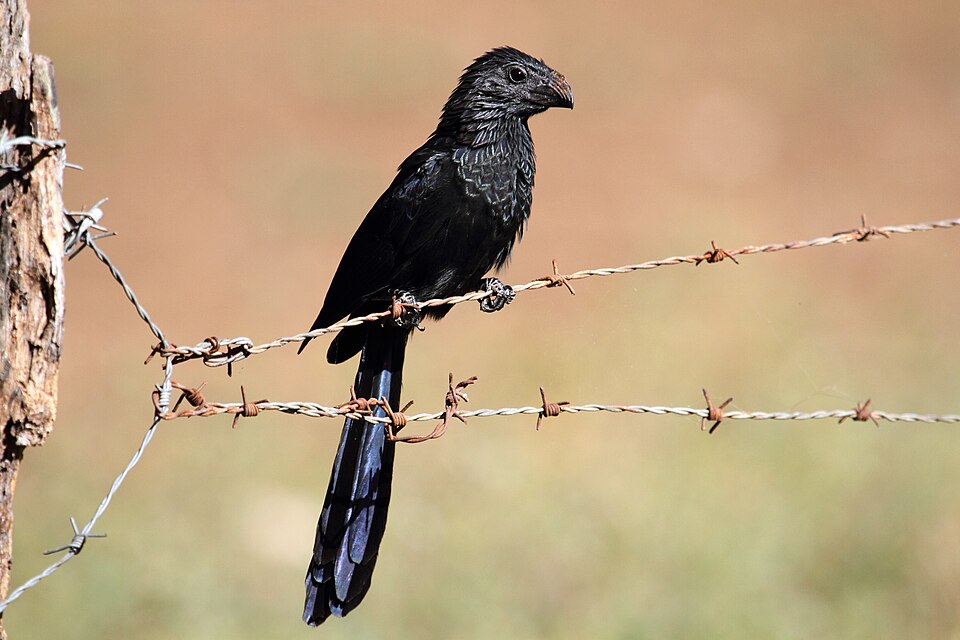
The Groove-billed Ani (Crotophaga sulcirostris) is a medium-sized, all-black member of the cuckoo family (Cuculidae) found in open, flat lands below 1,500 meters across the Americas. It is identified by its unique deep, grooved beak, leathery face, and cooperative breeding system where 3–4 pairs share a single nest and care for 15–20 eggs collectively.
Learn to identify
Groove-billed Ani perched in Santa Cruz County, Arizona.
Learning lesson · openly licensed photographs, labelled by BirdBot; labels checked against the cited sources and approved by AI

Huge grooved bill: high ridge; grooves along the upper bill. All-black plumage: completely black, with glossy reflections. Very long tail: almost as long as the body. Black bird, puffin-like bill: an ani.
Smooth-billed Ani is very similar; voice and range separate them.
Sources: Audubon Guide to North American Birds: Groove-billed Ani · Wikipedia: Groove-billed ani (revision 1329367332)
Photo: ALAN SCHMIERER, CC0, via Wikimedia Commons; labels added by BirdBot.
Adult Groove-billed Anis are medium-sized, all-black birds with a leathery, featherless face and gray-bordered, scalloped feathers around the neck. Their long, floppy tail and zygodactyl feet (two toes forward, two back) are consistent with other cuckoos. The beak is the definitive field mark: it is narrow but deeper than the skull, with a prominent downward curve on the upper mandible and distinct grooves running along its length. This unique, grooved structure is the primary feature distinguishing the species within its genus.
According to AviList v2026, the range extends from southern Baja California and southern Texas through Central and South America (including Curaçao and Trinidad) to northern Chile and northern Argentina. In the United States, the species is notably present in the Rio Grande Valley of Texas. The species prefers open habitats and flat lands, rarely occurring above 1,500 meters. They favor areas with dense ground vegetation and higher humidity, such as wetlands and tropical forests, for foraging and nesting, but are also found in drier grasslands and scrub forests.
One of the most remarkable aspects of the Groove-billed Ani is its cooperative breeding system. Breeding groups consist of 2 to 4 unrelated pairs of monogamous adults. They breed once a year, typically from early May to late September. All females in the group lay their eggs in a single colony nest, resulting in a total of 15 to 20 eggs per season. Chicks hatch around 13 days after being laid and begin fledging 8 to 10 days after hatching. They become independent from the colony group about 6 weeks after hatching. Sexual maturity is suggested to occur at around 2 years of age.
Parental care is shared by the entire group. Both males and females invest in caring for all the young, even if a specific pair did not breed that season. This cooperative investment is a key survival strategy for the species in its open habitats.
These birds are opportunistic omnivores, consuming seeds, grains, fruits, terrestrial insects, arthropods, and small vertebrates. They forage along the floor or in low-hanging branches and fences to ambush insects. A notable behavior is their commensal relationship with other species. They have been observed following giant anteaters (Myrmecophaga tridactyla) to consume insects disturbed by the anteater's movement. They also stay near domesticated cattle (Bos taurus) to eat ticks and other pests from their flanks.
Groove-billed Anis are social and diurnal. They live in groups of 3 to 4 breeding pairs, foraging together and protecting each other from predators. They defend a set territory year-round. In the morning, they have been witnessed basking on branches with their wings outstretched. Their calls consist of chirps and rattles used to communicate food locations, signal predators, and locate group members.
The Groove-billed Ani is listed as Least Concern (LC) in the IUCN Red List as recorded in AviList v2026. This status indicates that the species is not currently facing a high risk of extinction in the wild, though it is not a local abundance estimate. In the United States, the species is protected under the US Migratory Bird Act.
To observe Groove-billed Anis ethically, look for colonies in open habitats during the morning when they are active. Watch for groups foraging on the ground or basking on branches. Maintain a respectful distance to avoid disturbing their cooperative social dynamics or foraging activities. Listening for their distinctive chirps and rattles can help locate them before they are visible.


