
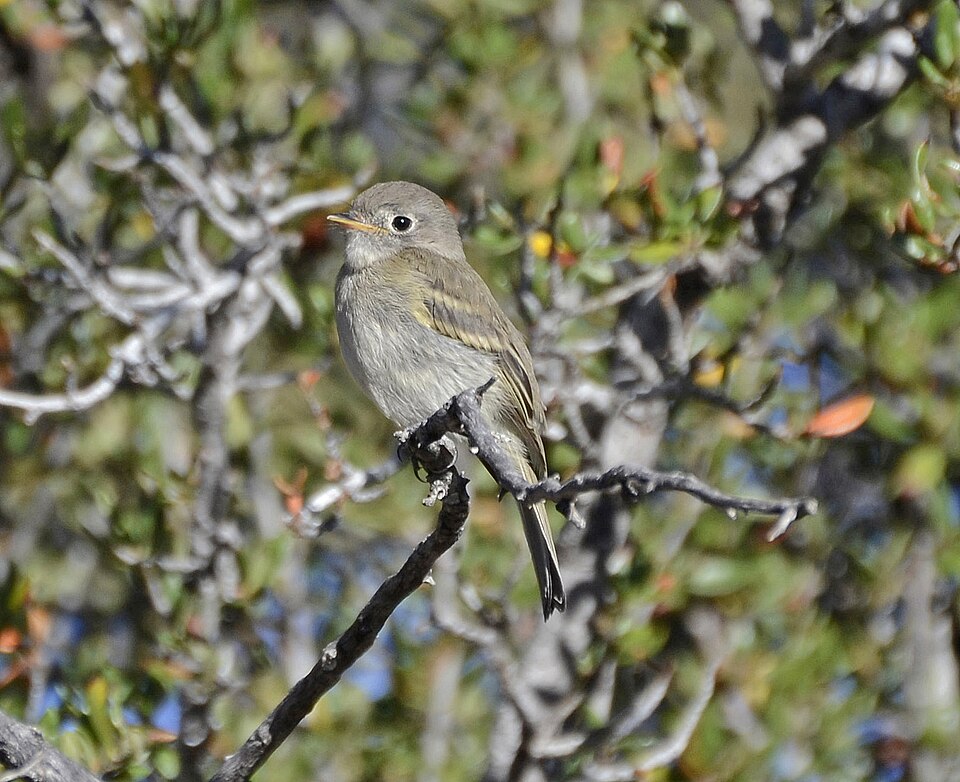
The American Dusky Flycatcher (Empidonax oberholseri) is a small, olive-gray insectivorous passerine in the tyrant flycatcher family. It is notoriously difficult to distinguish from other Empidonax species by appearance alone; the most reliable identification cues are its voice, breeding habitat, and range.
Learn to identify
American Dusky Flycatcher of western North America, photographed in July in its mountain breeding habitat in southern Nevada.
Learning lesson · openly licensed photographs, labelled by BirdBot; labels checked against the cited sources and approved by AI

White eye ring: a noticeable white ring around the eye. Olive-gray upperparts: drab olive-gray, darker on the wings. Pale wing bars: pale bars across the folded wing. Medium-length tail: longer than Hammond's, shorter than Gray's. Empidonax look alike; voice, breeding habitat and range help most.
Very like Hammond's and Gray Flycatchers; sight alone may not settle it.
Sources: Audubon Guide to North American Birds: Dusky Flycatcher · Wikipedia: American dusky flycatcher (revision 1321141025)
Photo: VJAnderson, CC BY-SA 4.0, via Wikimedia Commons; labels added by BirdBot.
Adults display olive-gray upperparts, darker on the wings and tail, with whitish underparts. The breast is washed with olive-gray. Key visual features include a noticeable medium-width white eye ring, white wing bars, and a medium-length tail. The bill is mainly dark.
Size comparisons can help narrow down the species: the Dusky Flycatcher is slightly smaller than the American Gray Flycatcher and slightly larger than Hammond's Flycatcher. However, because these species are so similar in appearance and behavior, visual ID is often insufficient. The best characteristics for distinguishing these species are voice, breeding habitat, and range.
For example, if you hear a dry whit call from a bird perched in a ponderosa pine on a mountain slope, the habitat and voice together strongly suggest a Dusky Flycatcher. In contrast, an American Gray Flycatcher in the same area would likely be found in a different habitat context, and its vocalizations, while similar, are distinct enough to separate the two when listened to carefully.
| Feature | Dusky Flycatcher | American Gray Flycatcher | Hammond's Flycatcher |
|---|---|---|---|
| Size | Medium | Slightly larger | Slightly smaller |
| Eye Ring | Medium-width white | Not specified in source | Not specified in source |
| Wing Bars | White | Not specified in source | Not specified in source |
| Primary ID Cue | Voice (dry whit, sad dew-hic) and habitat | Voice and habitat | Voice and habitat |

For Empidonax flycatchers, voice is the most critical field cue. The male sings a three-part song. The common call is a dry whit, which is similar to that of other Empidonax flycatchers. A less common call, possibly given only by the male, is a sad dew-hic. Listening for these specific vocalizations is the most effective way to confirm an identification in the field.
The Dusky Flycatcher breeds on mountain slopes and foothills with brush and scattered trees, especially ponderosa pine, across western North America. It migrates to southern Arizona and Mexico. As non-breeding residents in the south of its migration range, it is a passage migrant over the deserts of the southwestern United States, including the Mojave, Sonoran, and Chihuahuan Deserts, where it makes stops along the flyway.
Ecological research by Kroll (2004) at the University of Montana examined habitat selection and use by the Dusky Flycatcher at four different spatial scales. Kroll found that a habitat-based framework is tenable for species viability planning, but stressed that inferences must be made with reference to specific spatial scales, as differential effects may occur at different scales. This work highlights the importance of understanding how vegetation structure relates to territory size and density when assessing habitat quality for this species.

Watch for two distinct foraging actions: the bird often waits on an open perch and flies out to hawk insects in flight, or it hovers to glean insects directly from foliage. This combination of hawking and gleaning is typical for the species.
The Dusky Flycatcher constructs a cup nest low in a vertical fork within a shrub.
The American Dusky Flycatcher is listed as Least Concern (LC) in the AviList v2026 dataset. This status reflects its current global conservation assessment and does not indicate local abundance or population trends.
To observe Dusky Flycatchers ethically, target mountain slopes and foothills with brush and scattered ponderosa pines during the breeding season. Listen carefully for the dry whit call or the distinctive dew-hic. Avoid disturbing nesting shrubs and maintain a respectful distance.
A useful field exercise is to record the vocalizations of Empidonax species in areas where they overlap to refine your auditory identification skills, noting that not all species are syntopic in every location. When locating a bird, note its tendency to return to the same open perch after hawking; this behavior allows you to track the bird’s position without needing to approach or disturb it.


