
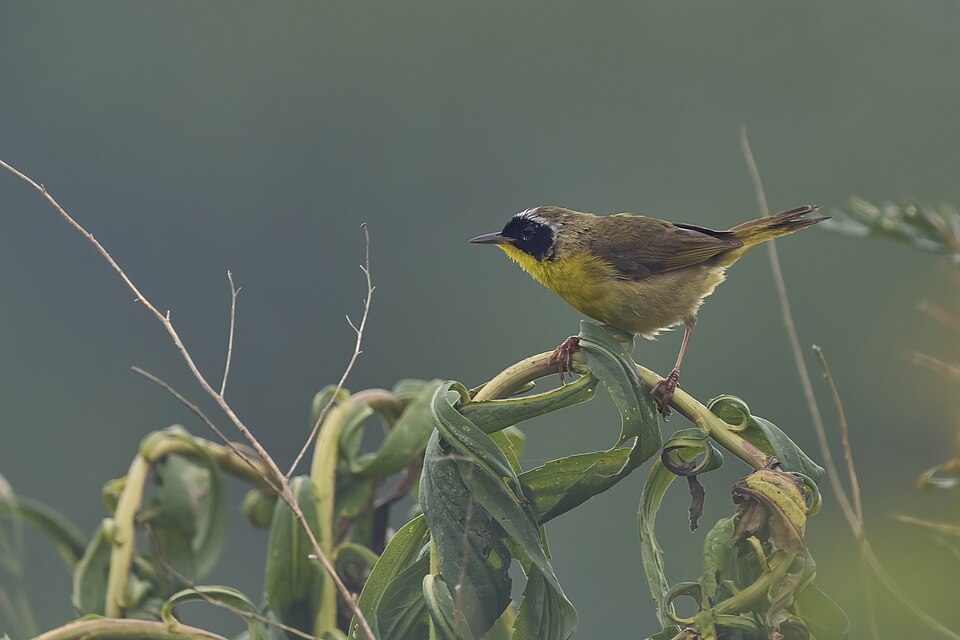
The Common Yellowthroat (Geothlypis trichas) is a bird you hear long before you see. Its signature "witchity, witchity, witchity" song often carries over damp brush and marshes, serving as the primary cue for birders. While the bird frequently sings from high in the air before diving into cover, visual identification is straightforward once located. Males display a striking black facial mask bordered by a blue-white band, a key field mark that distinguishes them from females, who lack the mask entirely. This small, wren-like warbler in the family Parulidae thrives in low, non-forested areas such as briers, weeds, and marshes, where it gleans insects and builds bulky nests low in shrubbery.
Learn to identify
Adult male Common Yellowthroat, photographed in Prospect Park, Brooklyn.
Learning lesson · openly licensed photographs, labelled by BirdBot; labels checked against the cited sources and approved by AI

Pale border: white or grey stripe above the mask. Black mask: across forehead and eyes to the neck sides. Yellow throat: bright yellow throat and chest. Olive upperparts: olive back, plain wings and tail. A black mask against a yellow throat means a male.
Females lack the mask; first-year males show a faint one.
Sources: Audubon Guide to North American Birds: Common Yellowthroat · Wikipedia: Common yellowthroat (revision 1380659766)
Photo: Rhododendrites, CC BY-SA 4.0, via Wikimedia Commons; labels added by BirdBot.
Standing 11 to 14 cm tall, the Common Yellowthroat is a compact, wren-like warbler with an upturned tail. Males are the easiest to identify, featuring olive-green upperparts, a white belly, and pale yellow on the chin, throat, breast, and undertail coverts. The definitive field mark is the year-round black facial mask, which is sharply bordered above by a blue-white band. Females resemble males in structure and color but lack the black mask, appearing duller overall. Immature birds are dull brown, with males showing a drab facial mask rather than the crisp black of adults. The beak is black, and the legs are pinkish.
Similar Species: The Yellow-breasted Chat (Icteria virens) is a common confusion species in similar brushy habitats. However, the Chat is significantly larger and lacks the black facial mask entirely, whereas the Yellowthroat is smaller and, in males, displays a prominent black mask.
Common Yellowthroats favor non-forested areas low to the ground, including briers, damp brushy places, weeds, and grasses along country roads or agricultural environments. They are also common in cattails, bulrushes, sedges, and willows by streamsides, swamps, and both freshwater and saltwater marshes. According to AviList v2026, the species breeds in wetland and prairie thickets from far southern Alaska to eastern Canada and southward across most of the USA to northern Baja California and south-central Mexico. It is resident in the southern USA and winters in southeastern Texas through Mexico, including southern Baja California, southward to central Panama, and in the Bahamas and Greater Antilles.
Common Yellowthroats exhibit jerky flight and often dart around, especially when males are scolding intruders. They fly about chattering chirps of "chack!" and will hide in dense cover before reappearing to vocalize again. The signature song, "witchity, witchity, witchity," is often heard when the bird is in flight, high up in full view. Males are predominantly polygynous and attract females with their song, following potential mates to display by fanning their tails, flicking their wings, and performing courtship flights.
Females lay eggs between April and July, incubating 3 to 5 eggs for 12 days. The eggs are white or cream-white, speckled brown, black, or grey at the large end. The nest is a cup-shaped, bulky structure made from dead leaves, coarse grass, and weed stems, lined with fine black rootlets. It is located low to the ground in shrubbery. While only the female incubates the eggs, both parents tend the young, which are altricial and leave the nest 8 days after hatching.
Generally an insectivore, the Common Yellowthroat gleans leaves of shrubbery, grasses, or weeds for adult and larval insects such as grasshoppers, dragonflies, beetles, butterflies, and spiders. Seeds are sometimes eaten as well. The species is one of the three most frequent victims of Brown-headed Cowbird (Molothrus ater) brood parasitism. Cowbirds target yellowthroat nests because they are in less-forested areas. Some host female yellowthroats respond by building new nest linings, thereby burying cowbird eggs.
The Common Yellowthroat is listed as Least Concern (LC) in AviList v2026. While there has been a general decline in neotropical migrants, the yellowthroat remains a very common species of wood warbler. Potential threats to its status include parasitism by cowbirds and the possibility of habitat loss from the development of open areas or wetlands.
The most effective way to observe Common Yellowthroats is to listen for the "witchity" song from a distance in marshy or brushy areas. The bird often sings from high in the air before diving into cover, so patience and stillness are key to catching a glimpse. Avoid approaching nests closely, as disturbance can lead to nest abandonment or increased vulnerability to predators. When contributing to community science platforms like BirdBot, ensure your observations are accurate and do not involve disturbing the bird or its habitat. For more on responsible birding, see our guide to American Robin observation ethics.


