
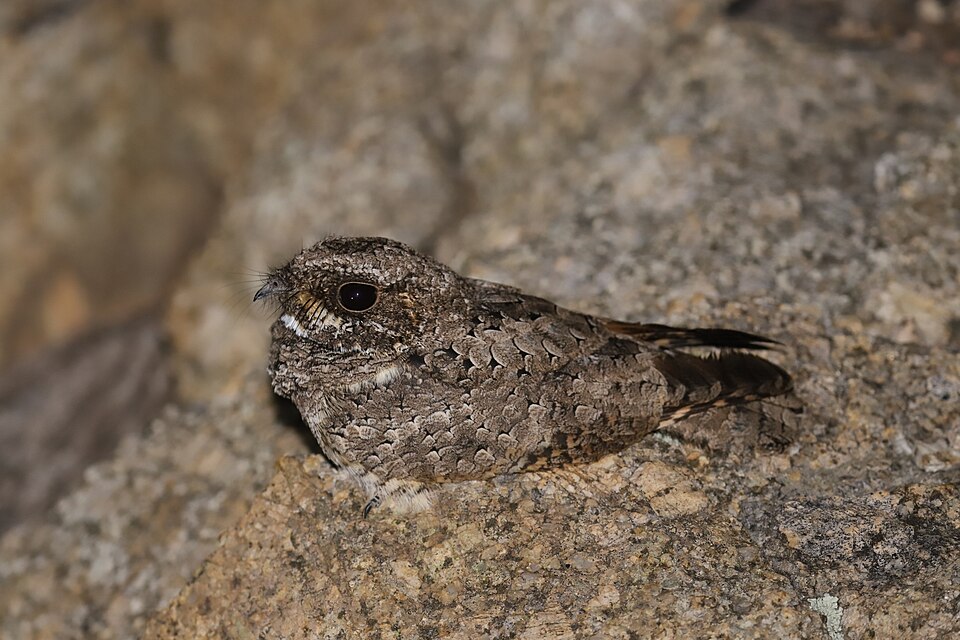
The Common Poorwill (Phalaenoptilus nuttallii) is a medium-sized, nocturnal bird in the order Caprimulgiformes and family Caprimulgidae. It is distinguished from other North American nighthawks by its short tail, thick white throat patch, and stout build. Found in dry, open habitats like grasslands and deserts, it hunts night-flying insects by ambushing them from the ground or low perches.
Learn to identify
Adult Common Poorwill resting on rock in western North America.
Learning lesson · openly licensed photographs, labelled by BirdBot; labels checked against the cited sources and approved by AI

Wingtips reach tail tip: rounded wings over a short tail at rest. Short bill: shorter than in similar nightjars. Mottled grey-brown: paler grey than similar nightjars. Small, grey and short-tailed: think poorwill.
White or buff tail corners show mainly in flight.
Sources: Audubon Guide to North American Birds: Common Poorwill · Wikipedia: Common poorwill (revision 1380659693)
Photo: jakeschneider00, CC BY-SA 4.0, via Wikimedia Commons; labels added by BirdBot.
While the Common Poorwill shares the cryptic, mottled plumage of other nightjars, its field identification relies on specific structural contrasts with its relatives. The most reliable visual cue is the tail length relative to the wingtips: in a Common Poorwill, the folded wingtips extend exactly to the end of the tail. In contrast, other North American members of the Caprimulgidae family possess longer tails that extend noticeably past the wingtip.
Additionally, the Common Poorwill features a thick, prominent white throat patch that is absent or less distinct in similar species. The lateral tail feathers (rectrices) display black and brown bands with white or dun-colored tips; males typically have white-tipped feathers, while females have buff-tipped ones, though the sexes are otherwise relatively monomorphic. The bird's stout appearance, created by a large head that transitions to the body without a distinct neck, further distinguishes it from the more slender profiles of other nighthawks.
Common Poorwills inhabit dry, open areas across diverse landscapes, including grasslands, deserts, hills, and open forests. They prefer short grasses, shrubs, or open forest with deciduous or coniferous growth. Roost sites are typically chosen for their proximity to bare ground and vegetative debris, with little live vegetation cover. Trees and shrubs often found near nesting and roosting areas include white fir, ponderosa pine, trembling aspen, Jeffrey pine, and creosote.
The species typically nests at elevations between 500 and 1,000 meters, though some individuals have been found over 2,500 meters. According to AviList v2026, the range extends from arid open fields and rolling prairies in southwestern Canada (southern British Columbia and Saskatchewan) southward through the western US and Great Plains to southern Baja California and northern Mexico, reaching as far south as central Sinaloa and Durango in Mexico.
Common Poorwills are primarily nocturnal, hunting from dusk to dawn. During the day, they roost on the ground or on low-hanging limbs, remaining still to rely on their camouflage. Roost sites are almost always changed on a daily basis. When not brooding or incubating, parents roost away from the nesting area.
Their flight is close to the ground and characterized by several moth-like flutters followed by a glide. They are awkward on the ground and typically land close to their nest. Unique behaviors include a rocking movement for 3 to 15 seconds before preening or scratching, and holding wings in a vertical position for 5 to 10 seconds after landing before snapping them back into a folded position. The exact reasons for these behaviors are not fully understood.
Common Poorwills are insectivorous, with a diet consisting largely of night-flying beetles (Coleoptera) and moths (Lepidoptera). Other insect orders make up less than 10% of their diet, as determined by fecal pellet analysis. Prey is selected for size, with a minimum length of 5 to 7 mm, which may maximize energy intake or represent the lower limit of visual detection in low light.
They use an ambush hunting style, waiting on the ground or a low perch and flying almost vertically upwards to a maximum of 3 meters to capture prey. Long foraging flights are rare, with most lasting about three seconds. One study estimated that Common Poorwills make 200 to 300 flights per night to obtain a minimum of 9.7 g of insects to maintain weight during the breeding season. Hunting activity increases during moonlight nights compared to dark nights, indicating a minimum light requirement for visual hunting.
Common Poorwills nest on the ground in small open areas with shelter provided by nearby low objects such as rocks, shrubs, or fallen trees. No nest structure is built; instead, they use small shallow depressions in the ground. Eggs and nestlings are moved short distances of 1 to 3 meters every couple of days for thermoregulation or in response to disturbance.
Incubation duties are shared between males and females. Typically, two buff-colored eggs are laid over two consecutive days, with an incubation period of 20 to 21 days. Nestlings are cared for for 20 to 22 days after hatching, with first flight occurring at 20 to 23 days. A remarkable adaptation is the ability of parents to enter torpor during inclement weather, with cloacal temperatures as low as 11.5°C recorded. While this saves energy, it reduces egg viability and can lead to higher rates of nest abandonment.
Both sexes produce a distinctive three-note call described as "poor-will-ow" in the 1.5 kHz range. This call is used for mating, territory defense, and general communication. Males call more frequently during the start of the breeding season, advertising their presence in a territory and attracting females. The call is made year-round, with frequency and duration increasing among males during the mating season. Observers should rely on passive listening for this natural call during active hours rather than using playback, which can stress the bird.
The Common Poorwill is listed as Least Concern (LC) in the IUCN Red List, as recorded in AviList v2026. Populations are presumed to be large, although the distribution may be somewhat fragmented. The species is not listed in the CITES appendices and is not protected under the United States Migratory Bird Treaty Act, despite presumed migration from Canada and the US to Mexico. They may benefit from human activities such as cattle grazing or logging, which create the open habitats they prefer.
Observing Common Poorwills requires patience and an understanding of their nocturnal habits. The best time to look is during dusk, night, or dawn hours in dry, open habitats with short grasses or shrubs. Listen for the distinctive three-note call from low perches or the ground. If you hear a call, remain still and quiet, as the bird may be roosting nearby.
Because this is a ground-roosting, cryptic bird, avoid using spotlights or other artificial lights, which can disturb the bird and contradict the goal of minimizing disturbance. Instead, rely on visual scanning of bare ground and low vegetation at dusk or dawn, keeping a respectful distance to allow the bird to continue its natural behaviors without stress.


