
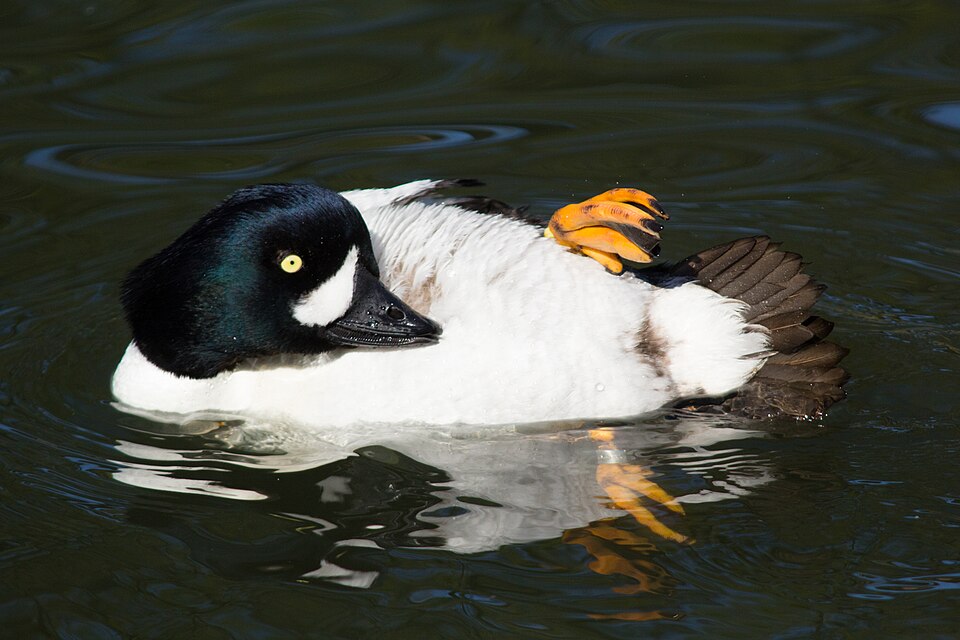
The Common Goldeneye (Bucephala clangula) is a medium-sized diving duck in the family Anatidae, order Anseriformes, known for its bright yellow eyes and synchronized diving behavior.
Learn to identify
Adult male Common Goldeneye, photographed in Gothenburg, Sweden.
Learning lesson · openly licensed photographs, labelled by BirdBot; labels checked against the cited sources and approved by AI

Dark head, green gloss: black-looking head with a greenish sheen. Golden-yellow eye: the mark the species is named for. Round white spot: a roundish patch between bill and eye. White chest and sides: contrast with the black back. Look for a round white spot on a dark, glossy head.
Females and young males have a brown head and grey body.
Sources: Audubon Guide to North American Birds: Common Goldeneye · Wikipedia: Common goldeneye (revision 1374022294)
Photo: flickr.com/photos/sbern, CC BY 2.0, via Wikimedia Commons; labels added by BirdBot.
While the species snapshot above covers basic plumage, the critical field challenge is separating Common Goldeneyes from Barrow's Goldeneyes (Bucephala islandica). Both species share the bright yellow iris, but subtle differences in head shape and wing pattern are the keys to a confident ID.
Field Tip: When in doubt, watch the bird in flight. The whistling sound of their wings is characteristic, and the extent of white on the secondaries is often the most reliable visual cue at a distance.
Common Goldeneyes are migratory, moving between summer breeding ranges and wintering grounds. They are often one of the last ducks to leave their summer grounds, wintering as far north as possible in ice-free areas.
| Season | Habitat Type | Key Features |
|---|---|---|
| Breeding (Summer) | Northern lakes and rivers | Surrounded by mature forests with tree cavities; clear water with little emergent vegetation; abundant invertebrate prey. |
| Wintering | Coastal marine, estuarine, and large interior waters | Shallow water with sandy, gravel, or rocky substrates; slow-flowing water preferred; refueling stops at large interior lakes and rivers. |
According to AviList v2026, the species breeds in the subarctic from Scotland and Scandinavia to Sakhalin and Kamchatka, and in North America from western Alaska to Labrador and New Brunswick, south through the northern tier of the contiguous USA. They winter in southern Europe, eastern China, and the middle tier of the USA.
Common Goldeneyes spend most of their time on the water, only walking when moving broods from the nest to the water or overland to other lakes. They are excellent swimmers and divers, typically foraging in small groups and diving synchronously to search for prey.
Common Goldeneyes are monogamous, with pair bonds formed in December and lasting until the male abandons the female at the beginning of incubation. Males perform complex courtship displays from December to March, including the "head-throw-kick," where a male thrusts his head forward, moves it back towards his rump, utters a call, and then flicks his head forward while kicking the water with his feet.
During the breeding season, males defend small territories that include the nest, ceasing defense when females begin incubating. Females defend both nesting and brooding territories. Female Common Goldeneyes show marked natal philopatry, tending to nest in the general vicinity of their previous nest or natal nest.
Common Goldeneyes typically hunt for prey in water less than 4 meters deep, preferring open water but also foraging along the edges of aquatic vegetation. Dives can last from 10 to 55 seconds, and prey items are typically consumed underwater.
A study of 395 Common Goldeneyes suggested that crustaceans, insects, and mollusks make up about 70% of their diet, with the remainder consisting of fish, eggs, and plant material. Diet varies regionally; for example, in British Columbia, salmon and their eggs can be a significant part of the diet.
Common Goldeneyes nest in tree cavities, but will accept nest boxes and occasionally use rock cavities. Nests are generally within 1.3 km of water. Females line the nest with a bowl of materials and downy feathers.
Common Goldeneyes are classified as Least Concern (LC) by the IUCN, as recorded in AviList v2026. This status reflects their large range, large population size, and no documented population declines. However, they face threats from acid rain, contamination, and habitat destruction. Population densities may be most affected by the availability of nest cavities. They are protected as a migratory bird under the U.S. Migratory Bird Act.
Common Goldeneyes are most easily observed in open water, where they forage in small groups and dive synchronously. In winter, look for them in coastal marine and estuarine habitats or large interior lakes with shallow, sandy, or rocky substrates.
Seasonal Cue for Courtship: The spectacular "head-throw-kick" display is best observed in late winter to early spring (December–March) on ice-free waters. During this period, males gather in groups to establish pair bonds, making it the prime time to see this behavior. In spring, focus on ice-free northern lakes where these displays are most frequent.
Observe from a distance to avoid disturbing nesting sites or broods, and listen for the distinctive whistling sound produced by their wings during flight.


