
You spot a long, slender duck flying low over a clear stream, its head, body, and legs aligned in a perfect horizontal line. As it lands, it paddles alternately with its head submerged, scanning the water below. Suddenly, it performs a slight leap before plunging underwater, propelling itself with its feet alone. This is the Common Merganser (Mergus merganser), the largest North American inland duck and a master of visual hunting in clear waters.
Learn to identify
Adult male Common Merganser (Goosander) in breeding plumage, photographed in England.
Learning lesson · openly licensed photographs, labelled by BirdBot; labels checked against the cited sources and approved by AI

Dark green head: black with an iridescent green sheen. Black back: contrasts with the white body. Red bill: thick at the base, long and narrow toward the tip. White body: often with a salmon-pink tinge. Male: green head, white body, slim red bill.
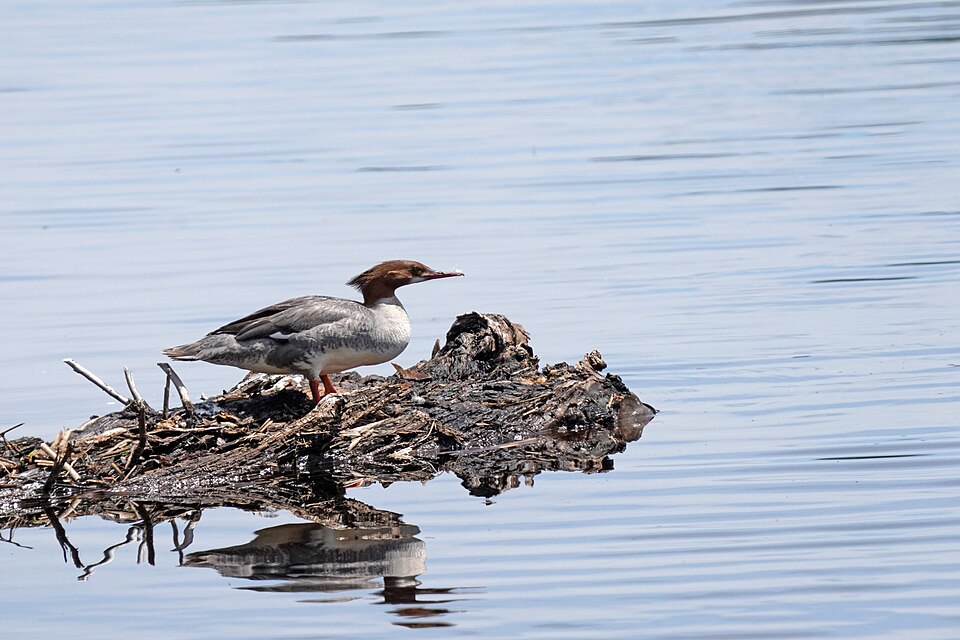
Females and eclipse males are gray, with a rusty head and white chin.
Sources: Audubon Guide to North American Birds: Common Merganser · Wikipedia: Common merganser (revision 1374111083)
Photo: Tony Hisgett, CC BY 2.0, via Wikimedia Commons; labels added by BirdBot.
Common Mergansers exhibit strong sexual dimorphism. Males are slightly larger, with a dark green to black head (turning brown in non-breeding plumage), a black back, and a white body with a slight peach tinge on the breast. They lack a visible crest. Females have a brown head with a larger, prominent crest, red feet and bill, and a grey-white body. A key field mark for females is the sharply defined line between the brown neck and white breast, which distinguishes them from the similar Red-breasted Merganser.
When observing males, compare them with Common Goldeneyes. Mergansers have longer necks, more cylindrical bodies, and lack the rounded shape and white eyes of Goldeneyes. The serrated edges of the merganser's bill are an adaptation for gripping slippery fish, a feature not present in the same way in other diving ducks.
Common Mergansers prefer wooded areas along streams, rivers, and small inland lakes. They are also found along the shores of the Great Lakes and coastal streams, such as those in British Columbia. Their range extends across the Palearctic and Nearctic regions, breeding from Iceland and northern Europe to subarctic Russia, northeastern Asia, and subarctic Canada. In North America, they breed from southwestern Alaska through subarctic Canada to Newfoundland, extending southward through the western USA and to the northern Great Lakes. During winter, they migrate to central Europe, eastern China, southern California, and Maryland.
These birds require clear water for feeding, as they hunt primarily by sight. They tend to feed in waters less than 4 meters deep, including estuaries, coastal bays, lakes, streams, and rivers. In winter, they may dive deeper to capture schooling fish.
Common Mergansers are social birds, often forming groups of up to 75 individuals. In winter, gatherings of hundreds have been observed. They fly horizontally at speeds of about 70 km/h, holding their head, body, and legs in a straight line. Flight is typically low along waterways or high and directional.
Their foraging behavior is distinctive. They swim along the surface of clear shallow waters, paddling alternately with their heads submerged to spot prey. Before diving, they perform a slight leap. Underwater, they use only their feet for propulsion, paddling in unison. While capable of staying underwater for up to two minutes, typical dives last less than 30 seconds. Maximum recorded dive times are 52 seconds in 2 to 3 meters of water and 37 seconds in 18 to 37 meters of water.
As skilled diving predators, Common Mergansers eat mainly slower small fish. Their serrated bills are well-suited for capturing these slippery prey items. When fish are scarce, usually in spring, they substitute other small aquatic prey such as insects, frogs, and snails. They have also been known to eat aquatic plants and feed on trout from freshwater streams when nearby ponds and lakes freeze. Feeding activity is most intense in the early morning after dawn, in the afternoon, and before sunset.
Common Mergansers form monogamous pairs in late winter. Males court females by circling them and displaying the Courtship-Intent Posture, with the neck stretched forward and head feathers erect. Pairs breed once per year, typically laying 9 to 12 eggs between May and June. The eggs are approximately 64 mm in length and pale yellow, ivory, or white buff in color.
Nests are typically located in crevices of deciduous trees along the shore, though they may also be found in other crevices, on the ground under tangled bushes, or in abandoned hawk nests. Males typically leave the breeding grounds when incubation begins. Females incubate the eggs for 28 to 35 days. The young are precocial, leaving the nest within 24 to 48 hours by jumping to the ground. Mothers lead their chicks to feeding sites, sometimes as far as 8 km downstream, where the young learn to feed independently. Within about 8 days, the young become skillful divers. Mothers abandon their broods before the young can fly, typically 30 to 50 days after hatching. Young mergansers often join other broods, forming mixed groups of more than 40 young.
Common Mergansers are relatively quiet birds. Males are typically vocal only during courtship, producing hoarse croaking sounds and a twang similar to a guitar string. Females are also predominantly silent, vocalizing only during courtship or as a warning of danger, using a harsh "karr, karr" call. Aerial chases, where two or more birds dive from flight into the water to produce an audible hollow sound, have been reported, but their purpose remains unknown.
The Common Merganser is listed as Least Concern (LC) in the IUCN Red List, as recorded in AviList v2026. They remain common in both the Palearctic and Nearctic regions. The primary limiting factor for their populations appears to be the availability of nesting sites. Urbanization and human development have led to the destruction of former habitats, causing breeding sites to shift farther south in the southeastern United States. However, the installation of artificial nest boxes has provided additional suitable nesting sites in some areas. While North American populations have declined somewhat over the last 200 years, they remain large and may now be increasing. In Europe, deforestation has caused some breeding range reduction, but populations continue to thrive and grow throughout Eurasia, particularly in Scotland, Ireland, and Wales.
To observe Common Mergansers ethically, position yourself at a distance in clear, shallow waters where the birds can be seen swimming with their heads submerged. Watch for the slight leap that precedes a dive, and note how they use only their feet for propulsion underwater. Avoid disturbing nesting sites, which are often in tree cavities, and maintain a respectful distance from broods. Observing during peak feeding times, such as early morning or late afternoon, increases the likelihood of seeing active foraging behavior.
Next Step: Scan the water surface for a bird swimming with its head submerged. Wait for the distinct slight leap that signals the start of a dive. This specific pre-dive motion, combined with the horizontal flight posture, is the most reliable field cue for confirming a Common Merganser in active foraging mode.


