
The Spectacled Eider (Somateria fischeri) is a distinctive sea duck in the family Anatidae, classified as Near Threatened. It breeds in lowland tundra near salt water in western and northern Alaska and northeastern Siberia, and winters in ice-free seas (polynyas) in the northern Bering Sea. Males are easily identified by their pale green heads, black chests, bright orange bills, and white eye patches that resemble spectacles, while females are drab brown with light brown eye patches.
Learn to identify
Adult male Spectacled Eider, photographed at Barrow (Utqiagvik), Alaska, in June.
Learning lesson · openly licensed photographs, labelled by BirdBot; labels checked against the cited sources and approved by AI
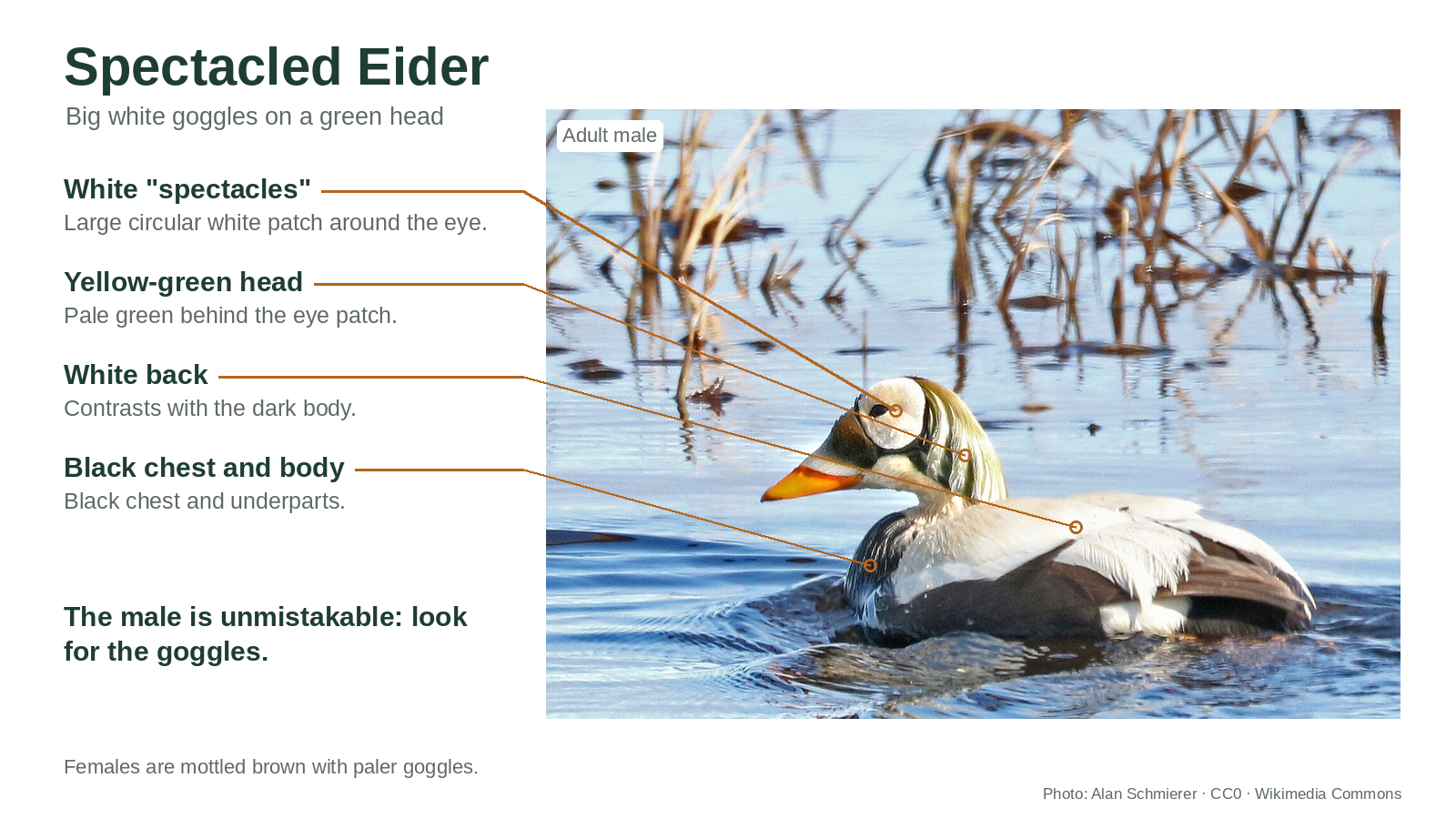
White "spectacles": large circular white patch around the eye. Yellow-green head: pale green behind the eye patch. White back: contrasts with the dark body. Black chest and body: black chest and underparts. The male is unmistakable: look for the goggles.
Females are mottled brown with paler goggles.
Sources: Audubon Guide to North American Birds: Spectacled Eider · Wikipedia: Spectacled eider (revision 1356839838)
Photo: Alan Schmierer, CC0, via Wikimedia Commons; labels added by BirdBot.
The Spectacled Eider is one of the most visually striking ducks in the Arctic, primarily due to the extreme sexual dimorphism between males and females. The species name itself refers to the male's unique facial markings.
Adult males are unmistakable in the field. Key identification features include:
A unique anatomical feature of the Spectacled Eider, distinguishing it from other eiders, is that its feathers extend down to the nostrils on the bill.
Females are significantly drabber, providing camouflage on the tundra and in coastal waters. They are brown with black discontinuous streaks and bars. Like the males, they have patches around the eyes, but these are light brown rather than white. Their bills are blue-gray, and their feet are also bright yellow.
The Spectacled Eider occupies a specific niche in the Arctic and sub-Arctic regions. Its habitat requirements are tightly linked to coastal environments.
During the breeding season, Spectacled Eiders prefer lowland tundra that is close to salt water. They typically nest near shores, lakes, and deltas. The species requires high grasses to build its nest, which is usually located in grass flats or on the periphery of tundra ponds. This proximity to both fresh water (for nesting) and salt water (for foraging) is a critical habitat feature.
In winter, the species moves to the northern Bering Sea, specifically to polynyas (areas of ice-free sea) between St. Lawrence Island and St. Matthew Island. The exact locations of wintering grounds can be difficult to pinpoint, which is a key area of ongoing conservation concern.
Spectacled Eiders exhibit specific social and breeding behaviors adapted to their short Arctic summer. Note: The following behavioral details are drawn from historical natural history accounts (ADW) and may not reflect the most current field observations.
Outside of the breeding season, Spectacled Eiders are generally solitary or found in very small groups of two or three. They fly low, close to the surface of the water. During the breeding season, they become more social and form colonies, with nests located very close together.
Pair bonds form at the beginning of each breeding season and are maintained with constant contact between the pair. These bonds dissolve immediately after the breeding season ends. Courtship is initiated by the female, who performs inciting movements and calls. The male responds with ritualized displays, including exposing his black chest.
The female builds the nest, lining it with grass stems and a large amount of down. Clutch sizes average 4.5 eggs, ranging from one to eight. Eggs are laid every other day. Incubation lasts approximately 24 days, and the fledging period is about 53 days. Once eggs are laid, the female is extremely protective of the nest and may be hesitant to leave. While this behavior can make the bird appear approachable, observers must maintain a significant distance to avoid causing stress or nest abandonment. Do not approach nesting sites.
Spectacled Eiders are omnivorous but rely heavily on invertebrates. Their diet primarily consists of mollusks, such as razor clams, as well as terrestrial and freshwater plant material. Juveniles have been observed eating caddis fly larvae. Unlike many other sea ducks, Spectacled Eiders rarely dive; they are mostly seen dabbling for food at the surface.
Vocalizations are sex-specific. Males are generally non-vocal. Females produce growling or croaking noises, particularly during the breeding initiation phase.
The Spectacled Eider is classified as Near Threatened (NT) in the IUCN Red List, as recorded in the AviList v2026 checklist. This formal category reflects the species' restricted breeding range and the ongoing uncertainty regarding its wintering habitats. While the Animal Diversity Web (ADW) account describes the species as "uncommon," this is a general descriptor of its relative abundance rather than a formal conservation assessment. A major current concern is the difficulty in pinpointing exact wintering locations in the northern Bering Sea, which complicates targeted conservation efforts.
Observing Spectacled Eiders requires respect for their remote habitat and sensitive breeding behaviors.


