
The Short-tailed Hawk (Buteo brachyurus) is a crow-sized raptor found from southern Florida to South America, known for its two distinct color morphs and unique hunting style of soaring high on thermals before diving on prey. It breeds in tall, dense wet forests near water and is currently listed as Least Concern globally, though the isolated Florida population faces specific local threats.
Learn to identify
Light-morph adult Short-tailed Hawk soaring overhead, photographed by a Colombian photographer.
Learning lesson · openly licensed photographs, labelled by BirdBot; labels checked against the cited sources and approved by AI
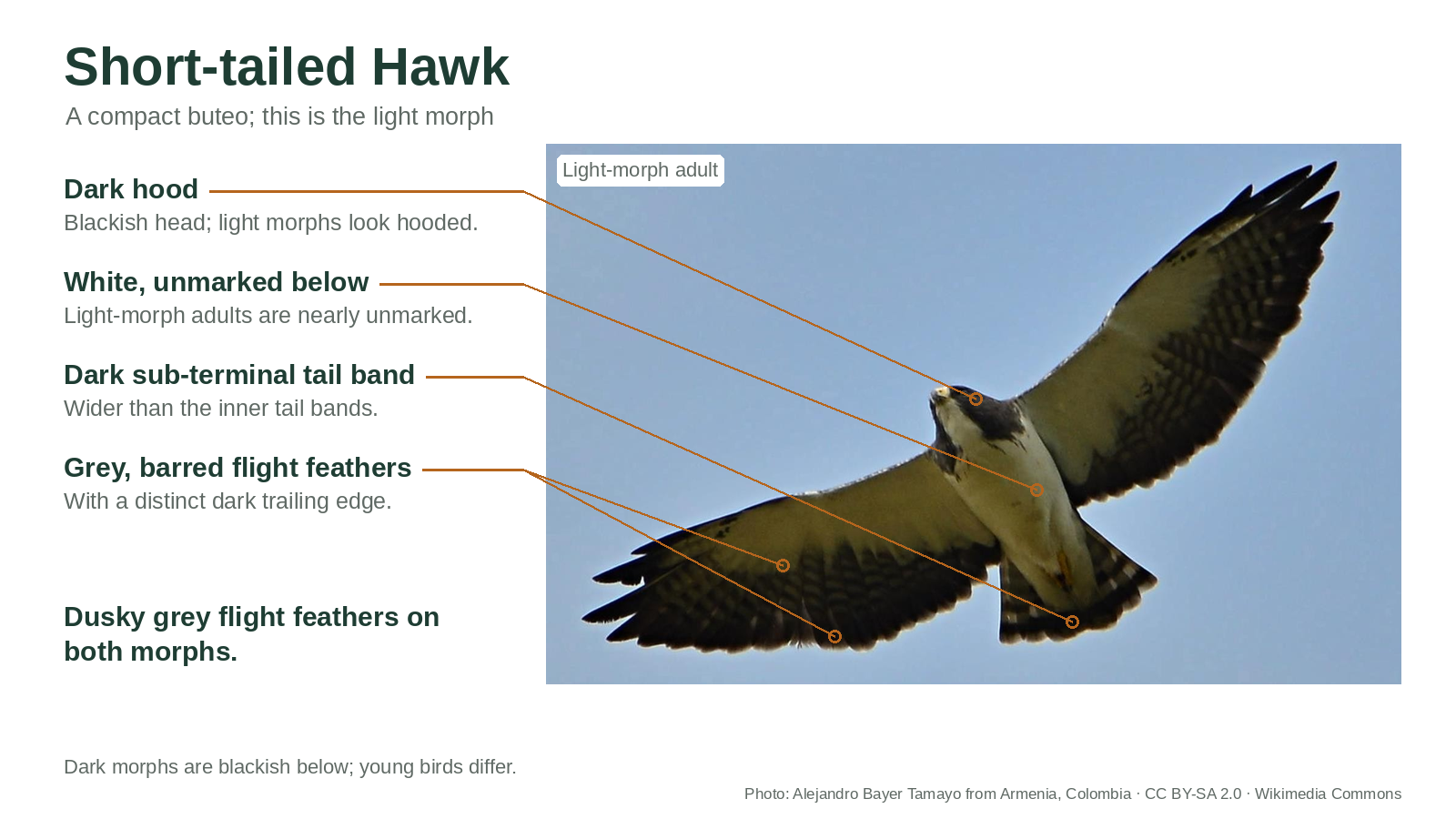
Dark hood: blackish head; light morphs look hooded. White, unmarked below: light-morph adults are nearly unmarked. Dark sub-terminal tail band: wider than the inner tail bands. Grey, barred flight feathers: with a distinct dark trailing edge. Dusky grey flight feathers on both morphs.
Dark morphs are blackish below; young birds differ.
Sources: Audubon Guide to North American Birds: Short-tailed Hawk · HawkWatch International Raptor ID: Short-tailed Hawk
Photo: Alejandro Bayer Tamayo from Armenia, Colombia, CC BY-SA 2.0, via Wikimedia Commons; labels added by BirdBot.
Short-tailed Hawks are one of the smaller species in the genus Buteo, measuring 39 to 44 cm in length with a wingspan of 83 to 103 cm. Despite the name, their tail length is typical for the genus; the "short" appearance comes from their relatively long wings, which reach the tail tip when perched. Females are larger than males, averaging 515 grams compared to the male's 392 grams, but the sexes are similar in the field.
The species exhibits two distinct color morphs with no intermediates:
In Florida, the dark morph is more numerous than the light morph. In other parts of the species' range, the dark morph is uncommon or nonexistent. Immature birds differ from adults; light-morph juveniles have pale buff or orange-buff on the breast and belly, with heavier and more numerous tail bands. Instead of the adult's dark hood, juvenile light morphs have ear coverts finely streaked with buff or pale ocher.
According to AviList v2026, the range of Buteo brachyurus extends from southern Florida to eastern Mexico, Brazil, Bolivia, Paraguay, and northern Argentina. The species occurs primarily in lowland and foothill habitats, typically up to 2,000 m elevation and occasionally to 3,000 m.
Breeding habitat is specific: tall, dense, wet forest patches near water, such as mangrove and cypress swamps. When not breeding, individuals are found near coastal areas, forests, forested edges, pine savannas, pastures, suburban areas, and open country. They are not usually found in dense, closed forest. While they roost and nest in larger trees, they hunt primarily in open country and on forest edges where wind conditions are best for their soaring style.
Short-tailed Hawks are infrequently seen perching. They are usually spotted soaring high in the air, scanning for prey below, or hovering at updrafts near forest edges. A key diagnostic flight characteristic is that the outer primaries are distinctly upturned while the rest of the wing is flat. They use thermals to gain altitude, spiraling inside the column of air, and are most active 2 to 3 hours after sunrise to 1 to 2 hours before sunset when thermals are available.
Once at the desired altitude, they use the wind to stay aloft. When prey is spotted, they dive, with occasional mid-flight holds to adjust direction. They are solitary for much of the year except when breeding, though groups of 3 to 11 have occasionally been seen during migration. Adult territories are 1.2 to 1.6 miles in diameter, generally featuring a long stretch of forest edge for easy soaring and stands of large trees for roosting. These territories are larger than those of the sympatric Red-shouldered Hawk (Buteo lineatus).
Short-tailed Hawks feed mostly on smaller birds. In Florida, over half their bird diet consists of Eastern Meadowlarks (Sturnella magna) and Red-winged Blackbirds (Agelaius phoeniceus), likely due to the conspicuousness of these species. They prey on adults and have not been observed feeding on nestlings. They also consume lizards, snakes, rodents, and occasional insects such as wasps and grasshoppers.
Hunting success is relatively low. A study by Ogden et al. (1974) reported a success rate of approximately 11%, with only 12 of 107 attempts successful over 30 hours of observation. They can catch prey on the wing or when it is on a conspicuous perch.
The breeding season runs from late January to July. These birds are presumed to be monogamous. Courtship involves the male circling and undulating above the perched female, presenting prey or nest material, and sometimes grasping each other's talons in the air before tumbling earthward.
Females build a platform nest made of sticks, lined with finer twigs and soft material like Spanish moss. Males gather the materials. Nests are located towards the top of taller trees, 9 to 29 meters up, in cypress swamps or mangroves. One to three preliminary nests may be constructed before a final site is chosen. Nests are often reused year after year.
The clutch size varies from one to three eggs, typically two. Eggs are unspotted bluish-white, sometimes with reddish-brown speckling. Incubation lasts 34 to 39 days, with the female incubating while the male provides food. Both parents care for the young until they are fledged and independent. In an estimated 45% of nests, at least one young is successfully raised.
The voice of Buteo brachyurus is described as a high-pitched, prolonged "keeeea," often given when humans approach the nest. A shorter "keeee" call is used at the nest site, especially when males return to incubating females. A "squeee" call is given before or after copulation and sometimes by a female receiving food. During the non-breeding period, these birds are usually silent. Newly hatched chicks give chip calls, transitioning to soft squeals for food after about four days.
Buteo brachyurus is listed as Least Concern on the IUCN Red List, as recorded in AviList v2026. In the United States, the species is protected under the Migratory Bird Treaty Act. While uncommon to rare throughout most of its range, the species is not currently threatened globally. However, the Florida population is at risk due to its small size (estimated at 500 individuals), geographic isolation, poor breeding success, and continuing loss of prairie, swamp forest, and mangroves.
Observing Short-tailed Hawks requires patience and an understanding of their thermal-dependent activity. The best time to look is mid-morning to late afternoon, when thermals are active. Position yourself near forest edges or open country where the hawks can access updrafts. Watch for the distinctive upturned outer primaries in flight.
During the breeding season, these birds become quite secretive and difficult to locate. The high-pitched "keeeea" call is a strong indicator of an active nest, often given when humans approach. Because the bird's secretive breeding behavior makes it hard to find, any human presence near active nests can be harmful. If you hear this call, maintain a significant distance from the nest site to minimize stress on the breeding pair. Avoid approaching known nesting areas in cypress swamps or mangroves during the breeding season (late January to July) and do not attempt to locate nests for observation purposes.


