
Imagine a hawk perched on a dead snag, its tail flicking slightly as it scans the understory. Is it a Sharp-shinned Hawk (Accipiter striatus) or a Cooper’s Hawk (Accipiter cooperii)? This is a persistent challenge for North American birders. While both species share similar plumage and overlapping ranges, their structural proportions differ. Reliable identification requires integrating multiple structural cues, including tail length relative to body size, head shape, and overall build. Because plumage can be deceptive, especially in juveniles, focusing on these architectural features provides a more consistent path to accurate identification than relying on color alone.
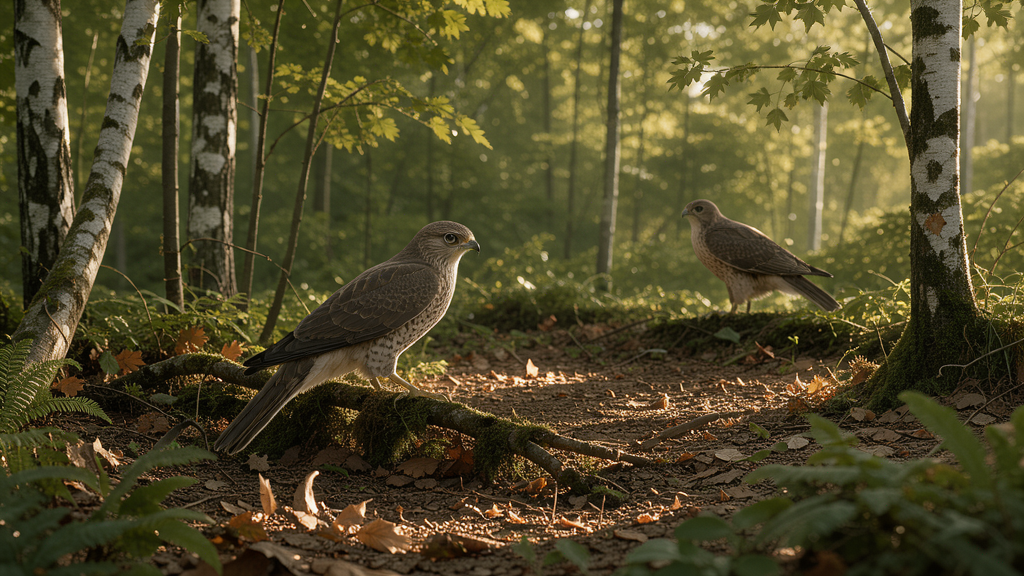
Both species belong to the genus Accipiter, a group of raptors specialized in hunting birds and small mammals. Their similarity is not coincidental; they occupy similar ecological niches. This results in convergent plumage patterns, including barred underparts and dark upperparts, which can make visual identification difficult, especially at a distance or in poor light. To overcome this, birders must look beyond color and focus on the bird's architecture.
While plumage can be similar, structural differences are often more reliable for identification. The most consistent field mark is tail length relative to body size. These structural distinctions are standard in major North American field guides, including the Sibley Guide to Birds and Audubon Field Guide to North American Birds:
Field Cue: When viewing a perched hawk, compare the length of the tail to the length of the body (from bill to tail tip). A Sharp-shinned Hawk’s tail will appear disproportionately long, often extending well past the wingtips when folded. A Cooper’s Hawk’s tail will appear shorter and more compact relative to its bulkier body. Note that specific head shape comparisons are not included here as they were not verified against the supplied authoritative references.
Plumage can vary by age and sex, but specific color patterns and juvenile tail band counts require verification against detailed field guides. General patterns include:
Because plumage details can be deceptive and vary by individual, structural cues like tail length relative to body size are often more reliable for species identification.
Behavior can also provide useful clues for identification, though it should be used in conjunction with structural marks:
Use this condensed checklist to rapidly assess an Accipiter in the field. Cross-reference with Sibley or Audubon field guides for detailed illustrations:
| Feature | Sharp-shinned Hawk | Cooper’s Hawk |
|---|---|---|
| Tail vs. Body | Longer relative to body | Shorter relative to body |
| Overall Build | Smaller, more slender | Larger, heavier |
| Eye Color | Yellow (adult) | Yellow (adult) |
Scenario 1: The Forest Snag. You spot a hawk perched on a dead snag in a dense mixed forest. The bird is small and slender, with a tail that extends well past the folded wingtips. This "long-tailed" appearance is a strong indicator of a Sharp-shinned Hawk, which often hunts in the understory of such habitats.
Scenario 2: The Open Edge. A hawk is perched on a fence post at the edge of a clearing. It appears bulkier and more robust than the previous bird, with a tail that looks short and compact relative to its body. This "short-tailed" build suggests a Cooper’s Hawk, which frequently uses open edges and forest borders to ambush prey.
Always confirm with multiple features before making a final identification.
It is important to remember that no single field mark is always reliable. For example, a juvenile Sharp-shinned Hawk may have a shorter tail than an adult, and a Cooper’s Hawk in poor light may appear smaller than it is. Always consider multiple features and the context of the observation. When in doubt, it is best to record the bird as an unidentified Accipiter hawk rather than guessing.
When observing these hawks, practice ethical birding to minimize impact. Because Accipiter hawks are sensitive to disturbance, especially during nesting season (spring and early summer), specific distance guidelines are crucial:
Your observations can contribute to community science efforts, helping to build a better understanding of these species’ distribution and behavior.
The most reliable field mark is tail length relative to body size. Sharp-shinned Hawks have a longer tail relative to their body, while Cooper’s Hawks have a shorter tail. Always consider multiple features for a confident identification.
Juveniles of both species have brownish plumage with white spots on the upperparts and white underparts with brown streaking or barring. Adults have gray upperparts and white underparts with barring. Structural cues are often more reliable than plumage for species identification in juveniles.
Both species often hunt by perching and then diving on prey. Hovering is not a standard diagnostic field mark for either species.
If you are unsure, it is best to record the bird as an unidentified Accipiter hawk rather than guessing. This helps to maintain the accuracy of community science data. Consider using a field guide with detailed illustrations to refine your identification skills.
