
The Killdeer (Charadrius vociferus) is a medium-sized plover in the family Charadriidae, easily recognized by its dark double-banded breast, head mask, and vivid reddish-orange rump visible in flight. It inhabits open areas such as pastures, sandbars, and human-altered zones like parking lots and agricultural fields across the Americas. Its loud, piercing "kill-dee" call serves as an alert system, and it is largely non-migratory, moving only when temperatures drop below 10°C.
Learn to identify
Adult Killdeer in North America, photographed in Ohio.
Learning lesson · openly licensed photographs, labelled by BirdBot; labels checked against the cited sources and approved by AI
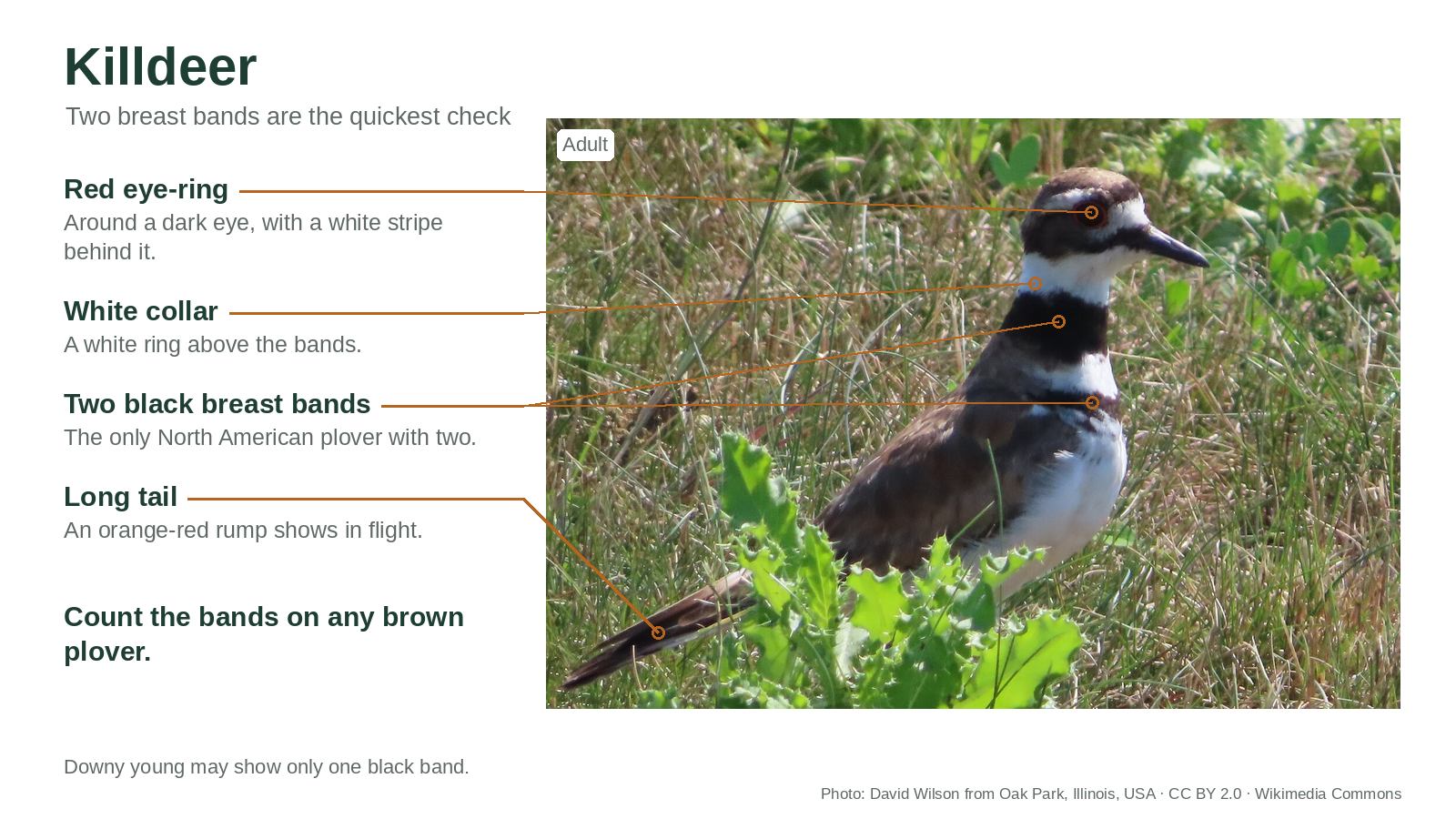
Red eye-ring: around a dark eye, with a white stripe behind it. White collar: a white ring above the bands. Two black breast bands: the only North American plover with two. Long tail: an orange-red rump shows in flight. Count the bands on any brown plover.
Downy young may show only one black band.
Sources: Audubon Guide to North American Birds: Killdeer · Wikipedia: Killdeer (revision 1361766784)
Photo: David Wilson from Oak Park, Illinois, USA, CC BY 2.0, via Wikimedia Commons; labels added by BirdBot.
Adult Killdeer measure 23–27 cm in length with an average wingspan of 17.5 cm. The most distinctive field mark is the dark, double-banded breast; the upper band completely encircles the upper body, while the lower band is partial. A continuous dark head mask thins across the forehead and above the bill, thickening at the supercilium and extending around the eye to the back of the head. The dorsal side, crown, and nape are grayish-brown, contrasting with a white ventral region. The plumage is otherwise relatively plain, except for the vivid reddish-orange rump, which is prominently displayed during flight and behavioral displays. Males and females are similar in appearance, though breeding females may show additional brown on the face. Juveniles resemble adults but have buffed fringes on their feathers. Three subspecies are recognized, differentiated by the coloration and pattern of rufous edgings on the back and wing coverts.
Killdeer occupy a wide range of terrestrial biomes, including savannas, taiga, and deciduous forest regions, but they strongly prefer open areas within these biomes. Common microhabitats include sandbars, mudflats, pastures, shorelines, and high-altitude regions. Temperature is a critical factor in their environment choice; they remain within their habitats year-round and migrate south only when temperatures drop to approximately 10°C or below. Their adaptability has allowed them to settle effectively into human-altered environments, including parks, agricultural zones, farm fields, road shoulders, parking lots, and flat graveled rooftops. According to AviList v2026, the species breeds from inland subarctic North America to central Mexico and the Caribbean, with local coastal populations in southwestern Central America and from coastal Ecuador to far northwestern Chile, wintering to northern South America.
Killdeer are usually solitary or found in breeding pairs, though they occasionally gather in loose flocks during non-breeding periods. They are active during both day and night. Breeding pairs form in the spring, with males claiming territories and using aerial displays and two-noted calls to attract mates. Non-migratory pairs may remain together year-round and breed together for several years. Home range data is limited to a few studies; one account reports breeding-season ranges between 0.23 and 0.68 hectares, but these figures should be treated as preliminary until corroborated by additional peer-reviewed research. Their loud calls make them easily heard throughout their habitat, often serving as an early warning system for other animals.
Killdeer are omnivorous, though their diet consists primarily of aquatic and terrestrial invertebrates, insects, and crustaceans. They forage in open areas, using their pointed, extended bill and lengthened tarsus to probe for food. Berries are occasionally included in their diet. This dietary flexibility supports their success in diverse and human-altered habitats.
Killdeer nests are simple depressions scraped into bare earth, gravel, or other substrates, typically located in open areas with sparse vegetation. Both parents participate in nest preparation and incubation. The female lays an average clutch of four eggs, though clutches may range from two to six. Eggs are incubated for 24 to 28 days. Chicks are precocial, hatching down-covered and active, and are able to leave the nest soon after their down dries. Unlike most birds, Killdeer do not feed their chicks in the nest; instead, the parents lead the chicks to feeding areas. Chicks remain with their parents until they are able to fly, which occurs 20 to 31 days after hatching. They are capable of breeding the following year.
The Killdeer's common name derives from its loud, piercing "kill-dee" call. This vocalization is a key identification feature and serves as an alert system for other individuals, including animals of different species. Killdeer also communicate using physical displays, particularly during courtship and territorial defense. The call is often described as incessant and noisy, making the bird easy to locate even when it is not immediately visible.
The Killdeer is listed as Near Threatened (NT) in AviList v2026, which reflects its current IUCN Red List category. This is not a new assessment but a record of the existing global status. The species is protected under the U.S. Migratory Bird Act. Killdeer are highly adaptable and thrive in many human-altered habitats, contributing to their common status. While an estimated worldwide population of 1,000,000 individuals has been cited in natural-history accounts, this figure is not supported by a recent primary survey in the current sources and should be interpreted with caution.
Listen for the loud, piercing "kill-dee" call to locate birds in open areas, as they are easily heard throughout their habitat. When observing Killdeer, maintain a respectful distance, especially during the breeding season. Their nests are often located in open, accessible areas such as parking lots and road shoulders, making them vulnerable to disturbance. Avoid approaching nests or chicks, and do not attempt to handle or move them. If you observe a Killdeer performing a distraction display (such as feigning lameness to lead predators away from the nest), observe from a distance and do not interfere. This behavior is a critical anti-predator strategy, and human interference can compromise the success of the display and the safety of the nest.


