
Wildfire changes bird habitat by removing vegetation, exposing the ground, and altering the structure that birds use for foraging, nesting, and shelter. In the immediate aftermath, bird abundance and species richness often decline in burnt areas, but the same species may persist at lower densities rather than being replaced by new ones. Over time, as vegetation regrows, different bird species return at different rates depending on their habitat needs, local climate, and the severity of the fire.
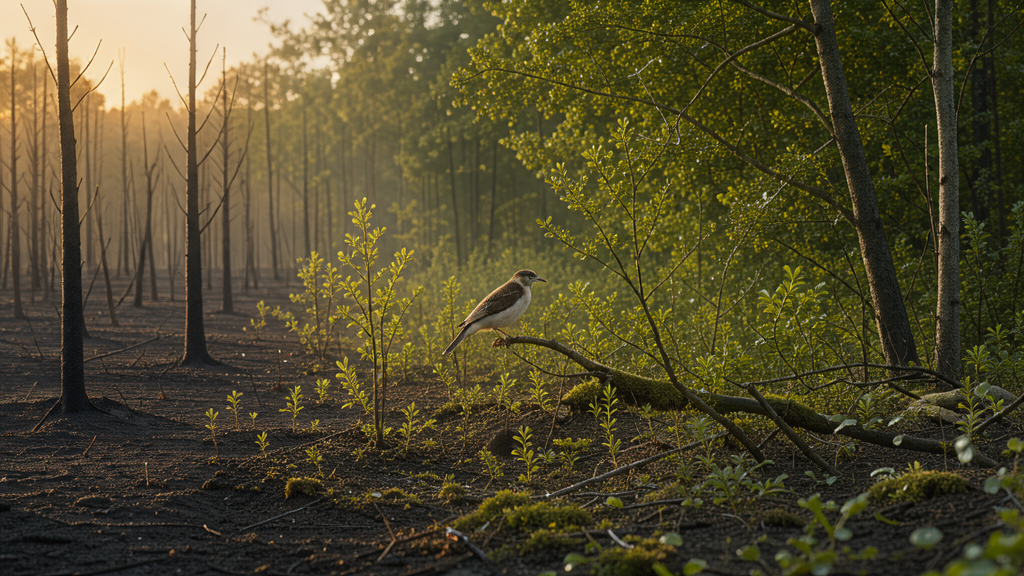
Fire acts as a sudden disturbance that resets the physical environment. For birds, this means the loss of the specific vegetation heights and densities they rely on. A study of heathland birds in Killarney National Park, Ireland, following a major wildfire in 2021, found that bird abundance and species richness were significantly reduced in burnt areas during the first two years. However, the community composition remained broadly unchanged. This suggests a pattern of "density reduction without species turnover," where the same species persist but in lower numbers, indicating a degree of short-term community resilience.
Not all species respond identically. In the same Irish study, meadow pipits (Anthus pratensis) showed increased singing activity in burnt sites despite their reduced abundance. This behavioral shift may reflect changes in territorial behavior or the need to advertise presence in a more open, less cluttered environment. For ground-foraging species like pipits and skylarks, the removal of dense heather can initially make invertebrate prey more accessible, even as overall abundance drops.
The recovery of bird communities is tightly linked to the regrowth of vegetation. In Mediterranean shrublands in Catalonia, Spain, researchers tracked the recovery of four warbler species over 11 years following wildfires. These warblers, including the Melodious Warbler (Hippolais polyglotta) and Subalpine Warbler (Sylvia cantillans), depend on shrub cover for foraging and breeding. The study found that time since fire positively influenced both bird species richness and the relative abundance of these focal species. However, the rate of recovery was not uniform; it was significantly hampered in arid areas where vegetation regrew more slowly.
This highlights a critical ecological link: birds often do not respond to fire directly, but to the habitat structure that fire destroys and then allows to regenerate. In the Catalan study, the highest vegetation layer (>100 cm) recovered slower in arid areas, which in turn delayed the return of birds that require taller shrub cover. In wetter areas, shrub cover recovered faster, allowing warbler populations to rebound more quickly.
Several factors determine how quickly and completely bird communities recover after a wildfire:
Research suggests that the most dramatic changes in bird abundance and richness occur in the first few years after a fire. In the Killarney study, which monitored bird communities from two months to three years post-fire, differences between burnt and unburnt plots weakened by the third year, suggesting the start of a recovery. In the Brazilian grassland study, differences in bird assemblages between naturally burned and prescribed-burned areas were no longer noticeable after 2-4 months. However, full recovery to pre-fire community states can take much longer, and in some cases, the post-fire community may not be identical to the pre-fire one.
Long-term recovery is also influenced by the frequency of fire. If fires occur too frequently, vegetation may not have time to reach the structural complexity required by many bird species. This can lead to a shift in community composition, favoring generalist or early-successional species over specialists that require mature habitat.
Observing birds in post-fire landscapes can be a rewarding way to witness ecological recovery in action. Here is a concrete field exercise you can try:
When observing in post-fire areas, always follow ethical birding practices: keep a respectful distance, avoid disturbing nesting birds, and stay on established trails to minimize your impact on recovering vegetation.
While research provides valuable insights, there are important uncertainties. Most studies are conducted in specific habitats (e.g., heathlands, shrublands, grasslands) and may not apply to all ecosystems. The long-term effects of climate change on fire regimes and bird recovery are still being studied. Additionally, the role of human management practices, such as salvage logging or prescribed burning, can significantly alter natural recovery trajectories. More research is needed to understand how overlapping disturbances, such as drought, heatwaves, and insect outbreaks, interact with fire to affect bird communities.
