
Hummingbirds maintain kinematically rigid wings during flight, a trait distinct from many other birds that fold or flex their wings during the upstroke. This rigidity, combined with extremely high metabolic rates, is balanced by daily torpor to conserve energy.
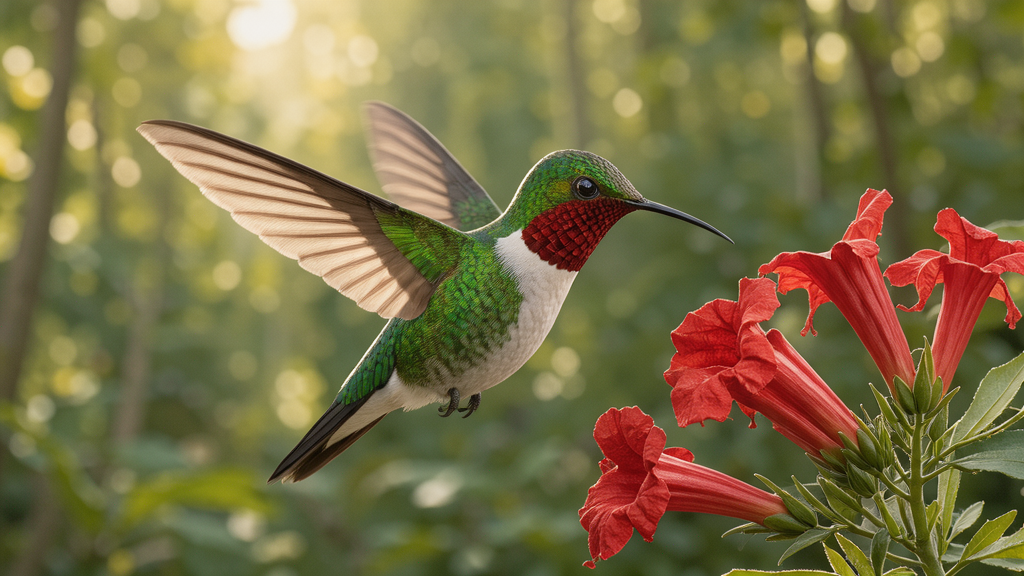
This synthesis examines what peer-reviewed research reveals about the aerodynamic mechanisms of hummingbird hovering, specifically the role of the upstroke, and how their metabolic strategies, including torpor, differ from those of insects and other birds. It is an AI-assisted evidence synthesis, not original research or a peer-reviewed paper.
Traditional avian flight models suggest that the upstroke is a recovery phase where birds fold or flex their wings to reduce drag, producing trivial aerodynamic forces. However, hummingbirds deviate from this pattern. Tobalske et al. used synchronized high-speed (500 Hz) video cameras to measure the three-dimensional wing and body kinematics of rufous hummingbirds (Selasphorus rufus, 3 g, N=5) as they flew at velocities of 0-12 m s(-1) in a wind tunnel. The study found that although hummingbirds flex their wings slightly at the wrist during upstroke, their average wingtip-span ratio of 93% revealed that they have kinematically rigid wings compared with other avian species.
Further research by Menzer et al. (2022) on yawing maneuvers confirmed that unsteady aerodynamic forces, including drag-based asymmetric force generation during both downstroke and upstroke, are critical for maneuvering precision. The study highlighted that wing flexibility is essential for generating the torque necessary for turns while producing sufficient lift for weight support.
The energetic cost of hovering is immense. Hummingbirds have the highest mass-specific metabolic rates among all vertebrates. A study by Shankar et al. found that daily energy expenditure (DEE) scales with body mass with a slope of 0.95, significantly higher than the 0.68 slope for all birds. This indicates that larger hummingbirds are less metabolically efficient than smaller ones, likely due to the high energetic demands of hovering and flight.
To manage these costs, hummingbirds use daily torpor. Eberts (2023) demonstrated that torpor use is not merely a response to energy emergencies but is governed by a flexible "adipostat" mechanism. In summer breeding periods, birds use torpor to survive energy emergencies when fat levels are critically low. In fall migration, torpor becomes a routine fat-sparing strategy to conserve energy for long-distance travel. This seasonal shift highlights the adaptability of hummingbird energy management.
While direct comparative data on hummingbird and insect flight mechanics is limited in the provided sources, a 2026 review by Prisăcariu and Dumitrescu notes that biological flight principles from insects, birds, and bats inform the design of micro air vehicles (MAVs). The review emphasizes that MAVs operating at low Reynolds numbers face aerodynamic and structural challenges distinct from conventional aircraft, and it reviews key unsteady aerodynamic phenomena governing low-Reynolds-number flight, including leading-edge vortex stability, wing-wake interactions, tandem-wing effects, and ground influence.
| Study | Setting | Method | Result | Limitation |
|---|---|---|---|---|
| Tobalske et al. (2007) | Rufous hummingbirds in wind tunnel | High-speed video (500 Hz) | Kinematically rigid wings (93% span ratio) | Controlled environment |
| Menzer et al. (2022) | Hummingbird yawing maneuvers | CFD simulations | Asymmetric drag controls turn speed | Simulation-based |
| Shankar et al. (2020) | Hummingbird clades | Allometric scaling | DEE slope 0.95 vs 0.68 for all birds | Phylogenetic constraints |
| Eberts (2023) | Ruby-throated hummingbirds | Field and lab torpor studies | Seasonal adipostat mechanism | Single species focus |
The high metabolic efficiency of smaller hummingbirds suggests a trade-off between size and energy cost. Shankar et al. found that the DEE-body mass relationship for hummingbirds has a slope of 0.95, significantly higher than the 0.68 slope for all birds. This indicates that larger hummingbirds are less metabolically efficient than smaller ones, likely due to the high energetic demands of hovering and flight. While smaller species can hover more efficiently per unit mass, they carry less energy reserves, making them more vulnerable to energy shortages. This is mitigated by their ability to enter torpor, but this strategy requires careful timing to avoid depleting fat stores needed for migration or breeding.
Most aerodynamic studies are conducted in controlled wind tunnel settings, which may not fully capture the complexity of natural flight environments. Metabolic studies often rely on laboratory conditions or limited field observations, which may not reflect the full range of energetic challenges hummingbirds face in the wild. Additionally, the specific mechanisms governing the transition between torpor and normothermy are still being elucidated.
This synthesis is based on a review of peer-reviewed studies and dissertations retrieved from stored passages. The search focused on hummingbird wing kinematics, upstroke lift, metabolism, torpor, and comparisons with insect flight. The evidence was synthesized to provide a comprehensive overview of the current scientific understanding, highlighting key findings, trade-offs, and limitations. Access was limited to selected verbatim passages, not complete paper texts.
Hummingbirds are best observed in the early morning or late afternoon when they are most active. Look for them hovering in front of flowers, particularly tubular flowers like fuchsia or bee balm. Their rapid wingbeats create a distinctive humming sound. To identify species, note the size, coloration, and behavior. For example, the Ruby-throated Hummingbird (Archilochus colubris) is common in eastern North America, while the Rufous Hummingbird (Selasphorus rufus) is found in western regions. Use binoculars or a telephoto lens to get a closer look without disturbing them.
