
Drought reshapes bird distribution and behavior by stripping away water and food resources, forcing species to contract ranges, shift to resilient habitats, and alter foraging strategies. In Puerto Rico, bird distributions contracted during a severe drought, while in China's Poyang Lake, Oriental Storks concentrated in sub-lakes with larger catchment areas and increased foraging effort in deeper water. These examples highlight that water stress drives species-specific and scale-dependent changes in avian ecology.
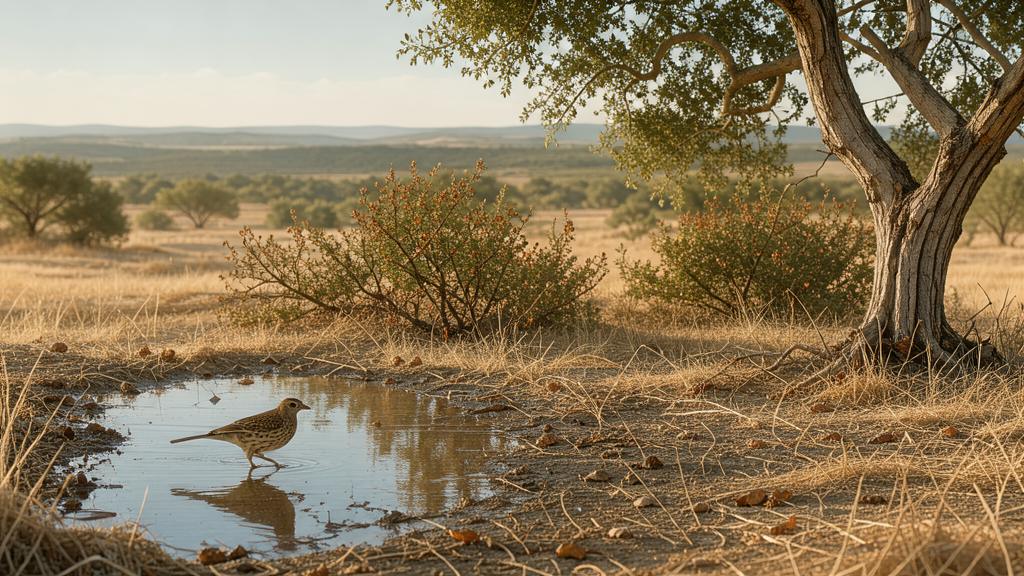
Drought is not merely a lack of rain; it is a cascade of ecological changes that directly impacts the resources birds depend on. For many species, water is a limiting factor for both survival and reproduction. When water levels drop, wetlands shrink, vegetation dries out, and prey populations decline. This forces birds to either adapt their behavior, move to new areas, or face population declines.
One of the most direct effects of drought is range contraction. A study in El Yunque National Forest, Puerto Rico, documented species occupancy and detectability in 59 sites along three elevational transects. The study period included a severe drought (2015–2016) and a category 4 hurricane (2017). The results suggest that for many species, particularly birds, the 2015–2016 drought in Puerto Rico had a greater negative effect than the hurricane. Furthermore, Puerto Rican frogs reproduce year-round, whereas birds concentrate their reproduction during a few months in the wet season.
Waterbirds often exhibit immediate behavioral changes in response to drought. In Poyang Lake, China, Oriental Storks (Ciconia boyciana) responded to drought-induced low water levels by concentrating in sub-lakes with larger catchment areas. Over time, Oriental Storks exhibited a gradual concentration in Changhu Lake, characterized by larger catchments, after resource depletion in sub-lakes with smaller catchments. As resources depleted, the storks shifted their foraging behavior, spending more time in deeper water and reaching their heads and necks into deeper water to forage. In accordance with area-restricted search theory, reductions in habitat quality resulting from drought, including extensive fish die-offs, forced Oriental Storks to increase their foraging efforts. Sustaining a specific water area in sub-lakes during droughts can preserve resource availability, which is crucial for the conservation of Oriental Storks.
Drought can also influence the timing of migration and breeding. While temperature is often the primary driver of phenological shifts, drought conditions can alter the availability of food and water along migration routes. A review by Gordo (2007) highlights that adverse weather conditions en route can hinder progression and force birds to land, affecting stopover duration and overall migration timing. The timing of life-cycle events in migratory birds is under the control of endogenous rhythms, which can constrain the plasticity of responses to climatic changes in some species.
Research on whooping cranes (Grus americana) shows that migration timing is not just a fixed response to climate but a learned skill. Older cranes, with more experience, are better at tracking environmental conditions such as vegetation greenness and snow depth. This experiential learning allows them to adjust their migration speed and timing to optimize foraging opportunities. Specifically, experiential learning enabled older individuals to tune their migratory movements to simultaneously track forage conditions and reduce cumulative snow exposure, which in turn can reduce energy expenditure during migration. Subadults relied primarily on social learning: migrating with older birds significantly increased subadults’ responsiveness to environmental conditions during their first independent autumn migration. Migrating with older birds allowed subadult cranes to better respond to environmental conditions encountered en route, indicating an important role of social learning in the ontogeny of behavioral plasticity during migration in this species.
Not all birds respond to drought in the same way. In glacial marshes of the central United States and Canada, the drought of the late 1950s and early 1960s produced dramatic effects on the quality and quantity of emergent vegetation. These vegetative changes had a great impact on the distribution and size of marsh bird populations. Similar plant responses must have resulted from the dry years of the late 1800s and the 1930s, and intervening wet years produced opposite extremes on many marshes. Such habitat changes undoubtedly have occurred throughout the racial history of many marsh animals, and the maintenance of a species depended upon its adaptability.
To observe the effects of drought on bird distribution and behavior, you can conduct a simple field exercise:
Data Sheet Template: To ensure your data is useful for citizen science, record the following specific metrics for each observation session:
Interpreting Your Data: If you observe birds foraging in significantly deeper water than usual, it may indicate that shallow, productive zones have dried up, forcing them to expend more energy to access food. This mirrors the response of Oriental Storks in Poyang Lake, where drought-induced low water levels forced birds to reach their heads and necks into deeper water to forage, a specific indicator of shallow zone loss. An increase in time spent foraging relative to resting suggests that food is becoming scarcer or harder to catch, a common response to drought-induced habitat degradation. Conversely, if birds are abandoning a site entirely, it may signal that local resources have fallen below the threshold needed to sustain them.
Next Step: Share your observations with local birding groups or upload them to established citizen science platforms to contribute to community efforts tracking drought impacts.
While the evidence for drought impacts on birds is growing, there is still much uncertainty. Most studies focus on specific species and regions, and the mechanisms driving these responses are complex. Future research needs to incorporate range-wide assessments and consider the interactions between drought, land-use change, and climate change. Additionally, the role of learning and behavioral plasticity in helping birds adapt to drought is an area that requires further investigation.
