
The Elf Owl (Micrathene whitneyi) is the smallest owl in the world, measuring just 12.4–14.2 cm in length. It inhabits arid to semiarid lowlands and mountains across the southwestern United States and Mexico, favoring deserts, thorn woodlands, and riparian forests. Nocturnal and insectivorous, it is best observed at dusk or dawn by watching for its distinctive flight patterns and listening for its soft whistles.
Learn to identify
Adult Elf Owl perched on a dead branch at night.
Learning lesson · openly licensed photographs, labelled by BirdBot; labels checked against the cited sources and approved by AI
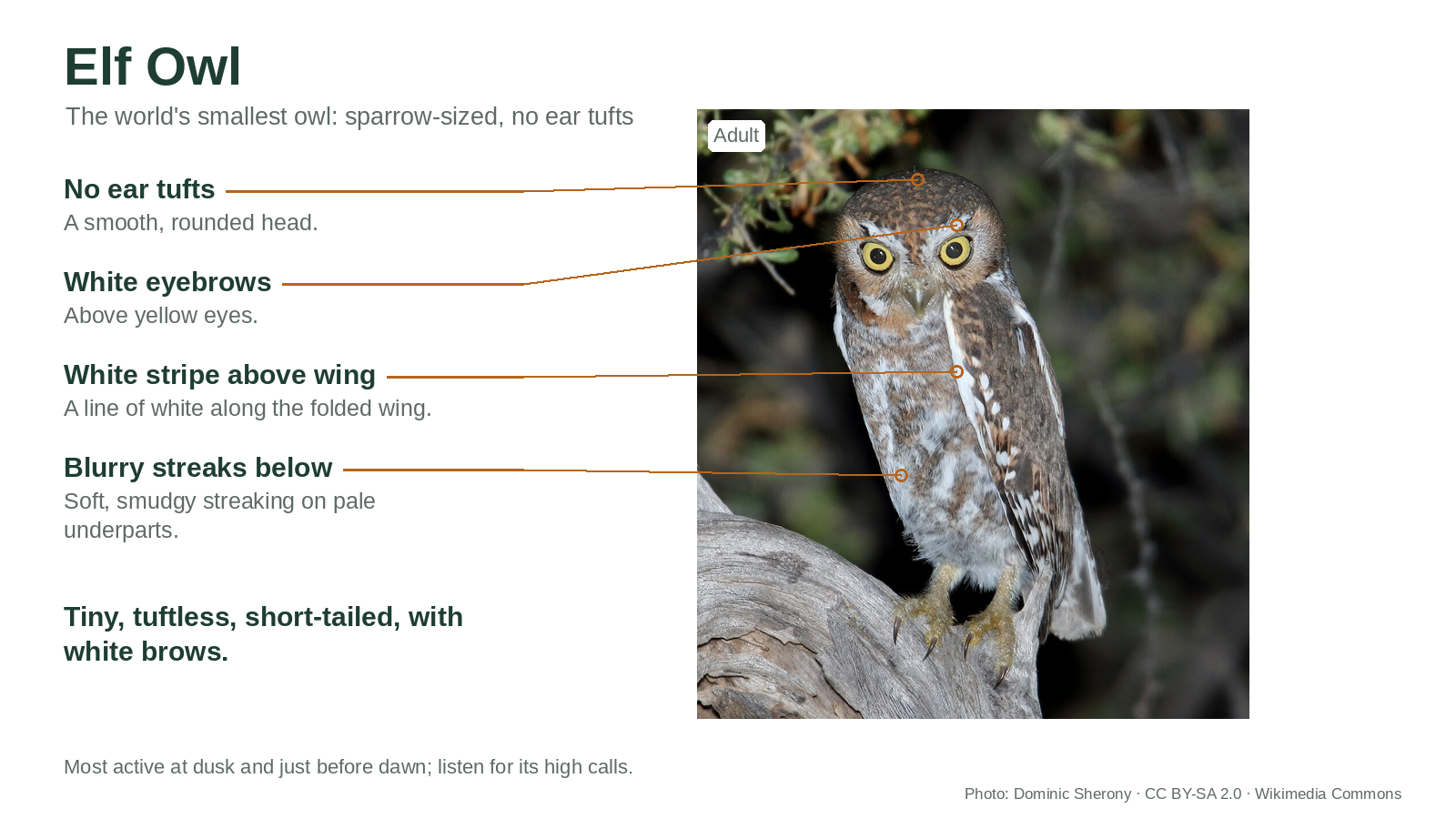
No ear tufts: a smooth, rounded head. White eyebrows: above yellow eyes. White stripe above wing: a line of white along the folded wing. Blurry streaks below: soft, smudgy streaking on pale underparts. Tiny, tuftless, short-tailed, with white brows.
Most active at dusk and just before dawn; listen for its high calls.
Sources: Audubon Guide to North American Birds: Elf Owl · Wikipedia: Elf owl (revision 1380664163)
Photo: Dominic Sherony, CC BY-SA 2.0, via Wikimedia Commons; labels added by BirdBot.
At 12.4 to 14.2 cm in total length and weighing between 35 and 55 grams, the Elf Owl is the smallest owl in the world. Its compact size is matched by a distinct plumage pattern that aids in camouflage against bark and cactus stems. Adults feature a grayish-brown back with buff mottling and cinnamon-brown vertical streaks on the breast. The face is marked by conspicuous white eyebrow marks and bright yellow irises, which stand out in low light. Two rows of white spots on the wings are a key field mark, especially visible in flight. Males and females look similar, though females are slightly larger, measuring about 3% longer and 6% heavier than males.
Flight and Movement: In the field, look for a small, compact owl that moves by walking, hopping, and climbing. When hunting, it strikes prey in a straight line from a perch. Between perches, it flies in distinctive U-shaped arcs, often gliding or hovering briefly. These flight patterns, combined with its small size and white wing spots, help distinguish it from other small owls.
Elf Owls occupy a wide variety of arid and semiarid habitats, from upland deserts to montane evergreen woodlands and canyon riparian forests. Their range spans the southwestern United States, including southern Arizona and southern Texas, and extends southward through the southern half of Baja California, Sinaloa, and Mexican border states. A disjunct population exists in south-central Mexico, primarily in Puebla and Oaxaca. They are also found in partially urbanized areas, where they adapt to human-modified landscapes.
Where to look: In the U.S., focus on arid lowlands and mountains in southern Arizona and Texas. In Mexico, they are common in the arid zones of Sinaloa and the border states. Look for them near saguaro cacti, Arizona sycamores, and alligator junipers, as well as in suburban areas with mature trees and utility poles.
Elf Owls are cavity nesters, relying on pre-existing holes rather than building nests. They typically use old woodpecker holes in columnar cacti like the saguaro (Carnegiea gigantea), trees such as the Arizona sycamore (Platanus wrightii), and agave or yucca flowering stalks. In canyon riparian and evergreen woodlands, alligator juniper (Juniperus deppeana) is a common host for nest cavities. In suburban and agricultural areas, they may use fence posts, utility poles, or nest-boxes. Males are polyterritorial, defending multiple cavities for roosting or renesting if the primary nest fails. Breeding occurs annually from April to July, with clutches usually containing three eggs, though sizes range from one to five. Young fledge 28 to 33 days after hatching.
Elf Owls are primarily nocturnal, with most activity occurring at dusk and before dawn. They move by walking, hopping, and climbing, with a parrot-like ability to grip branches. Their hunting strategy is a mix of sit-and-wait and active pursuit. They often strike prey in a straight line from a perch, but also fly in U-shaped arcs between perches, glide, and hover. In urbanized areas, they forage near outdoor lights, lighted windows, and even hummingbird feeders, catching insects in flight with their feet or beak. According to the Animal Diversity Web account, they are known to remove dangerous body parts, such as scorpion stingers, before consuming prey.
The Elf Owl's voice is a key identification tool. Males sing from cavities to claim territory and attract females, producing a song that rises and falls in volume. Both sexes use a short, single, soft whistle to communicate during nesting, often while feeding young. When threatened, Elf Owls bark, flip their tails quickly, and clap their bills. Nestlings peep, squeak, and rasp at high rates when hungry, trilling at high pitches when fed.
The Elf Owl is classified as Least Concern (LC) in the AviList v2026 checklist. Local threats include habitat loss due to deforestation, which destroys the woodpecker holes they depend on for nesting. Conservation efforts have included the installation of nest-boxes modeled after woodpecker cavities, though the effectiveness of these measures varies and requires further study. The species is protected under the US Migratory Bird Treaty Act (MBTA) and listed under CITES Appendix II.
Observing Elf Owls requires patience and minimal disturbance. The best time to look is at dusk or dawn, when they are most active. Listen for the male's song from a cavity and watch for the distinctive flight patterns described in the Identification section. Maintain a safe distance and avoid using lights or calls that could stress the bird or disrupt its foraging. In urban areas, check around outdoor lights and feeders, but do not approach nests or roosts.
Next Step: Record your sighting in eBird to contribute to community science data. This helps researchers track population trends and habitat use in real-time.


