
The Eastern Towhee (*Pipilo erythrophthalmus*) and Spotted Towhee (*Pipilo maculatus*) are sister species distinguished primarily by geographic range, plumage spotting patterns, and song structure. Eastern Towhees occupy eastern North America and feature a black back with white spots on the wing coverts, while Spotted Towhees inhabit the western U.S. and Mexico with a black back and white spots on both the back and wings. Their songs differ in trill rate and introductory syllables, with the Eastern Towhee producing a slower trill and a distinct introductory phrase.
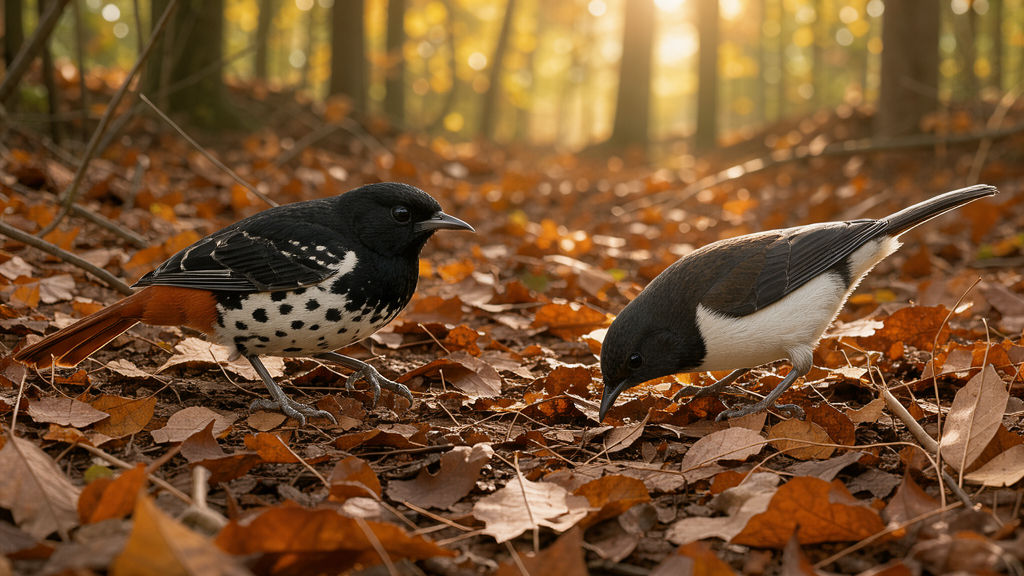
Both species share a similar overall shape: a long, black tail, rufous flanks, and a black head. The critical visual difference lies in the spotting pattern on the upperparts. The Eastern Towhee has a solid black back, with white spots restricted to the wing coverts. In contrast, the Spotted Towhee displays white spots on both the back (scapulars) and the wing coverts. This distinction is consistent across adult plumage and is the most reliable visual cue for identification in the field.
Historical studies of towhee hybridization in Mexico, such as Sibley and West (1958), utilized a "hybrid index" to score plumage variation, noting that white spots on scapulars and wing coverts are a key character distinguishing *P. erythrophthalmus* from related forms like *P. ocai*. While that study focused on Mexican populations, it underscores the importance of spotting patterns in towhee taxonomy. For North American field identification, the presence or absence of spots on the back is the primary diagnostic feature.
The breeding range of the Eastern Towhee covers the eastern side of the United States and southern Canada. It favors forest edges, brushy undergrowth, and areas with dense shrubs. The Spotted Towhee breeds on the western side of the United States, extending into Mexico and southern Canada. Its habitat is often more arid and treeless, consisting of brushy undergrowth in open landscapes. The two species have partially overlapping ranges in the Great Plains, particularly in Nebraska, where hybridization has been reported.
Both species produce a loud, clear song. While the acoustic details of these components differ significantly between the species, the structural differences are the primary cues for identification.
| Feature | Eastern Towhee | Spotted Towhee |
|---|---|---|
| Introductory Phrase | Present; relatively simple whistled syllables | Reduced or entirely absent |
| Trill Rate | Slow, amplitude-modulated (AM) | High AM rate |
A 2025 study by León Du’Mottuchi and Creanza analyzed 16 song features from community-science recordings and found that while no single song feature reliably distinguishes the two species, machine learning models classified songs with high accuracy (88-90%). The study noted that species classification was less accurate in the zone of overlap, suggesting that subtle variations in multiple features contribute to species recognition. Khanna (2000) further explored the acoustic properties of these songs, finding that the Eastern Towhee's introduction blurs significantly less than its trill over long distances, potentially aiding in species identification in its native edge habitat.
The Eastern and Spotted Towhees are recently diverged sister species. Their current hybridization in the Great Plains is likely a result of secondary contact following Pleistocene glaciation, which fragmented their breeding range and accelerated speciation. In the overlap zone, particularly in Nebraska, individuals may exhibit intermediate plumage and song characteristics. A 2023 study by Rohwer et al. compared survival rates of hybrid and parental towhees, finding that hybrid towhees had survival rates similar to parentals, unlike hybrid grosbeaks which showed lower survival. This suggests that the towhee hybrid zone may be maintained by factors other than reduced hybrid fitness, such as behavioral isolation via song recognition.
To practice identifying these species, focus on the following cues during your next birding trip:
In the hybrid zone, plumage and song may be intermediate. In such cases, listen carefully to the song structure and observe the spotting pattern on the back and wings. If the bird is in Nebraska or the surrounding Great Plains, consider the possibility of a hybrid or an individual with intermediate traits.
