
The Canvasback (Aythya valisineria) is the largest species of diving duck, easily recognized by its long, sloping profile and wedge-shaped head. Males display rich reddish-brown heads and black breasts, while females are more subdued. They breed in shallow wetlands with dense emergent vegetation and winter in large lakes and estuaries, where they dive deep to forage on aquatic plants and invertebrates.
Learn to identify
Adult male Canvasback swimming, photographed in North America in December.
Learning lesson · openly licensed photographs, labelled by BirdBot; labels checked against the cited sources and approved by AI
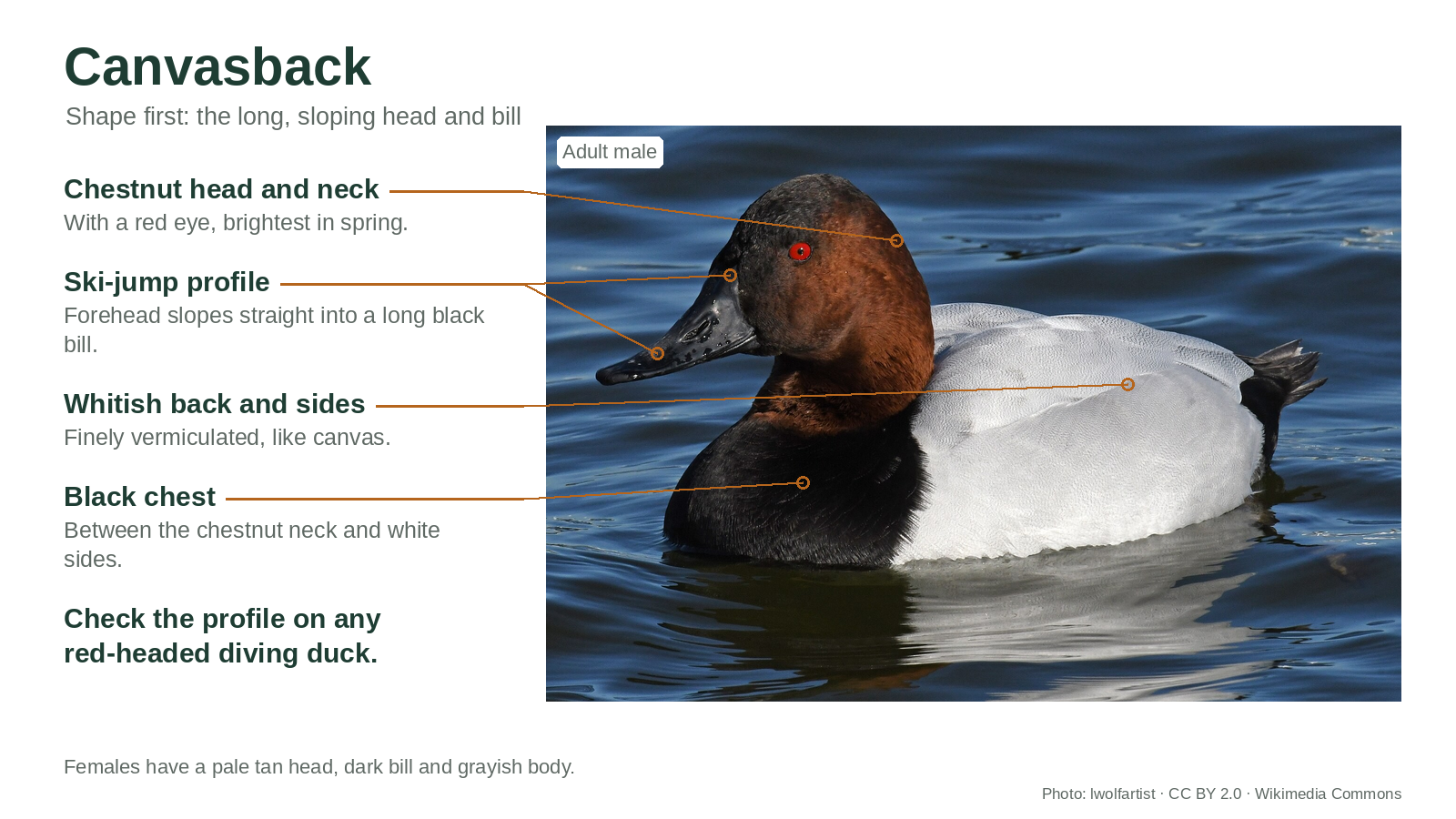
Chestnut head and neck: with a red eye, brightest in spring. Ski-jump profile: forehead slopes straight into a long black bill. Whitish back and sides: finely vermiculated, like canvas. Black chest: between the chestnut neck and white sides. Check the profile on any red-headed diving duck.
Females have a pale tan head, dark bill and grayish body.
Sources: Audubon Guide to North American Birds: Canvasback · Wikipedia: Canvasback (revision 1368509687)
Photo: lwolfartist, CC BY 2.0, via Wikimedia Commons; labels added by BirdBot.
Canvasbacks are often called the "aristocrat of ducks" due to their elegant appearance. They are the largest diving duck species, with males measuring 51 to 56 cm in body length and females 48 to 52 cm. The most critical field mark is the head shape: the bill is long and slopes continuously into the forehead, creating a distinctive wedge-like profile. This continuous slope, combined with their large size, is the primary way to distinguish them from similar species like Redheads and Scaup in the field.
Females and non-breeding males are generally brownish overall, making them harder to distinguish from other female diving ducks. In these cases, size and the distinctive wedge-shaped head remain the most reliable cues. Immature birds are also brownish and may be confused with female Redheads or Scaup, but the Canvasback's larger size and longer bill are usually apparent in good light.
Canvasbacks breed primarily in the aspen parklands of central Canada, where they favor small ponds, slow-moving rivers, and marshes with dense emergent vegetation such as cattails (Typha), bulrush (Scirpus acutus), and reeds (Phragmites communis). During migration and winter, they shift to larger aquatic areas with high food availability, including estuaries, large freshwater lakes, coastal bays, and river deltas. They may also use flooded fields and farm ponds during migration.
According to AviList v2026, Canvasbacks breed in North America from northern Alaska and western Canada southward through northern California, southern Colorado, and Minnesota, and winter as far south as central Mexico, with occasional records in central Japan. This broad range reflects their migratory nature and dependence on seasonal habitat availability.
Canvasbacks are highly social and fast-flying, often migrating in loose V-shaped flocks. They are among the fastest flying ducks, capable of reaching air speeds of up to 90 km/h (ground speed up to 115 km/h). Before takeoff, they must run along the water's surface for some distance to gain lift. In the water, they are powerful swimmers with legs positioned near the rear of their body, allowing them to dive to depths of over 9 meters for 10 to 20 seconds.
Their foraging behavior is closely tied to their diet. Canvasbacks are omnivorous and opportunistic, feeding on aquatic vegetation, snails, clams, and aquatic insect larvae. In winter and migration, they primarily consume aquatic plants, including buds, roots, tubers, and rhizomes. Their scientific name, valisineria, refers to their favorite winter food, the aquatic plant Vallisneria americana, or wild celery. During the breeding season, their diet expands to include seeds, leaves, and various aquatic invertebrates such as caddisfly larvae, damselfly and dragonfly nymphs, mayfly nymphs, and midge larvae.
Outside the breeding season, Canvasbacks forage in groups ranging from small to very large (over 1,000 individuals), primarily in the morning and evening. They use a variety of foraging techniques, including diving, stripping plants with their feet or beaks, and grabbing prey from the water surface or air. In a dive, they use their robust, cone-shaped heads to probe and excavate submerged plants. Research on prairie wetlands indicates that Canvasbacks specifically utilize hemi-marsh sites in spring, preferring habitats with intermediate water depths and vegetation cover over the most open or deepest sites used by other diving ducks like Ruddy Ducks and Lesser Scaup.
Canvasbacks are seasonally monogamous, with courtship beginning during spring migration and continuing on the breeding grounds. Females choose the same home ranges for nesting sites each year, preferring medium to large-sized, shallow wetlands with extensive emergent vegetation. Nests are built in emergent vegetation above water, though they may occasionally be built on land in protected areas. Nesting peaks in mid to late May, with one brood per year, although pairs will re-nest if the first brood is destroyed.
Females lay 5 to 11 smooth, elliptical, greenish drab eggs, with average clutch sizes ranging from 6.6 to 8.3 eggs per nest. Incubation lasts 24 to 29 days, and young are precocial, able to swim and forage soon after hatching. Males defend the nesting area initially but abandon their mates and nests during incubation. Females brood the young when the weather is cold and remain with their broods until close to migration, which may be as early as 2 to 3 weeks after hatching for late-season broods.
Canvasbacks are generally quiet ducks, but they use a variety of distress calls and emit coos and rattles during courtship. Visual signals also play a significant role in their communication, particularly in courtship displays.
Canvasbacks are listed as Least Concern (LC) in AviList v2026. They are protected as migratory gamebirds in the United States, Mexico, and Canada. While the LC category indicates the species is not currently at risk of extinction, populations can be affected by hunting pressure, habitat degradation, and pollution. Because they feed on vegetation in aquatic sediments, they are susceptible to toxins that accumulate in those sediments, particularly in areas of high industrial activity.
When observing Canvasbacks, it is important to maintain a respectful distance, especially during the breeding season when they are more vulnerable to disturbance. In winter and migration, they can be observed in large flocks in estuaries, large lakes, and coastal bays. Look for loose V-shaped flocks in flight and note their fast, direct flight pattern. On the water, watch for their deep diving behavior, where they submerge completely and resurface with food in their beaks.
Try This: Visit a large estuary or coastal bay during the morning or evening hours. Canvasbacks forage primarily during these times, so you are more likely to see them actively diving and feeding. Focus on identifying the wedge-shaped head and the continuous slope of the bill, which distinguishes them from other diving ducks in mixed flocks.


