
The Broad-winged Hawk (Buteo platypterus) is a small, stocky raptor in the family Accipitridae, easily recognized by its dark brown back, barred underside, and a broad white band across the tail. It breeds in dense deciduous or mixed forests near water and openings, and is famous for migrating in massive flocks called kettles, where it soars on thermal currents to conserve energy.
Learn to identify
Juvenile light-morph Broad-winged Hawk soaring over Brooklyn, New York, seen from below.
Learning lesson · openly licensed photographs, labelled by BirdBot; labels checked against the cited sources and approved by AI
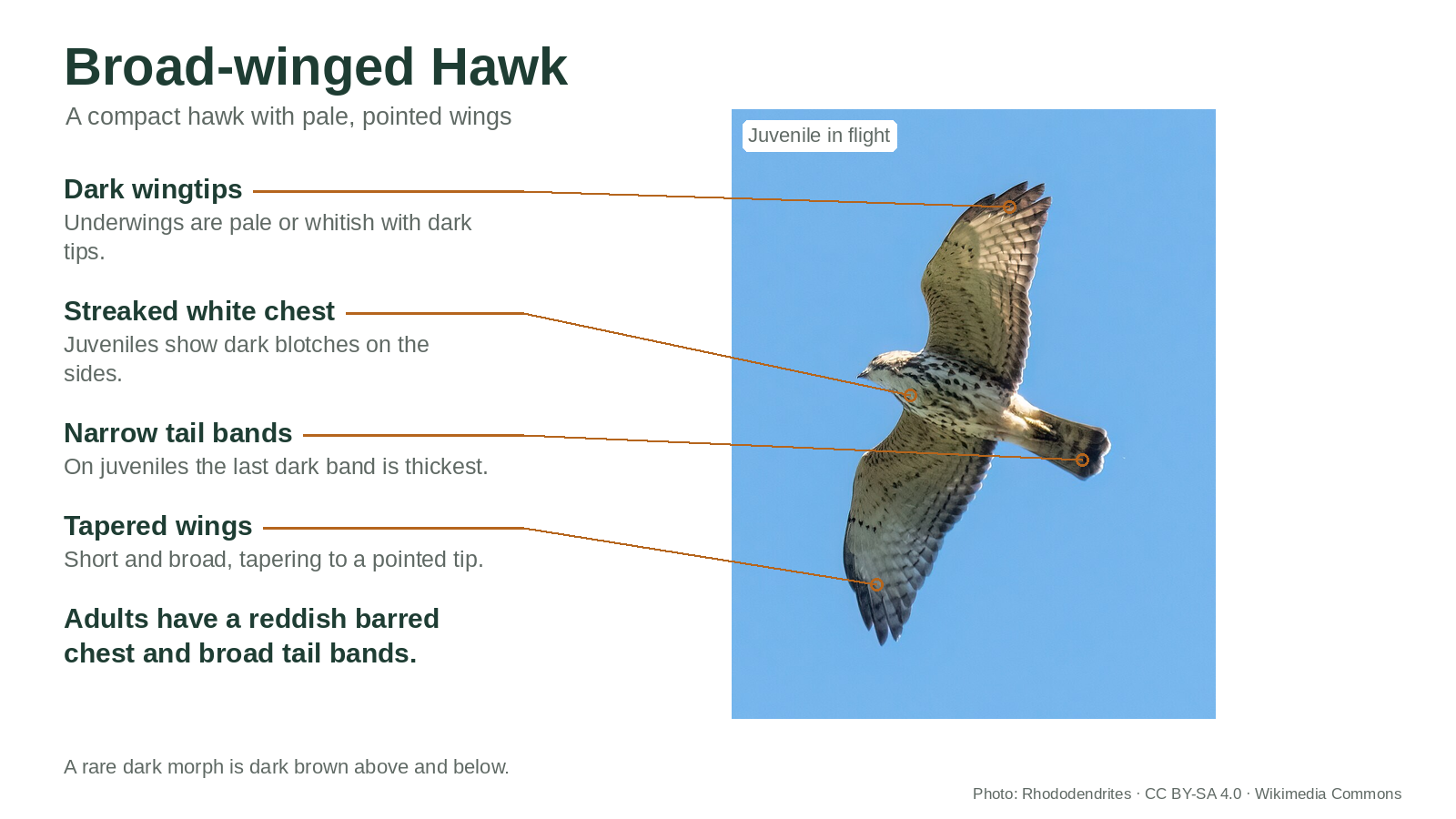
Dark wingtips: underwings are pale or whitish with dark tips. Streaked white chest: juveniles show dark blotches on the sides. Narrow tail bands: on juveniles the last dark band is thickest. Tapered wings: short and broad, tapering to a pointed tip. Adults have a reddish barred chest and broad tail bands.
A rare dark morph is dark brown above and below.
Sources: Audubon Guide to North American Birds: Broad-winged Hawk · Wikipedia: Broad-winged hawk (revision 1380657115)
Photo: Rhododendrites, CC BY-SA 4.0, via Wikimedia Commons; labels added by BirdBot.
Adult Broad-winged Hawks are compact birds, measuring 34 to 44 cm in length with a wingspan of 81 to 100 cm. Their plumage features a dark brown back and a pale underside marked with horizontal cinnamon or chestnut barring. The most diagnostic field mark is the tail: dark gray to black with a conspicuous broad white stripe across the middle, flanked by two less conspicuous white stripes at the base and tip.
When perched, the wing tips do not reach the end of the tail, a feature that helps distinguish them from other buteos. In flight, their wing tips appear pointed. Juveniles resemble adults but display longitudinal (vertical) rather than horizontal barring on the chest and belly, and they tend to have more white on the underparts. Females are larger than males, typically about 22% heavier, though the sexes look similar in plumage.
Broad-winged Hawks favor dense deciduous or mixed deciduous-coniferous forests for nesting. They prefer locations with water and openings such as roads, trails, wetlands, or meadows nearby, which they use for foraging. They tend to avoid nesting near human dwellings.
According to AviList v2026, the species breeds from central and southern Canada to the southeastern USA, is resident in the Caribbean, and winters in Central and South America, extending to Brazil and Bolivia. In winter, they occupy deciduous and mixed forest habitats at elevations ranging from sea level to several thousand meters.
Outside of migration, Broad-winged Hawks are solitary and territorial. However, they are one of the few North American raptors that migrate in large flocks. At the peak of migration, these flocks, known as kettles, can number in the tens of thousands and may include other raptor species.
During migration, they utilize thermal currents to soar, minimizing the energy spent on flapping. This behavior makes them a spectacular sight at migration hotspots. During the breeding season, they are active primarily during the day and use their characteristic calls to advertise territory occupancy.
Broad-winged Hawks are carnivores with a diet that shifts seasonally. During the nesting season, they commonly eat chipmunks, shrews, voles, frogs, lizards, and nesting birds. In winter, their diet includes insects, lizards, frogs, snakes, crabs, and small mammals. They hunt by perching and swooping down to capture prey on the ground. Mammals are eaten whole, while frogs and snakes are skinned and birds are plucked.
Broad-winged Hawks are monogamous, with pairs forming in mid- to late-April. Both parents build a stick nest in the main crotch of a deciduous tree or on a platform of branches next to a conifer trunk. The nest is lined with bark chips. The female lays 1 to 4 eggs (usually 2 to 3) and incubates them for 28 to 31 days. The male provides food to the female during incubation. Chicks are semi-altricial, covered in gray down, and leave the nest 5 to 6 weeks after hatching. They remain in the parental territory for another 4 to 8 weeks, beginning to capture their own prey at about 7 weeks old.
The most common call is a high-pitched, 2- to 4-second whistle described as "kee-ee" or "peeoweee." This call is used for territorial disputes and communication with mates or offspring. There are four recognized calls in total, used in various social situations.
The Broad-winged Hawk is classified as Least Concern (LC) in AviList v2026. In North America, the species is considered quite common.
Observing Broad-winged Hawks during migration offers a unique opportunity to study raptor behavior. To observe ethically, use established overlooks or maintain a significant distance to avoid disturbing the flock's soaring patterns. A useful field exercise is to count the number of Broad-winged Hawks in a kettle over a 10-minute period from a fixed, non-intrusive vantage point and note the presence of other raptor species. This contributes to community science data on migration intensity and species composition.
When identifying Broad-winged Hawks within a mixed kettle, focus on the tail pattern: look for the broad white band across the middle of the tail, which distinguishes them from many other buteos. Use binoculars to check for the stocky build and pointed wing tips in flight. Since kettles can contain tens of thousands of individuals, scanning for the distinctive tail band is often more effective than trying to resolve fine plumage details at a distance.


