
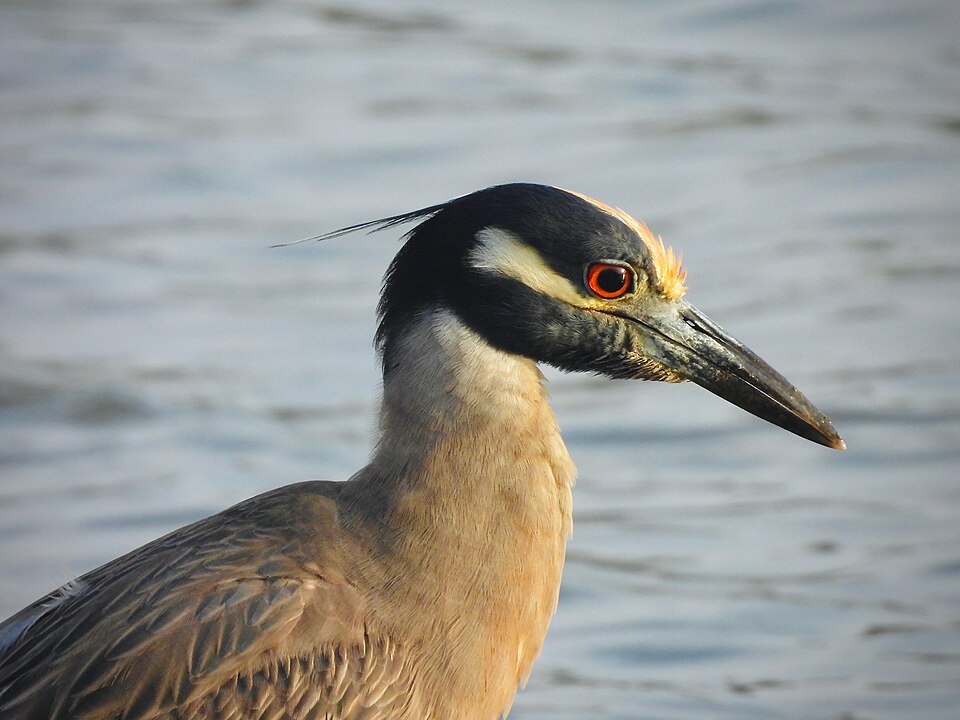
The Yellow-crowned Night Heron (Nyctanassa violacea) is a medium-sized wading bird in the family Ardeidae, weighing between 650 and 800 g. It is a crustacean specialist that inhabits both inland freshwater wetlands and coastal mangroves, foraging at all hours despite its name.
Learn to identify
Adult Yellow-crowned Night Heron walking on the beach at Boca Raton, Florida.
Learning lesson · openly licensed photographs, labelled by BirdBot; labels checked against the cited sources and approved by AI

Pale yellow crown: from the bill over the head; often looks whitish. White cheek stripe: part of a black-and-white striped face. Scaled grey back: grey-blue with a black scaled pattern. Yellow legs: long; coral to red during courtship. Grey body, striped head, thick black bill.
Young birds are brown and spotted, like young Black-crowned.
Sources: Audubon Guide to North American Birds: Yellow-crowned Night Heron · Wikipedia: Yellow-crowned night heron (revision 1383537733)
Photo: Ianaré Sévi, CC BY 3.0, via Wikimedia Commons; labels added by BirdBot.
| Quick Reference | Details |
|---|---|
| Range | Central and eastern USA to eastern Brazil; Galapagos (AviList v2026). |
| Conservation | Least Concern (AviList v2026). |
| Key Flight Cue | See Identification for the flight cue distinguishing this species from the Black-crowned Night Heron. |
Adults display a slate-gray body with a black head, a white streak across both cheeks, and a distinct yellowish crown and plumes. Their bill is black, broad, and stout, while their legs are orange-to-yellow and their eyes are noticeably red. The feathers on their wings, mantle, and back have black centers edged in light gray, creating a scaled appearance.
Juveniles look entirely different. They are grayish-brown across the body and head with fine white speckles. Crucially, they lack the yellow crown and plumes, though they do possess the red eyes of the adult. Their bill and legs are black. Juveniles slowly develop adult plumage over several years of molting.
Immature Yellow-crowned Night Herons closely resemble juvenile Black-crowned Night Herons. The most reliable field cue to distinguish them is in flight. In Yellow-crowned Night Herons, the feet and part of the legs extend beyond the tail. In Black-crowned Night Herons, the feet and legs are barely visible in flight.
Yellow-crowned Night Herons occupy two major habitat types. Inland, they are found in freshwater wetlands, wooded swamps, marshes, and lowlands that regularly flood. Along the coast, they inhabit brackish to saline thickets, lagoons, mangrove forests, and rocky, cliff-bound coasts. They have even been observed on dry islands in the Caribbean Sea with little fresh water. Their presence is tied to these habitats because their diet consists mostly of aquatic prey.
According to AviList v2026, the species' range extends from the central and eastern USA to eastern Brazil, including the Galapagos. Nests are built at a variety of heights, ranging from a few meters above the water to tree branches 12 meters above the ground.
These herons are crustacean specialists. Over 80% of their diet consists of crayfish and crabs, particularly fiddler crabs, marsh crabs, and green crabs. Their wide, stout beak is well-adapted for crushing crustacean exoskeletons. Inland herons eat primarily crayfish, while coastal herons consume mostly crabs.
The remaining 20% of their diet includes mussels, snails, aquatic worms, insects, leeches, amphibians (frogs and tadpoles), and small fish such as eels and pipefish. They also hunt terrestrial organisms like lizards, snakes, small mammals, and young birds that fall from nests.
Despite the "night" in their name, they do not exclusively hunt at night and have been observed foraging at all hours. They typically forage alone, walking slowly through shallow water and stalking prey. A large group of herons in one area may indicate an abundant food source. Juveniles are less efficient foragers than adults and often learn by observation, sometimes being outcompeted by adults in group settings.
Yellow-crowned Night Herons are monogamous and nest either alone or in colonies of four to five nearby nests. Pair formation occurs during migration or early in the breeding season. The male typically collects materials, while the female builds the nest, which is a platform of sticks lined with leaves or needles. In freshwater habitats, oak branches and pine needles are common; in brackish conditions, mangrove materials are used.
Nest location varies by habitat. Inland herons tend to nest in the upper reaches of the canopy, while coastal herons nest closer to the water surface, often in low mangrove swamps. They breed once a year, usually laying three to five oval, pale blue-green eggs. Incubation lasts two to three weeks, and both sexes participate. Chicks fledge in six to eight weeks but remain dependent on their parents for food and foraging lessons for a couple more weeks.
Adults use six major types of calls. The most common is the "scaup" call, a loud, high-pitched quawk used when startled or leaving the colony. Breeding calls include a "whoop" during stretch displays, a "huh" during pair formation, and a soft "yup, yup" during the greeting ceremony. Aggressive calls, such as "ahhh, ahhh," squawks, and bill snaps, are used to defend the nest against intruders.
The Yellow-crowned Night Heron is listed as Least Concern (LC) in AviList v2026. While the species has historically been hunted for food in areas like southern Louisiana and the Bahamas, this hunting has not caused a severe threat to its population.
To observe Yellow-crowned Night Herons ethically, maintain a safe distance, especially in shallow wetlands or mangroves where they forage. Look for slow stalking movements in the water and, if they take flight, note the flight cue described in the Identification section. Avoid using call playback to lure them, as this can disrupt foraging and breeding behaviors.
Where and When to Look: Inland, target freshwater swamps and wooded marshes; along the coast, check brackish thickets, mangroves, and lagoons. They have been observed foraging at all hours of the day.
Next Step: Record your sighting in eBird or iNaturalist to contribute to range expansion data. This helps track how the species is moving into new areas and supports conservation planning for wetland habitats.


