
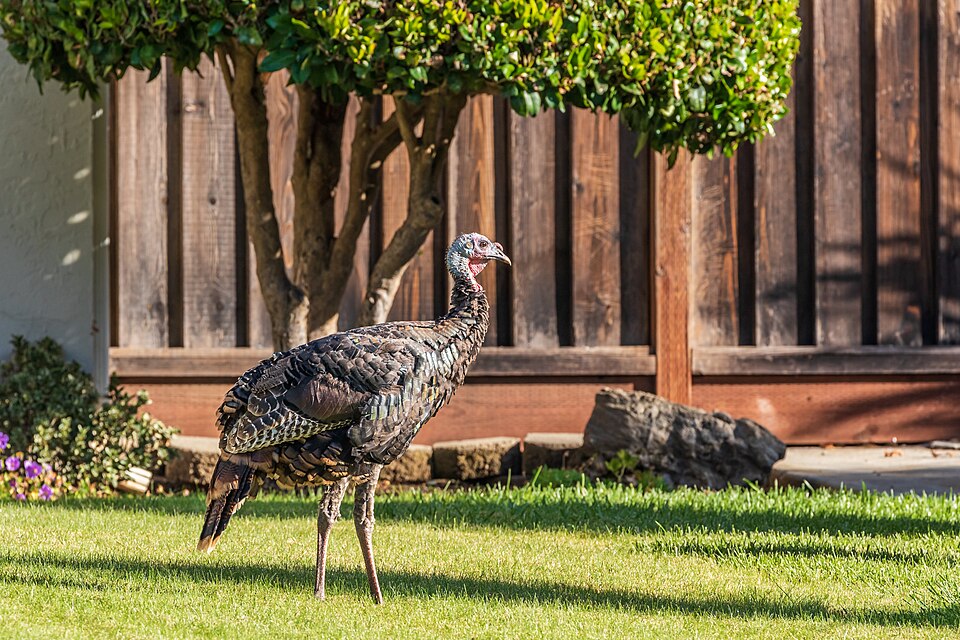
The Wild Turkey (Meleagris gallopavo) is a large, ground-dwelling bird in the order Galliformes and family Phasianidae. Males (toms) are distinguished by dark iridescent plumage, a blackish breast tuft (beard), and fleshy red, blue, or white head caruncles, while females (hens) are smaller, duller, and typically lack a beard. They inhabit mixed forests with adjacent open fields across North America; AviList v2026 records the species as Least Concern.
Learn to identify
Adult male Wild Turkey in display (Creekside Park, North America).
Learning lesson · openly licensed photographs, labelled by BirdBot; labels checked against the cited sources and approved by AI

Featherless head: bare skin flushes red when excited. Red wattles: hang from the throat of mature males. Fan-shaped tail: long and wide; spread in display. Beard: hair-like tuft from the breast of most males. Bare head, wattles and a fanned tail: a displaying tom.
Females and young are smaller, duller and mostly lack beards.
Sources: Audubon Guide to North American Birds: Wild Turkey · Wikipedia: Wild turkey (revision 1383359386)
Photo: Caleb Putnam, CC BY-SA 2.0, via Wikimedia Commons; labels added by BirdBot.
Wild Turkeys exhibit strong sexual dimorphism, making it relatively easy to distinguish sexes in the field, particularly during the breeding season. Males, known as toms or gobblers, are significantly larger and more colorful than females.
Look for Wild Turkeys where woodland meets fields or clearings. Their North American range includes eastern and western populations. They are generally non-migratory, although some seasonal wandering occurs. The Audubon account describes varied wooded habitats rather than a single habitat type.
Wild Turkeys are active by day and roost in trees at night. They form social groups; winter bands may develop dominance hierarchies. Watch a flock quietly from a distance, noting which birds feed, walk or pause to look around.
Wild Turkeys are vocal birds with a repertoire of distinct calls. The most famous is the male's "gobble," which is used primarily during the breeding season to attract females and repel rival males. Biologists recognize at least 15 different wild turkey vocalizations, including the widely recognized "gobble." Other vocalizations are used by both sexes to communicate a variety of messages, though specific functions for individual calls beyond the gobble are not detailed in the primary sources.
Wild Turkeys are omnivores. Their diet consists primarily of vegetable matter, including acorns, nuts, seeds, buds, leaves, and fern fronds. They also consume ground-dwelling insects and salamanders. They walk while feeding and scratch through leaf litter to uncover food, as described in the Audubon field guide.
Wild Turkeys are polygynous, meaning one male may mate with multiple females. Courtship begins in early spring, with southern populations starting in late January and northern populations in late February. Males perform a display called "strutting," where they fan their tails, lower their wings, and inflate their crops while gobbling.
Females build a shallow depression on the ground, usually concealed by dense brush, vines, or fallen trees. The chicks are precocial, meaning they are able to walk and feed themselves within 24 hours of hatching. The female cares for the young, which stay with her through the fall (males) or early spring (females). Males provide no parental care.
AviList v2026 records the Wild Turkey as Least Concern. This is the category in that dataset, not a new assessment or a claim that every local population is abundant.


