
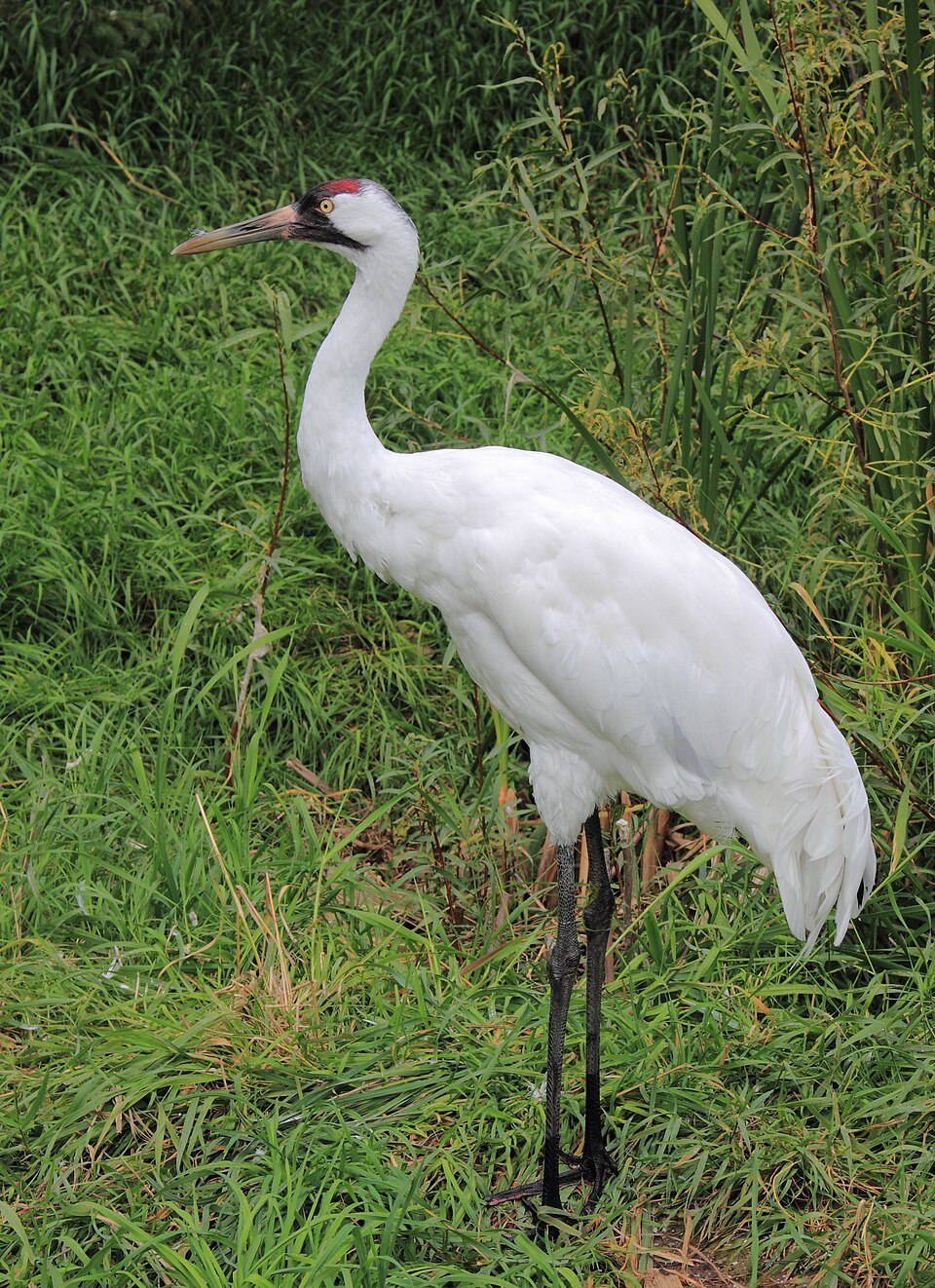
The Whooping Crane (Grus americana) is a large, white crane with black primary wing feathers, long black legs, and a distinctive red bare crown. It measures 130 to 160 cm in length with a wingspan of 200 to 230 cm. Classified as Endangered (EN) in the AviList v2026 checklist, this species breeds in the open wetlands of northern Canada and winters in coastal bays and marshes of southeastern Texas. Key field cues include its head-bobbing gait, synchronized courtship dances, and loud, trumpeting unison calls.
Learn to identify
Adult Whooping Crane standing in grass at the Calgary Zoo (a typical adult, not a wild bird).
Learning lesson · openly licensed photographs, labelled by BirdBot; labels checked against the cited sources and approved by AI

Red crown: bare red skin on top of the head. Dark face pattern: black marks on the face below the eye. White body: adults are mostly white; black wingtips show in flight. Long dark legs: trail behind the tail in flight. Bigger than any egret; Sandhill Cranes are grey.
Immatures are cinnamon-brown on the head and back.
Sources: Audubon Guide to North American Birds: Whooping Crane · Wikipedia: Whooping crane (revision 1380782589)
Photo: Sasata, CC BY-SA 3.0, via Wikimedia Commons; labels added by BirdBot.
Adult Whooping Cranes are unmistakable in their habitat, but distinguishing them from similar species requires attention to specific details. The bird is primarily white, with black primary wing feathers that are visible in flight. The long legs are black, while the toes are a grayish-rose color. The most striking feature is the bare skin on the crown, lores, and malar areas, which varies from bright red to black and is covered in short, black bristles. The eyes are yellow, and the bill is pinkish at the base but mostly gray or olive.
The primary confusion species is the Sandhill Crane. Sandhill Cranes are gray and smaller than Whooping Cranes, though they may appear white in bright sunlight. In flight, Wood Storks can also resemble Whooping Cranes, but they differ by having black secondary as well as primary feathers, yellow feet, and a short neck with bare, dark skin. Juvenile Whooping Cranes have feather-covered heads and white plumage blotched with cinnamon or brown, which helps distinguish them from adults.
| Feature | Whooping Crane | Sandhill Crane | Wood Stork |
|---|---|---|---|
| Plumage | White with black primaries | Grayish | White with black primaries and secondaries |
| Head | Bare red/black crown with bristles | Bare red crown | Bare dark skin, short neck |
| Legs/Feet | Black legs, grayish-rose toes | Black legs | Yellow feet |
| Size | 130-160 cm length | Smaller than Whooping Crane | Similar size, different neck structure |
Whooping Cranes prefer open areas close to large amounts of water and vegetation, which allow them to visually detect predators. Breeding habitats include wetlands, marshes, and shallow ponds, specifically favoring bulrush (Scirpus validus) marshes, diatom ponds, willow, sedge meadows, and mudflats. Bogs are typically avoided. The species prefers marshes with a neutral to slightly alkaline pH range of 7.6 to 8.3.
During migration, they seek similar habitats in wetlands, submerged sandbars, and agricultural fields. Wintering grounds are found in brackish bays and coastal marshes. The elevation varies significantly between ranges: the Aransas National Wildlife Refuge on the Gulf Coast is at low elevations (0-10 m), while the northern breeding grounds in Wood Buffalo National Park can reach elevations of up to 945 m.
Whooping Cranes are diurnal and roost on the ground at night. They live primarily in breeding pairs or small family groupings. A distinctive behavior is the head-bobbing gait they exhibit while walking. In flight, they can flap, soar, or glide, with soaring and gliding being more important for long migratory journeys. They also use distraction and threat displays to ward off predators.
Courtship is a complex, synchronized ritual. Pairs form around two or three years old and bond through unison walks, calls, and dances. The dance involves bowing, hopping, and wing flapping, followed by repeated leaps into the air on stiff legs until both individuals leap in sync. The male may jump over the female as she bows. Unison calling is also critical for pair maintenance, with the male producing a lower call and positioning his head straight up, while the female is completely vertical or forward of vertical.
Whooping Cranes are omnivorous, consuming a variety of plant and animal material on the ground and in water. Their diet shifts seasonally:
Whooping Cranes are monogamous and breed once a year, typically from late April to May. Both sexes participate in building a flat, ground nest, usually on a mound of vegetation surrounded by water. Drought can render nesting sites unsuitable. Typically, two eggs are laid, with an incubation period of 30 to 35 days. Both parents share incubation duties equally, while the non-incubating partner guards the nest.
Fledging occurs between 80 to 100 days, but the young remain with their parents until independence at 9 months of age. Parents continue to feed and care for the fledgelings, with the female providing food more often than the male. Sexual maturity is reached between 4 and 5 years old.
Vocal communication is the key form of interaction for Whooping Cranes. They possess a diverse repertoire of calls, including contact, stress, distress, food-begging, flight-intention, alarm, hissing, flight, guard, location, precopulation, unison, and nesting calls. Unison and guard calls are specifically linked to territory defense and pair formation. These calls serve to deter predators, warn of attacks, protect young, and locate other individuals within the species.
The Whooping Crane is listed as Endangered (EN) in the AviList v2026 checklist. The species has recovered from near-extinction levels in the 1940s and 1950s, when the population was critically low. Conservation efforts have included protection under laws such as the United States Migratory Bird Act, as well as intensive captive breeding and re-introduction programs. Techniques such as costume-rearing, where human caretakers dressed as cranes raise eggs, and the use of small aircraft to guide juveniles on their first migration, have been employed to help re-introduced birds learn migration routes. While these methods have had mixed success, the overall population trend is not explicitly quantified in the provided sources; historical recovery is documented, but current census data is required to confirm ongoing increases.
When observing Whooping Cranes, it is crucial to maintain a significant distance to avoid disturbing these wary birds. Their great height allows them to see observers from long distances above the marsh grass. Look for the head-bobbing gait while walking or synchronized flight patterns to distinguish them from similar species. Observing from a distance in open wetlands provides the best chance to see their natural behaviors without causing stress.
Responding to Distress Displays: Whooping Cranes use distraction and threat displays to intimidate and ward off perceived predators. If you witness a crane displaying agitation or defensive posturing, you are being perceived as a threat. In this case, retreat immediately and quietly to a greater distance. Do not attempt to photograph or observe the display up close, as this can escalate the bird's stress response and disrupt its protective behavior.


