
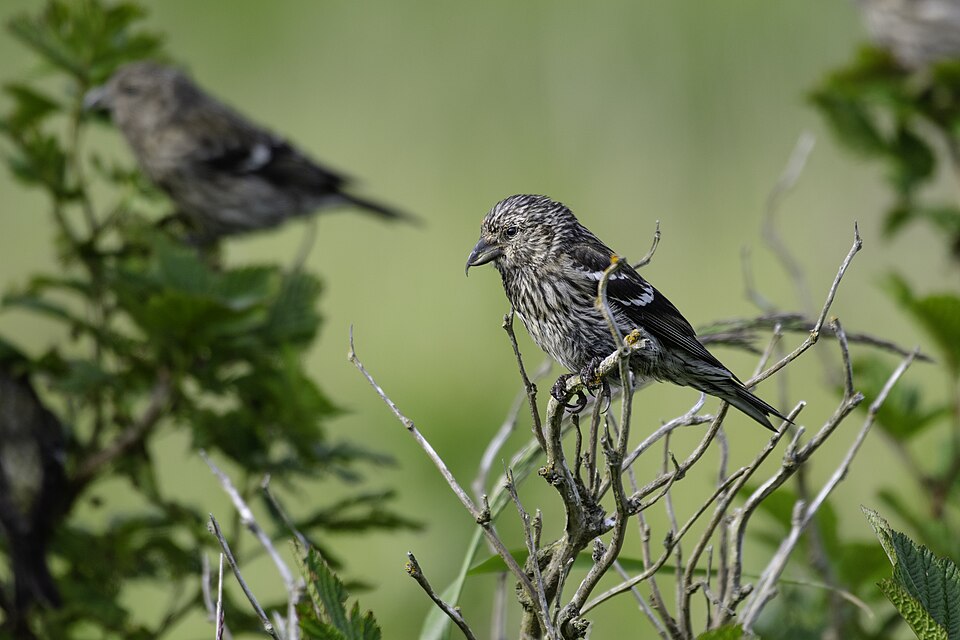
The Two-barred Crossbill (Loxia leucoptera), also known as the White-winged Crossbill, is a small passerine in the finch family (Fringillidae) distinguished by two prominent white wing-bars, white tertial tips, and a crossed bill. Males are raspberry-red, while females are greenish-yellow. It is a specialist feeder on conifer cones, with a strong preference for larch, and breeds in coniferous forests across the subarctic to northern temperate Holarctic regions.
Learn to identify
Adult male White-winged Crossbill (Two-barred Crossbill), photographed in winter in Minnesota.
Learning lesson · openly licensed photographs, labelled by BirdBot; labels checked against the cited sources and approved by AI

Two white wing bars: broad white bars on black wings. Crossed bill: tips cross, for prying open spruce cones. Rose-red body: adult males are mostly rose-red. Red Crossbill lacks broad white wing bars; a few show thin ones.
Females are dull yellowish without pink, but share the wing bars.
Sources: Audubon Guide to North American Birds: White-winged Crossbill · Wikipedia: Two-barred crossbill (revision 1348773819)
Photo: Kimberly Emerson, U.S. Fish and Wildlife Service, Public domain, via Wikimedia Commons; labels added by BirdBot.
At 14.5–17 cm (5.7–6.7 in) and 25–40 g (0.88–1.41 oz), the Two-barred Crossbill is a compact finch with a specialized tool for its diet: a crossed bill. This unique shape is an adaptation for prying open conifer cones to extract seeds, a task that requires the dexterity of a parrot-like beak. While the bill is the defining feature of the genus, the plumage provides the critical field marks for species-level identification.
The male of the nominate subspecies is a striking raspberry-red, with black or blackish-brown scapulars edged in pink and black upper tail coverts fringed with white. The female is more subdued, featuring a greenish-yellow head and upperparts. The key to separating this species from the Red Crossbill lies in the wings: the Two-barred Crossbill displays two prominent white wing-bars and white tips to the tertials. These marks are the source of its legacy name, the White-winged Crossbill. However, identification requires care, as some Red Crossbills occasionally show weak white wing-bars. In such cases, the Two-barred Crossbill’s brighter, pinker red plumage and its weaker, higher-pitched chip call are essential for a confident identification.
In North America, the Two-barred Crossbill is easier to identify than other crossbills because only the Red Crossbill (Loxia curvirostra) and this species occur. Within its Palearctic range, the Two-barred Crossbill is smaller-headed and smaller-billed than the Parrot Crossbill and Scottish Crossbill, making the Red Crossbill the main confusion species in both regions.
A crossbill species on Hispaniola in the Caribbean, previously treated as a subspecies (Loxia leucoptera megaplaga), is now recognized as a distinct species: the Hispaniolan Crossbill (Loxia megaplaga). It is associated with the Hispaniolan pine tree (Pinus occidentalis) and differs from the Two-barred Crossbill in darker plumage, a stouter bill, and geographic isolation.
The Two-barred Crossbill breeds in coniferous forests across subarctic to northern temperate Holarctic regions. Its range includes eastern Scandinavia through Russia to the Sea of Okhotsk, southward through south-central Russia, northeastern Mongolia, and probably Heilongjiang (far northeastern China). In North America, it is found in Alaska and Canada (except the far north), the Rocky Mountains, and the northern tier of the contiguous United States. It may winter irruptively southward.
This crossbill is mainly resident but will irregularly irrupt south if its food source fails. The American race seems to wander more frequently than the Eurosiberian subspecies. Outside the breeding season, the species forms flocks, often mixed with other crossbill species. It is a rare visitor to western Europe, usually arriving with an irruption of Red Crossbills.
Two-barred Crossbills are specialist feeders on conifer cones. The unusual bill shape is an adaptation to assist in extracting seeds from the cone. The species has a strong preference for larch (Larix), using Siberian larch (Larix sibirica) and Dahurian larch (L. gmelinii) in Eurosiberia, and Tamarack larch (L. laricina) in North America. It will also take rowan (Sorbus) berries, and in North America, eastern hemlock (Tsuga canadensis) and white spruce (Picea glauca) cones.
The nest is placed 2–20 m (6 ft 7 in – 65 ft 7 in) above the ground, usually against the trunk of a conifer. The nest is built by the female and mainly consists of conifer twigs. The clutch of 3–4 eggs is incubated by the female for 14–15 days. The chicks are fed by both parents. They fledge after 22–24 days but then remain with their parents for up to 6 weeks.
The Two-barred Crossbill is listed as Least Concern (LC) in AviList v2026. This status reflects its broad range and stable population, though it is not a new assessment or a local abundance estimate.
Because the Two-barred Crossbill is a specialist feeder with a strong preference for larch, your best chance of finding them is in coniferous forests that include larch stands. In North America, look for Tamarack larch (Larix laricina); in Eurosiberia, focus on Siberian and Dahurian larch. Outside the breeding season, these birds form flocks, often mixed with Red Crossbills, so scanning for the distinctive white wing-bars in a mixed group is a practical strategy.
Feeding activity is most visible when the birds are actively working on cones. Use binoculars or a spotting scope to observe from a distance, allowing you to appreciate the dexterity of their crossed bills without disturbing the flock. Listen for the weak, high-pitched chip call, which can help locate birds hidden in the canopy. Always maintain a respectful distance from nesting sites, which are located high in conifer trunks, to ensure the birds can continue their breeding activities undisturbed.
Field Challenge: Next time you are in a larch grove, try to spot the white tertial tips in flight or listen for the high-pitched chip call that distinguishes the Two-barred Crossbill from its red relatives.


