
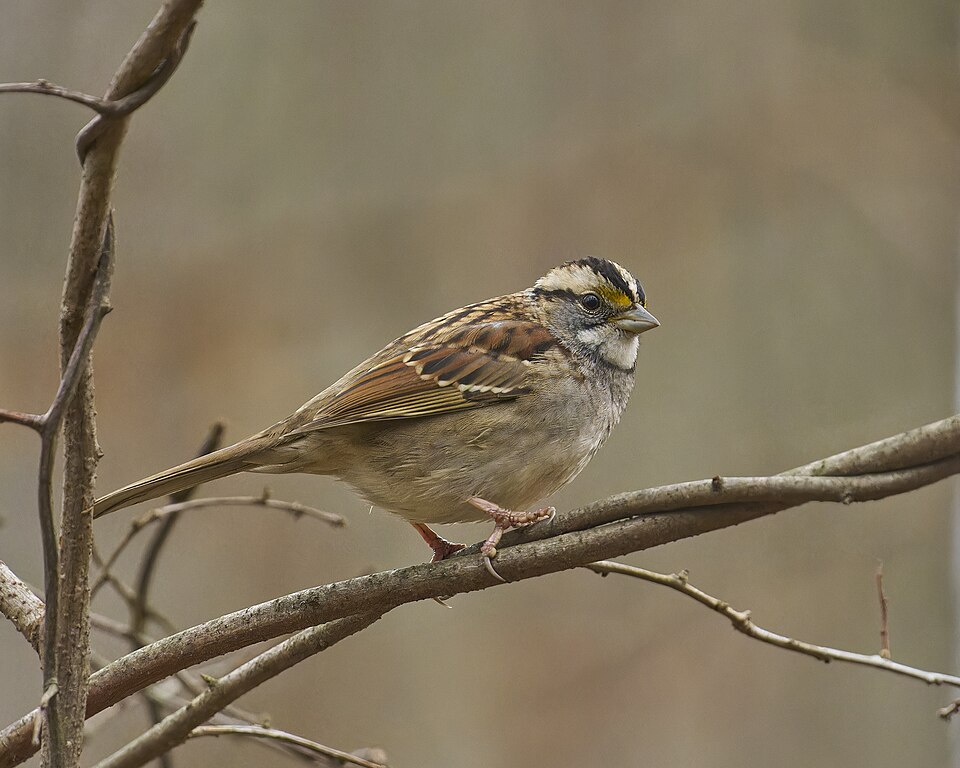
The White-throated Sparrow (Zonotrichia albicollis) is a medium-sized New World sparrow in the family Passerellidae, order Passeriformes. It is identified by a white throat bordered in black, bright yellow lores, and a striped head pattern. The species breeds in northern North America and winters in the southern United States and northern Mexico.
Learn to identify
Adult white-striped White-throated Sparrow, photographed in Quebec.
Learning lesson · openly licensed photographs, labelled by BirdBot; labels checked against the cited sources and approved by AI

Check the head: white throat, yellow lores. Striped crown: black with a white central stripe on this form. Yellow lores: a yellow spot in front of the eye. Grey cheeks, dark eye line: the grey cheek's upper edge forms the eye line. White throat: conspicuous; gives the bird its name. White throat plus yellow lores: White-throated Sparrow. Tan-striped adults have brown and tan head stripes instead.
Tan-striped adults have brown and tan head stripes instead.
Sources: Wikipedia: White-throated sparrow (revision 1383857785) · Audubon Guide to North American Birds: White-throated Sparrow
Photo: Cephas, CC BY-SA 3.0, via Wikimedia Commons; labels added by BirdBot.
The most reliable field marks for the White-throated Sparrow are the bright yellow patch on the lores (the area between the bill and eye) and the clean white throat. The throat is sharply bordered by a black malar stripe, creating a high-contrast pattern that distinguishes it from other sparrows. The head features bold stripes; adults display both tan and white stripes, while first-year birds have only tan stripes and are heavily streaked underneath.
The body is generally brown with dark streaks on the back and wings, and a whitish belly. The bill is dark, a key feature that separates it from the similar White-crowned Sparrow. Males exhibit darker head stripes and brighter yellow lores than females. The legs are pink.
White-throated Sparrows favor semi-open coniferous and deciduous forests, particularly those with dense undergrowth. They are commonly found in brushy fencerows, forest edges, shrubby willows, and the borders of swamps with dense brush. In winter, their range extends to the western coasts of Oregon and dry deserts in Texas.
According to AviList v2026, the species breeds in northern North America and winters in the southern United States and northern Mexico. This broad migratory range allows them to occupy diverse habitats, from boreal forests to semi-open wooded areas with sufficient shrubby growth.
These sparrows are seasonal migrants, moving across North America twice annually. They are social birds that often flock with other Zonotrichia species, juncos, and occasionally house sparrows. In western Oregon, specifically the Klamath Basin, they have been observed flocking with golden-crowned sparrows.
They are primarily ground foragers, scratching through leaf litter for food. While they can be seen in trees, they prefer to stay close to protective cover and will quickly retreat to the brush if they sense danger. Their keen vision and hearing help them detect predators and locate food in dense vegetation.
White-throated Sparrows are omnivorous. Their diet consists of seeds, fruits, and insects. Seeds are gathered from the floor of forests and bushy clearings, as well as from grasses and weeds. They also feed on wild fruits from blackberry tangles and shrubbery. During the breeding season, parents feed their nestlings almost exclusively insects to provide the necessary protein for growth.
Reproduction occurs mainly in spring when the birds settle in northwestern Canada and the northeastern United States. They build open-roofed nests on the ground, typically near trees, stumps, or logs. These structures serve as lookout perches, helping the birds detect predators such as American crows. The female lays 3 to 6 eggs, usually 4. The young are altricial, hatching without feathers, and fledge 8 to 9 days after hatching.
The call of the White-throated Sparrow is often phonetically described as "Poor Sam Peabody." They use an array of other vocalizations for communication within flocks and during territorial disputes. The song is a high-pitched, clear whistle that has inspired a variety of regional interpretations. Neltje Blanchan, in Bird Neighbors (1923), noted that New Englanders heard "Pea-body, Pea-body," while listeners just over the British border understood the bird to sing "Swee-e-e-t Can-a-da." Blanchan also recorded a Maine tradition that the bird sings "All day, whit-tle-ing, whit-tle-ing," and the anecdote of a farmer named Peverly who heard the bird advise, "Sow wheat, Pev-er-ly." These divergent interpretations highlight how the perception of the song's sweetness depends less on a specific name and more on the listener's local context.
The White-throated Sparrow is listed as Least Concern (LC) in the IUCN Red List as recorded in AviList v2026. This status indicates that the species is not currently facing a high risk of extinction in the wild. For birders, this means the species is stable and widely available across its range, but it does not negate the need for ethical observation. Because they often nest on the ground in dense brush, maintaining a respectful distance is crucial to prevent stress and potential nest abandonment.
To observe White-throated Sparrows, visit brushy fencerows, forest edges, or shrubby areas during migration or winter. Listen for their distinctive song before trying to spot them, as they often hide in dense undergrowth. Observe quietly from a distance to avoid stressing the birds. If you see a nest, do not approach closely, as ground nests are vulnerable to disturbance and predation. Recording their song and noting their foraging behavior can be a valuable contribution to community science datasets.


