
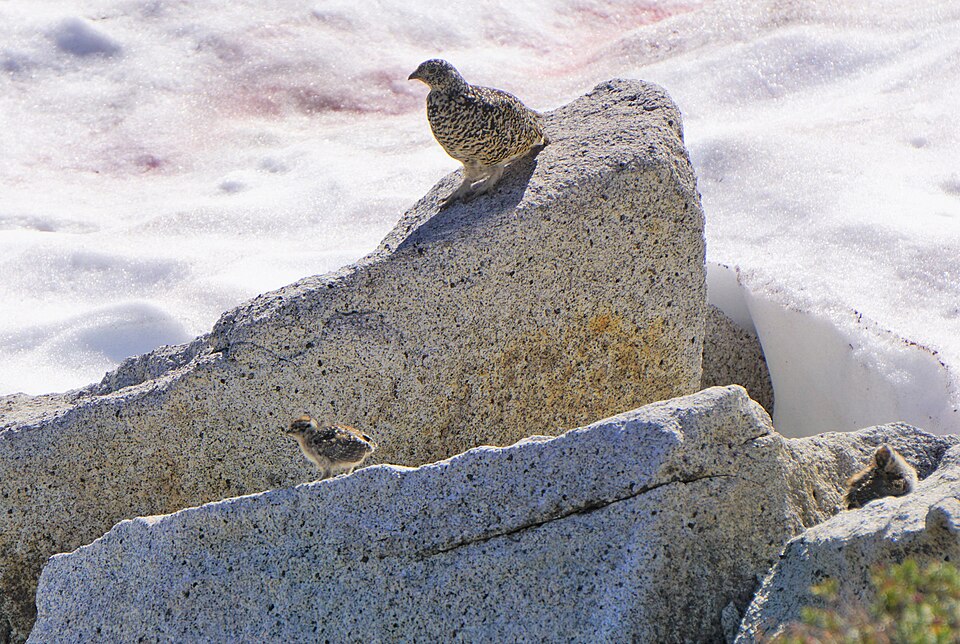
The White-tailed Ptarmigan (Lagopus leucura) is a small, round alpine bird distinguished by its white tail feathers, which set it apart from all other North American ptarmigan species. It inhabits rocky, willow-dotted terrain above treeline in the western North American Rockies, molting from mottled brown-gray in summer to pure white in winter for camouflage. As one of the highest-ranging birds in the region, it occupies the "upper story" of the mountains, a habitat preference noted by early observers like Leander S. Keyser in his 1902 account of the Rockies.
Learn to identify
White-tailed Ptarmigan in moulting summer-to-winter plumage, photographed in the Rocky Mountains, Alberta.
Learning lesson · openly licensed photographs, labelled by BirdBot; labels checked against the cited sources and approved by AI

Small black bill: on the smallest ptarmigan. Finely barred grey back: greyer than the browner Willow and Rock Ptarmigan. White wings and belly: white at every season. White tail: other ptarmigan have black tails; seen best in flight. Check the tail: white here, black in other ptarmigan.
In winter the whole bird is white.
Sources: Audubon Guide to North American Birds: White-tailed Ptarmigan · Wikipedia: White-tailed ptarmigan (revision 1367784173)
Photo: John Hill, CC BY-SA 3.0, via Wikimedia Commons; labels added by BirdBot.
The most reliable field mark for the White-tailed Ptarmigan is its tail. Unlike the Willow, Rock, and Sharp-tailed Ptarmigan, which have black tail feathers, adults of this species display distinct white rectrices. This feature is visible in both summer and winter plumage, making it a critical identifier when the bird is in flight or flushing from cover.
In summer, the bird presents a mottled brown-gray coloration that blends seamlessly with lichen-covered rocks and sparse vegetation. The outer wing feathers are also white. As winter approaches, the plumage shifts to a uniform white, leaving only the black bill, eye, eye comb, and claws visible. This seasonal molt occurs almost continually from late April to early November, allowing the bird to match its background in both seasons.
Another distinctive adaptation is the heavy feathering on the legs and feet. These "snowshoes" increase surface area, aiding locomotion on deep snow and providing insulation against the cold. The bird is the most petite member of the grouse family (Tetraonidae) in North America, with a total length of approximately 30 to 31 cm.
During the breeding season, males and females can be distinguished by their eye combs and breast patterns. Males display prominent crimson eye combs and black-and-white barring on the breast. Females have smaller, pinkish eye combs and brown-and-black plumage with yellow barring. Outside of breeding season, the sexes differ only slightly in size and shape.
The White-tailed Ptarmigan is a strictly alpine species, found above treeline in the Rocky Mountains of western Canada and the northwestern United States. Its range extends from northern Yukon and southern Alaska southward to western Washington, western Montana, western Colorado, and northern New Mexico.
Within this range, the bird selects specific microhabitats that offer both food and protection. Breeding territories are typically located at the base of talus slopes, windswept saddles, or knolls where snow melts early. These areas feature tall willow shrubs (over 30 cm), subshrub cover, moss, and boulders. In winter, the bird favors stream beds and wind-exposed areas where willow growth remains visible above the snowpack, as willow is its primary food source during the cold months. Historical records from Colorado indicate breeding elevations often exceed 11,500 feet, placing the species in some of the most extreme environments in the state.
White-tailed Ptarmigan are generally monogamous, with pairs remaining together for up to three months during the breeding season. Males exhibit high philopatry, often returning to the same area in successive years, while females disperse farther. Both sexes guard territories, but males are more aggressive in defense, using ground pursuits, exposed eye combs, and strident cackling calls to ward off intruders.
These birds are energy-efficient walkers, preferring to walk rather than fly to conserve energy in harsh alpine conditions. They seek refuge in rock piles or pockets under the snow, which are several degrees warmer than the surrounding air. In late summer and winter, they form flocks ranging from 2 to 80 individuals. Predators include prairie falcons, golden eagles, red foxes, and coyotes.
The diet of the White-tailed Ptarmigan is primarily plant-based, consisting of willow buds, leaves, flowers, berries, and lichens. Willow is particularly critical in winter, providing the bird's main source of food when other vegetation is buried under snow. Insects are consumed to a lesser degree, especially during the summer months when chicks are being reared. Females feed on green vegetation such as Geum, Carex, and Polygonum after hatching. The bird also ingests grit to aid in digesting coarse plant material.
Females are yearlings when they first breed. They construct loose nests of dried vegetation in topographic depressions, often concealed by surrounding rocks or vegetation. A single brood is produced each season, consisting of four to seven faintly spotted eggs. Incubation lasts 22 to 24 days. The reproductive season begins in early spring when males display in groups before dispersing to individual territories. Eggs are laid in mid- to late June, and chicks hatch in mid- to late July.
The call of the White-tailed Ptarmigan is characterized by soft, low hoots, which can be heard on territories, brood-rearing areas, and in flocks. During territorial disputes, males emit a strident cackling call. Females may also produce a strident flight scream if they encounter another hen during incubation.
The White-tailed Ptarmigan is listed as Least Concern (LC) in the AviList v2026 checklist. While the species is not endangered, it faces threats from human activities such as road construction, mining, all-terrain vehicle use, and ski area development, which can reduce the availability of winter food sources. The bird is protected in areas such as Rocky Mountain National Park in Colorado, where its historic range has been largely preserved.
Observing White-tailed Ptarmigan requires patience and respect for their sensitive alpine habitat. Look for the bird walking among rocks and willows, keeping a safe distance to avoid stressing the animal. In summer, scan for the white tail feathers against the brown-gray background. In winter, the bird may be difficult to spot against the snow, so listen for soft hoots or watch for movement in willow patches.
When approaching nests in rocky terrain, move slowly and quietly to avoid triggering a flush, which can expose eggs to predators. Because alpine vegetation grows slowly and soil is fragile, staying on established trails is critical to prevent erosion and protect the moss and lichen cover that provides essential camouflage and foraging habitat for the birds.


